
Compositions and methods for treatment of multiple sclerosis
a technology of multiple sclerosis and compositions, applied in the direction of peptide sources, peptide/protein ingredients, drug compositions, etc., can solve the problems of axons not being able to effectively conduct signals, progressing to physical and cognitive disability, and going completely away
- Summary
- Abstract
- Description
- Claims
- Application Information
AI Technical Summary
Benefits of technology
Problems solved by technology
Method used
Image

Examples
example 1
Preparation of MDP-Microparticle
[0051]A multiple repeat of muramyl dipeptide (MDP) isolated from Propionibacterium acini, formed the core structure of the MDP-microparticle immunostimulant of this example. The chemical composition of the preferred monomeric subunit is as shown below.
[0052]MDP has well known immunostimulatory properties, which have been extensively evaluated in studies designed to determine its effect on increasing immune function. To date, both MDP isolated from natural sources and synthetic MDP have been associated with significant toxicity when administered to mammals. This toxicity has limited the effectiveness of MDP as an adjuvant.
[0053]A method for the isolation of MDP, free from toxic components, is described in the co-pending international application PCT / NZ2009 / 000049, incorporated by reference herein. Briefly, Propionibacterium acnes was grown to a mid-stationary growth phase and washed to remove contaminants of bacterial culture origin employing technique...
example 2
MIS416 Stimulation of Human PBMC Results in the Production of Anti-Inflammatory Cytokines IL-10 and PGE2
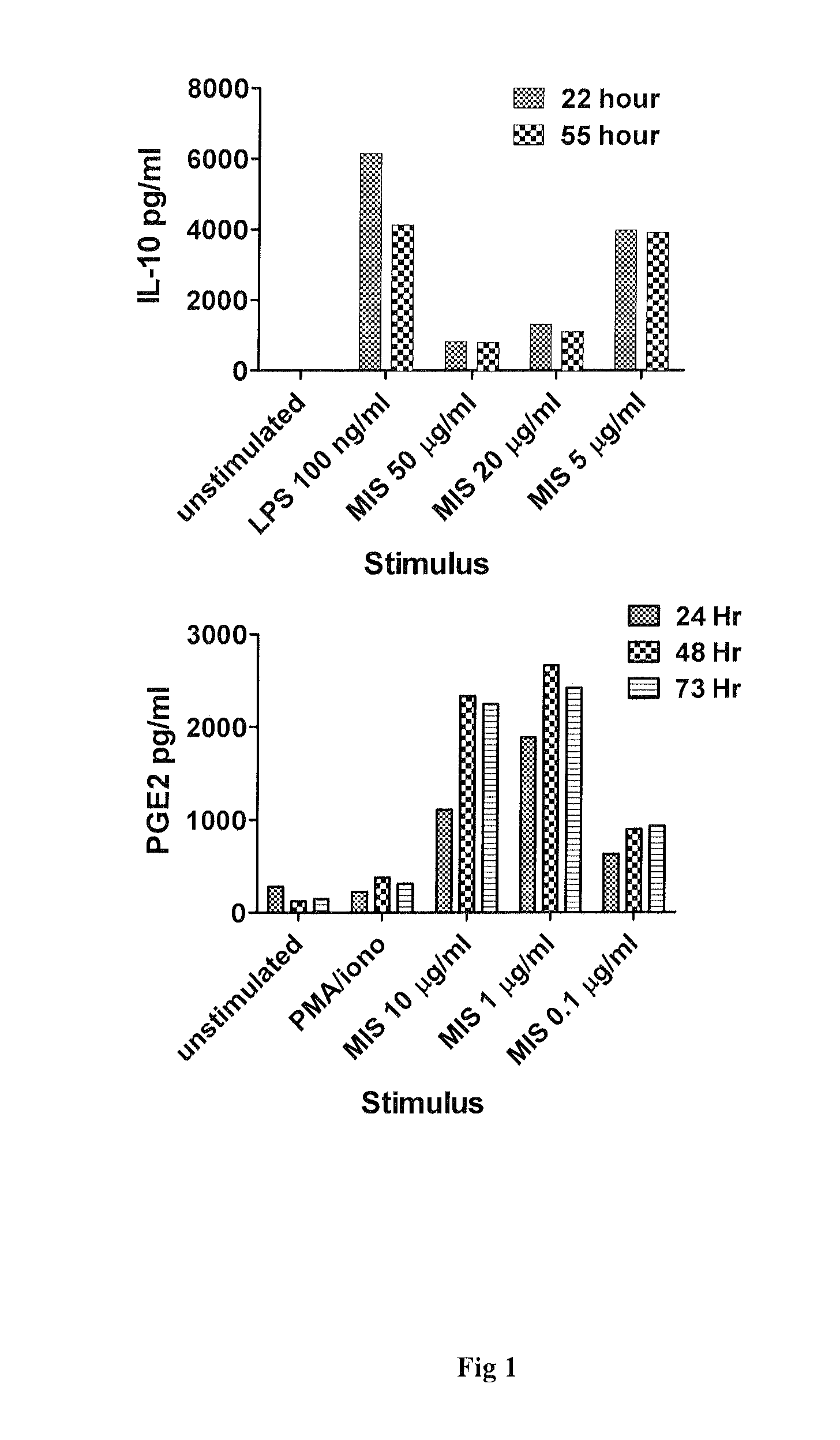
[0057]Human PBMC (106 / mL) were cultured with LPS (E coli; 100 ng / mL) which served as an assay positive control or MIS416 at 50, 20 and 5 μg / mL for a total culture period of 55 hours. Cell-free supernatants were harvested at 22 hours and 55 hours and assayed for secreted IL-10 using flow cytometric cytokine bead array technology according to the manufacturers' standard protocols (Bender MedSystems GmbH, Vienna, Austria). Results are provided in FIG. 1.
[0058]Human PBMC (106 / mL) were cultured for a total of 96 hours with MIS at 10, 1 and 0.1 μg / mL. PMA (1 nM)+Ionomycin (100 ng / mL) co-stimulation served as an assay positive control. Cell-free supernatants were collected at 24, 48 and 72 hours and assayed for PGE2 using a commercial PGE2 ELISA used exactly according to manufacturers recommendation (R&D Systems Inc. Minneapolis, USA). Results are provided in FIG. 1.
example 3
MIS416 Therapy Reduces Serum Levels of Cytokines Known to be Involved in Humoral Immunity and Autoantibody Production
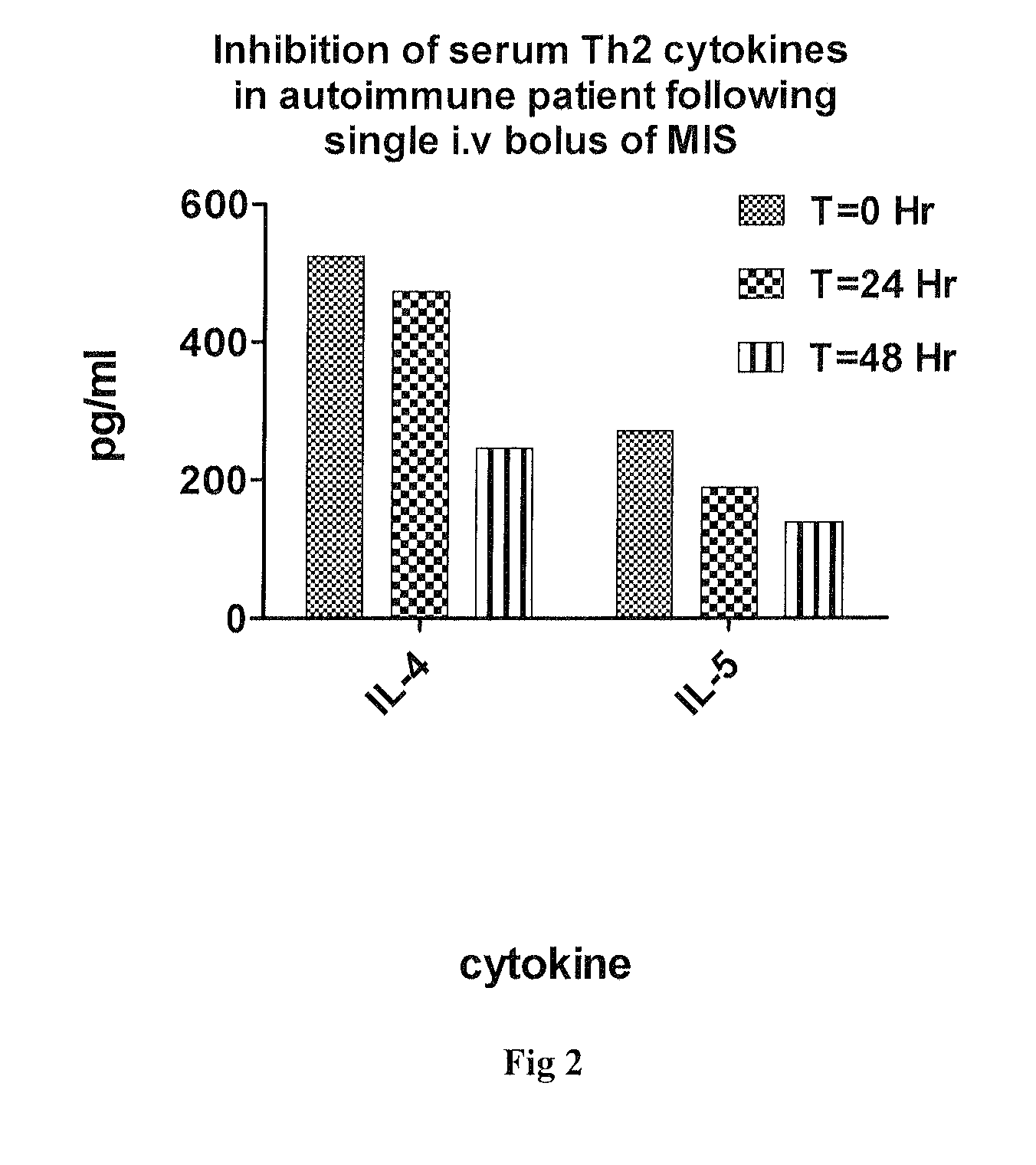
[0059]Peripheral blood serum was harvested from a patient receiving a single dose of MIS416 under compassionate use immediately prior to, and at 24 and 48 hours following, a single i.v. bolus of MIS416 diluted in saline. IL-4 and IL-5 in the serum was determined using flow cytometry bead array technology according to manufacturer's instructions (Bender MedSystems GmbH, Vienna, Austria). Results are provided in FIG. 2.
PUM
| Property | Measurement | Unit |
|---|---|---|
| Mass | aaaaa | aaaaa |
| Mass | aaaaa | aaaaa |
| Mass | aaaaa | aaaaa |
Abstract
Description
Claims
Application Information
 Login to View More