Check patentability & draft patents in minutes with Patsnap Eureka AI!

Method and system for production of a clean hot gas based on solid fuels

a technology of solid fuels and hot gas, which is applied in the direction of gasification process details, combustion process, inorganic chemistry, etc., can solve the problems of uneven air distribution, hot spots, and standard “coal reactors” that are not optimal for the conversion of biomass and was

Active Publication Date: 2011-06-23
DALL ENERGY HLDG
View PDF9 Cites 27 Cited by
  • Summary
  • Abstract
  • Description
  • Claims
  • Application Information

AI Technical Summary

Benefits of technology

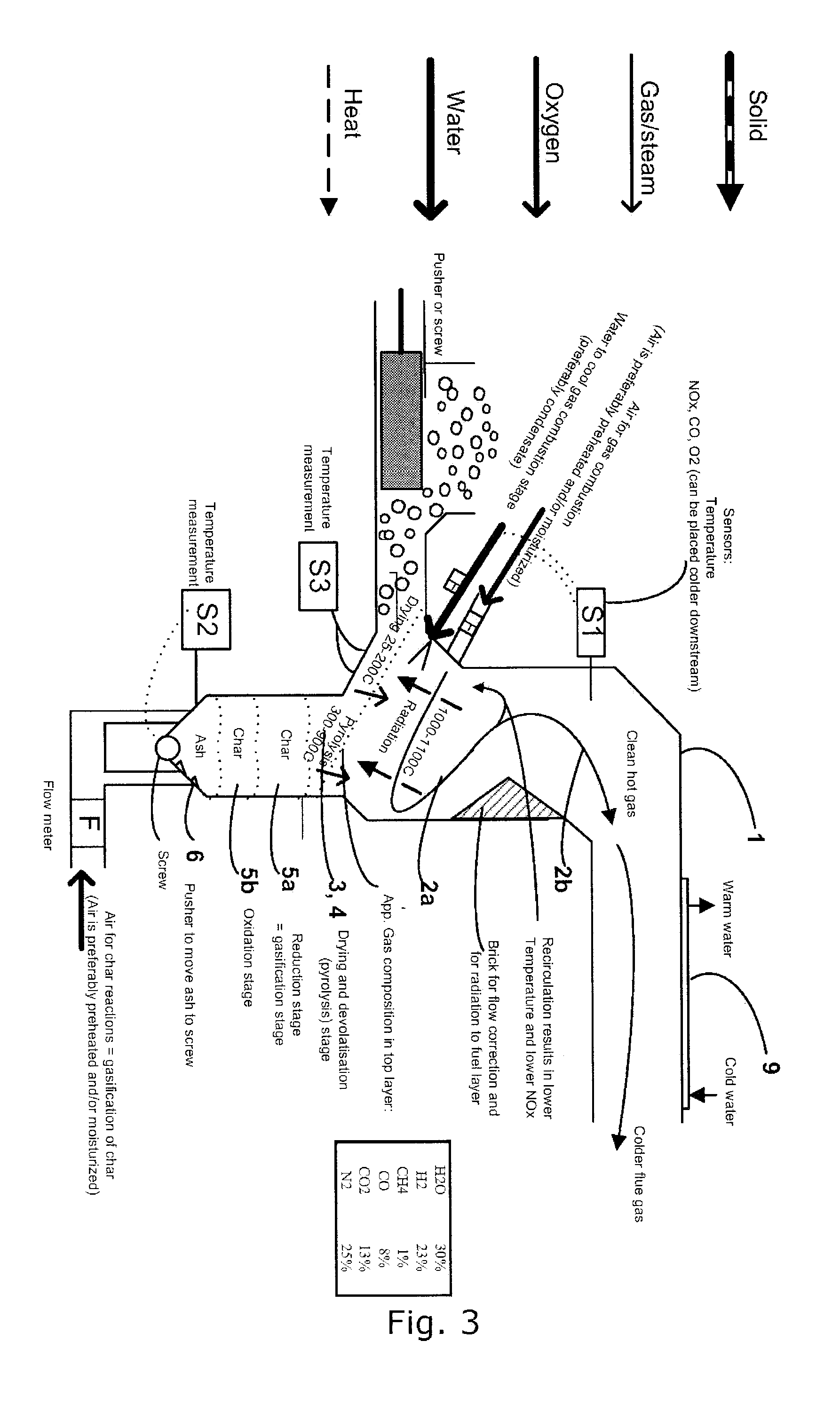
[0086]As the drying stage is effectively heated to a high temperature, such as 400° C. or even 600° C. or above, the drying reaction time in this reactor is short, such as below 5 minutes, thus resulting in a very compact drying stage.
[0170]As described above, the system offers a number of advantages compared to state-of-the-art combustion technologies. It could therefore be expected that the system will be expensive and complicated. However, the simplicity and the compactness of the system is a main advantage of the invention.Pressure of System

Problems solved by technology

Further, the content of water in fresh biomass and waste is often above 20%, and even often above 50%, so drying of the fuel is often a very important issue in biomass and waste reactors.
Therefore, standard “coal reactors” are not optimal for conversion of biomass and waste.
These systems may have several problems including hot spots on the grate, uneven air distributions, ash / char falling through the grate, controlling the stages on the grate etc.
The fluid-bed systems may have problems with separating the bed material from the ash, and with separating the different process steps as fluid beds are normally well-stirred reactors.
However, the updraft gasification technology has some disadvantages such asThe produced gas has a high content of CO, tars and other unburned gases, which are difficult to clean up when syn-gas production is the aim of the gasifierScaling up is normally difficult as round shapes are usually used
This can have some process advantages, but it also has the disadvantages that the reactors becomeLargerMore expensive to builtMore expensive to do maintenance on.
One of the major technical and environmental problems in converting solid fuels into a clean flue gas is to prevent unwanted substances in the flue gas.
When oxygen is let into the drying and / or pyrolysis stage and / or oxidation stage it is not specifically aimed for either burn-out of de-volatilized char or gas combustion, which then results in a high level of excess air for the total plant.
This leads to an efficiency and environmental problem: The carbon contains valuable energy, which is not utilised, but also environmental unfriendly substances, such as PAH.
Further, a main technical problem is often that ash sinters at 700-900° C. depending on the ash components.
Further, in grate systems, unburned fuel with high char content often falls through the grate; hence the char content in the bottom ash will increase.
In grate systems and in fluid-bed systems, the ash removal systems are costly and complicated.
Typically, this grate is made of high-grade steel, which is both costly and also needs replacement.
Normally, a part of the grate is replaced at least every year, and costs related to downtime, materials and labour may be very high.

Method used

the structure of the environmentally friendly knitted fabric provided by the present invention; figure 2 Flow chart of the yarn wrapping machine for environmentally friendly knitted fabrics and storage devices; image 3 Is the parameter map of the yarn covering machine
View more

Image

Smart Image Click on the blue labels to locate them in the text.
Viewing Examples
Smart Image
  • Method and system for production of a clean hot gas based on solid fuels
  • Method and system for production of a clean hot gas based on solid fuels
  • Method and system for production of a clean hot gas based on solid fuels

Examples

Experimental program
Comparison scheme
Effect test

Embodiment Construction

[0070]The present invention provides an improved method and an improved system or installation for combustion of biomass and waste. Various aspects, features and embodiments of the invention will be presented in the following.

Thermal Reactors

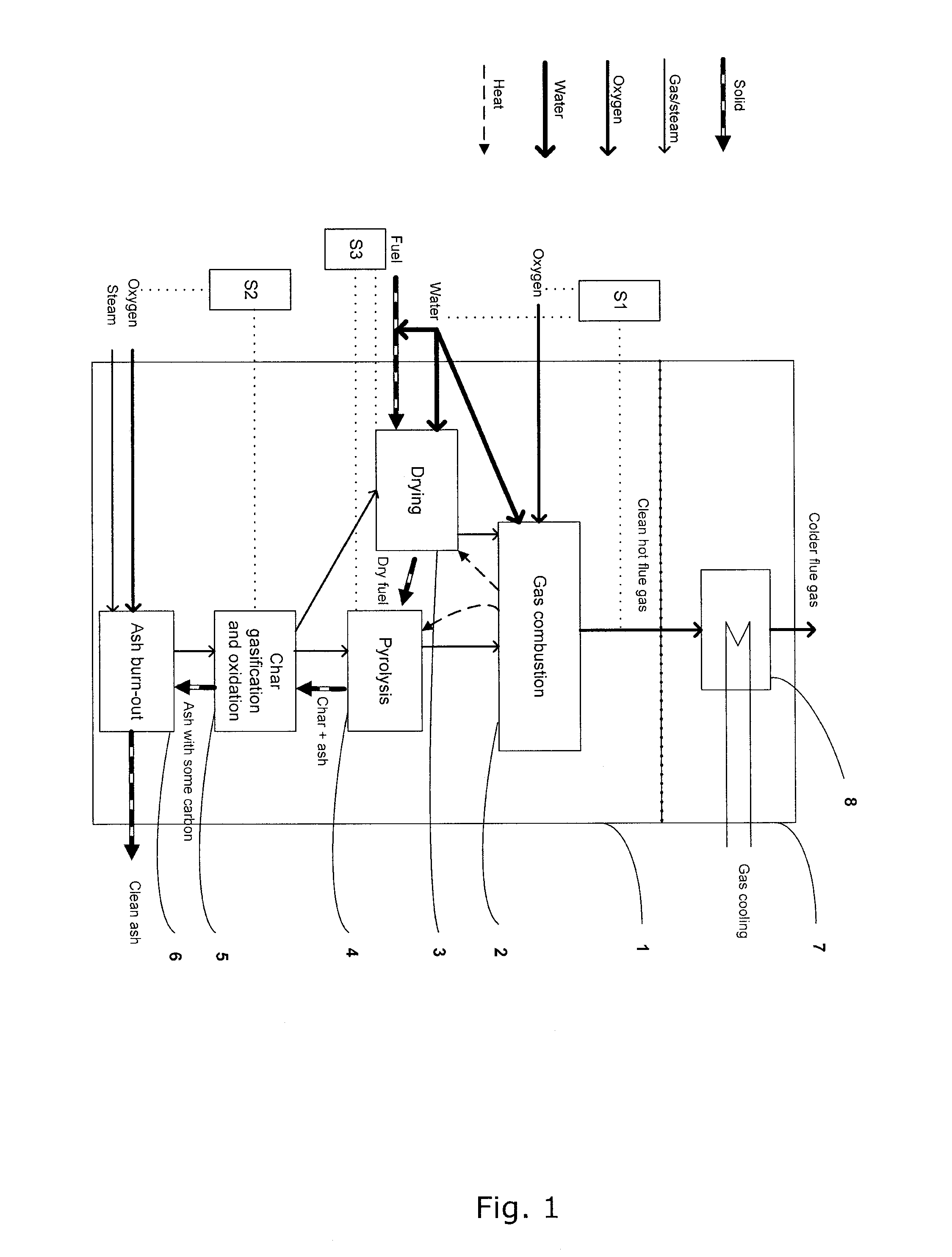
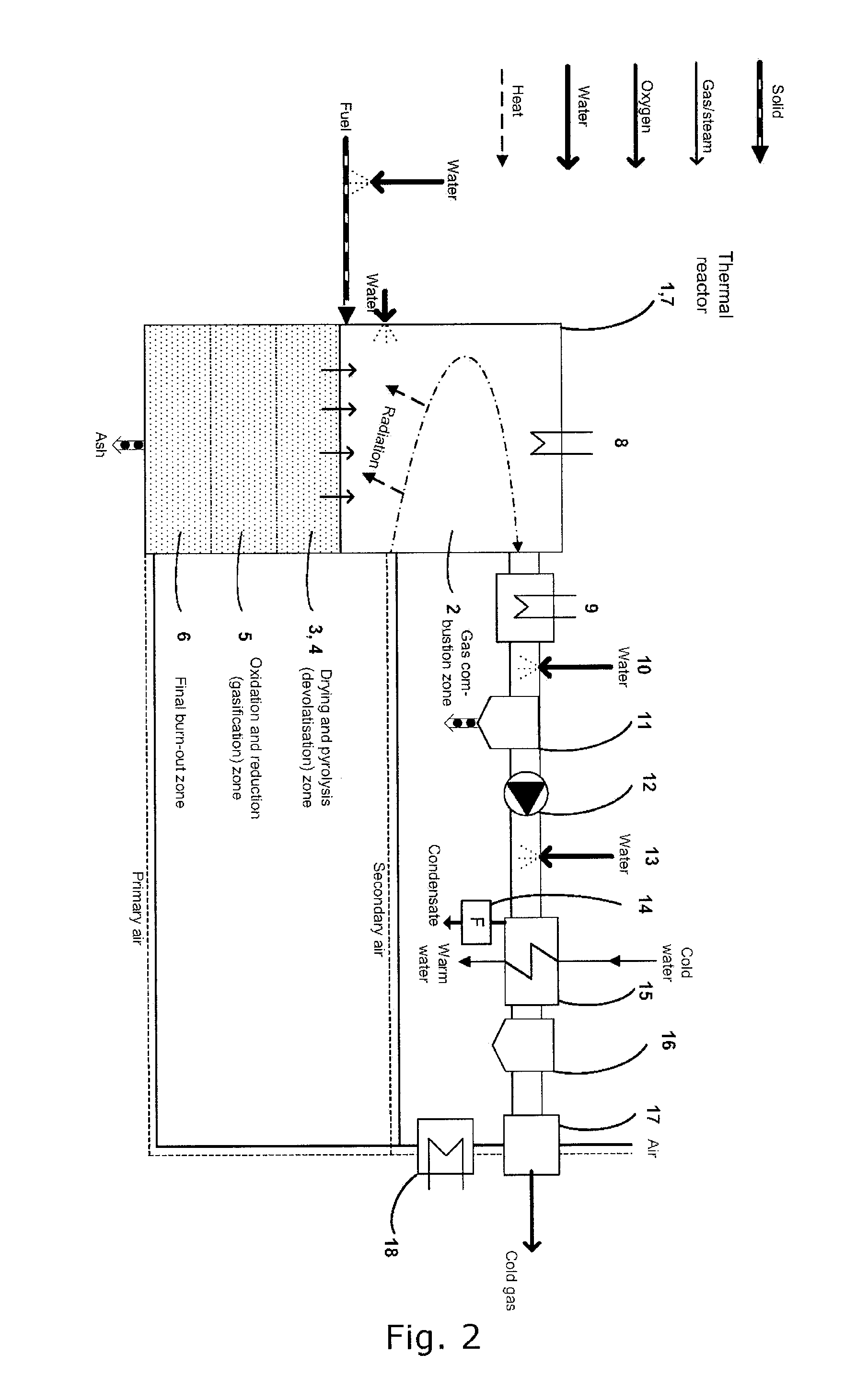
[0071]The present invention may be viewed as using a moving-bed technology. The updraft gasification principle is used for converting the fuel into gas and ash: In many preferred embodiments fuel is fed into the top and converted into a burnable gas in the following successive and coherent stages (from top and down): a drying stage, a pyrolysis stage, a char gasification and an oxidation stage and an ash burn out stage. Above the updraft gasifier is a gas combustion stage where the gases from the updraft gasifier are burned, and heat from the gas combustion is transferred to the top layer of fuel in the updraft gasifier, which hereby effectively dries and pyrolyses the fuel.

[0072]Thus, the present invention provides a method for decomposing comb...

the structure of the environmentally friendly knitted fabric provided by the present invention; figure 2 Flow chart of the yarn wrapping machine for environmentally friendly knitted fabrics and storage devices; image 3 Is the parameter map of the yarn covering machine
Login to View More

PUM

No PUM Login to View More

Abstract

Solid fuel can be converted into a clean hot flue gas with a low content of volatile organic compounds (VOC's), NOx and dust, and clean ash with a low carbon content by means of a stage-divided thermal reactor, where the conversion process of the solid fuel is in separate vertical stages (from below and up): ash burn-out, char oxidation and gasification, pyrolysis, drying, and a gas combustion stage where gas from the gasifier is combusted.

Description

[0001]The invention relates inter alia to a method and a system for producing clean hot flue gas with a low content of volatile organic compounds (VOC's), NOx and dust, and clean ash with a low carbon content by means of a stage-divided thermal reactor. In the stage-divided thermal reactor the conversion process of the solid fuel is in separate vertical stages (from below and up): ash burn-out, char oxidation and gasification, pyrolysis, drying and a gas combustion stage wherein gas from the gasifier is combusted. The gas-combustion stage functions both as gas burner and heat source for drying and pyrolysis the top layer of the updraft gasifier.[0002]Production of hot flue gases during thermal conversion of fuel is well known. Hot flue gas can be used for several purposes, e.g. for production of steam, hot water, hot oils etc.[0003]Reference is made to WO 2007 / 036236 A1, which concerns heat recovery of hot gas produced in a thermal reactor, by injecting water into the gas at one or ...

Claims

the structure of the environmentally friendly knitted fabric provided by the present invention; figure 2 Flow chart of the yarn wrapping machine for environmentally friendly knitted fabrics and storage devices; image 3 Is the parameter map of the yarn covering machine
Login to View More

Application Information

Patent Timeline
no application Login to View More
IPC IPC(8): C10B1/00C01B3/36
CPCC10J3/34Y02E20/344C10J3/80C10J2200/09C10J2200/154C10J2200/158C10J2300/0916C10J2300/092C10J2300/0946C10J2300/0956C10J2300/0973C10J2300/1884C10J2300/1892C10K1/101F23G5/027F23G5/24F23G5/50F23G2201/303F23G2201/304F23G2201/40F23L7/007F23L2900/00001C10J3/723Y02E20/12Y02E20/34
Inventor BENTZEN, JENS DALL
Owner DALL ENERGY HLDG
Features
  • R&D
  • Intellectual Property
  • Life Sciences
  • Materials
  • Tech Scout
Why Patsnap Eureka
  • Unparalleled Data Quality
  • Higher Quality Content
  • 60% Fewer Hallucinations
Social media
Patsnap Eureka Blog
Learn More