[0025]In accordance with an advantageous embodiment, the domain under consideration is partitioned, i.e. split up into individual grid cells, by an unstructured grid, in particular by a tetrahedral, pyramidal, prismatic grid or by a mixed form of these grid cells, which can for example also comprise hexahedral cells. Unlike a structured grid, an unstructured grid cannot be considered without knowledge of proximity relationships with adjacent grid cells. Structured grids, in particular hexahedral grids or grids in spherical or cylindrical coordinates, permit simple addressing of a
grid cell by means of three indices in the three-dimensional case. Unstructured grids, in particular tetrahedral grids, can only be addressed with a greater effort in consideration of a proximity relationship between individual grid nodes, grid surfaces and grid edge. On the other hand, unstructured grids permit a better approximation of geometrical surfaces.
[0032]An explicit integration method permits a simple direct calculation of the field values of a subsequent
time step by values of one or more preceding time steps. An implicit method requires for this the solution of an equation system and hence involves a greater determination effort, since a direct update of the field values is not possible. A leapfrog method is a simple method for explicit numerical time integration of an
ordinary differential equation by means of physical components offset by half a
time step, for example electrical and
magnetic field components allocated within a time grid and offset by half a
time step. It is thus for example possible to calculate an
electrical field strength component Exn+1 at the time (n+1)Δt with time step Δt from a previous
electrical field strength component Exn to the previous time step n and from the spatial derivative of a magnetic Hz
field strength component to the time step n+1 / 2 withEx(n+1)=Ex(n)+xHz(n+1 / 2).Runge-Kutta methods are based on a truncated Taylor series of a
time derivative, where E-field and H-field components can be allocated on the same time grid. By using the leapfrog or Runge-Kutta timestepping method, a
transient analysis of an
electromagnetic field development can be efficiently performed with
linear complexity of the computational effort for the spatial and / or time derivatives in N and M, where the computational effort for the entire problem can grow in superlinear manner up to a fixed end time T thanks to a
stability criterion with regard to the time step.
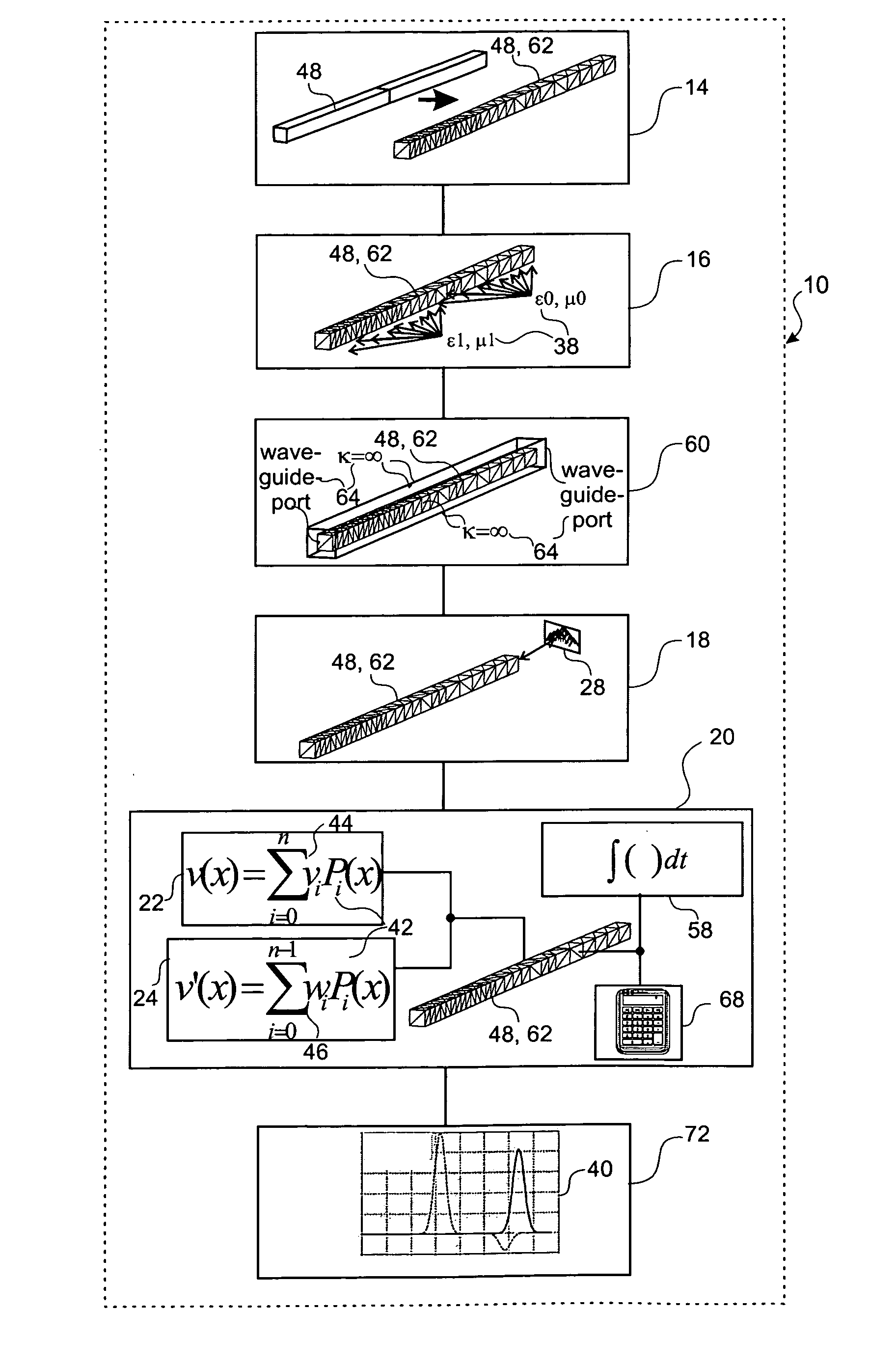
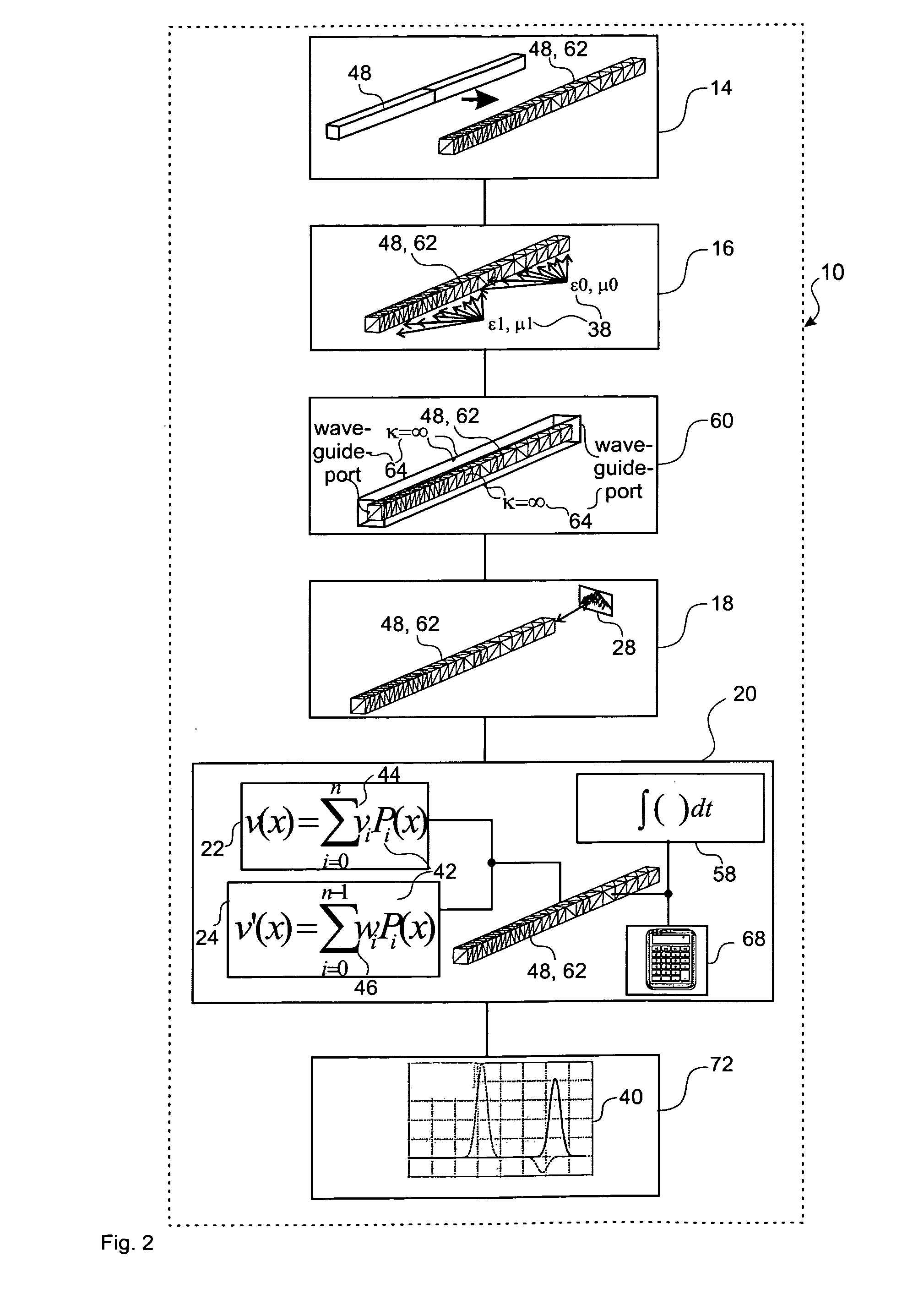
[0037]In accordance with an advantageous further development of the device, the field determination unit is constructed to determine at least one and in particular all electromagnetic near-field components by means of a DG-FEM method (Discontinuous Galerkin
Finite Element Method). A DG-FEM method for calculation of electromagnetic fields using orthogonal ansatz functions, whose weighting coefficients can be determined in linearly recursive manner from predetermined weighting coefficients, allows an efficient determination of electromagnetic fields with substantially
linear complexity of the number N of partitions and, regardless of this, substantially
linear complexity with regard to the number M of used ansatz functions Pi.
[0052]The method achieves, thanks to an implicit and fast application of the operators involved (gradient, trace and their transposes, and the
mass operators and their inverses) enhanced efficiency with regard to storage requirements and computation time on hexahedral, prismatic, pyramidal and tetrahedral elements. This represents the central component of the method. For each grid element, only auxiliary quantities are stored and the operators do not have to be explicitly set up as matrices. This permits complexity reduction of the storage requirement. By the use of hierarchical orthogonal ansatz functions (Legendre or Jacobi polynomials) with
tensor structure (e.g. Dubiner ansatz on the tetrahedrons [2]) and
covariant transformation to reference elements, the complexity of the runtime for the method is reduced. In the three-dimensional case, storage requirement and runtime of the
algorithm possess the complexity O(p3) for non-curved elements with
cell-constant and field-independent material coefficients and O(p4) for curved elements and / or variable and / or field-dependent material coefficients (i.e. non-linear material laws). p designates the polynomial degree of the method. Absolute runtimes and storage requirement are set forth in the calculation examples further below. For non-curved elements, the result is thus a linear complexity; for the curved elements applied only in special cases in part-areas, the result is a considerably less than quadratic complexity.
[0062]The geometrical independence of the curl and trace operators is achieved by use of a
covariant transformation of the ansatz and test functions of any elements from the function spaces of the reference elements, as described for example in [1 p. 331ff]. The following describes the core of the method, fast application of the curl and trace operators and their transposes for the grid elements.
Recursion formulas for hierarchical orthogonal Jacobi polynomials were developed and used, which reduce the complexity of the storage requirement and of the application of the curl and trace operators and their transposes to O(p3).Curl Operator


 Login to View More
  Login to View More