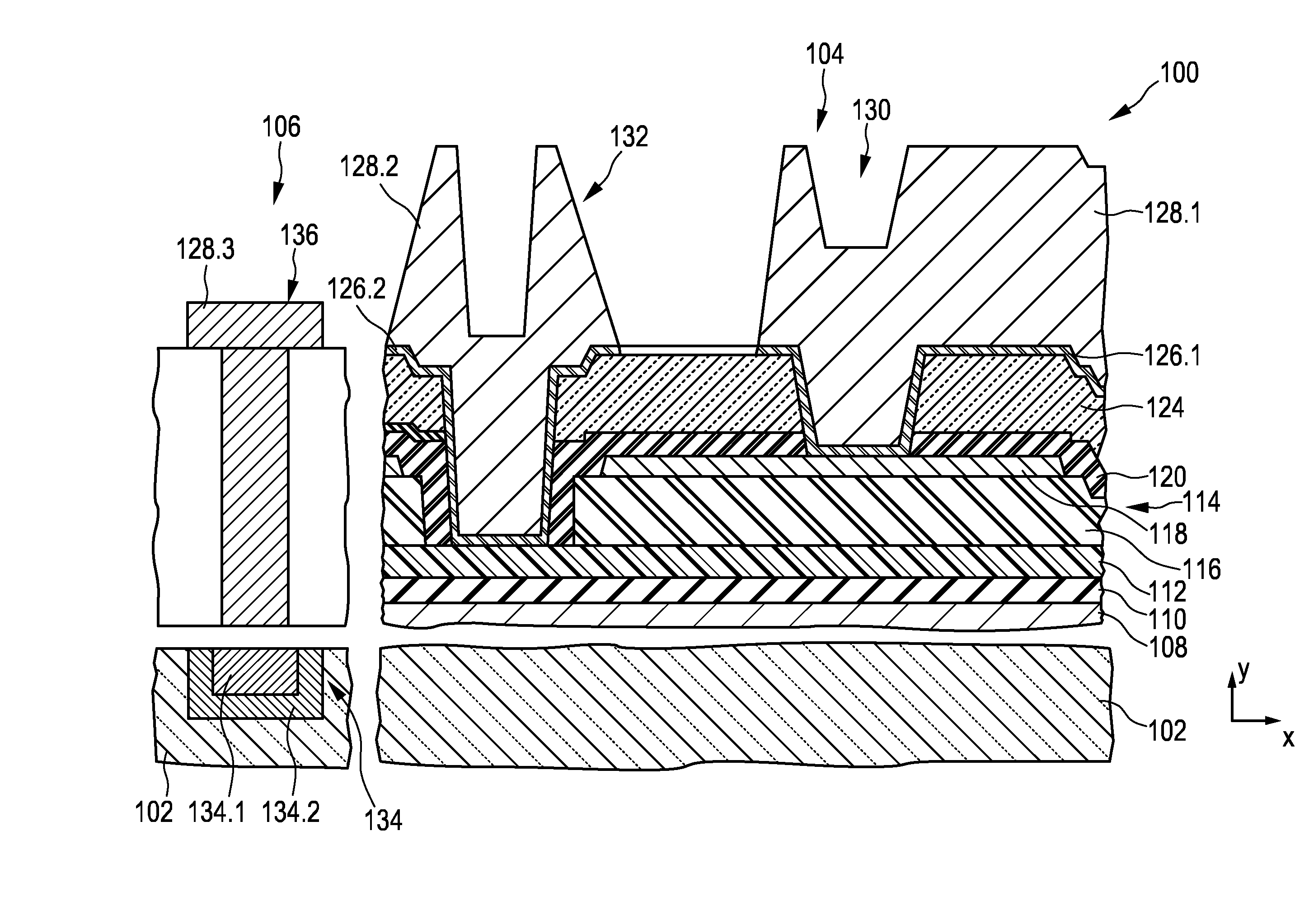
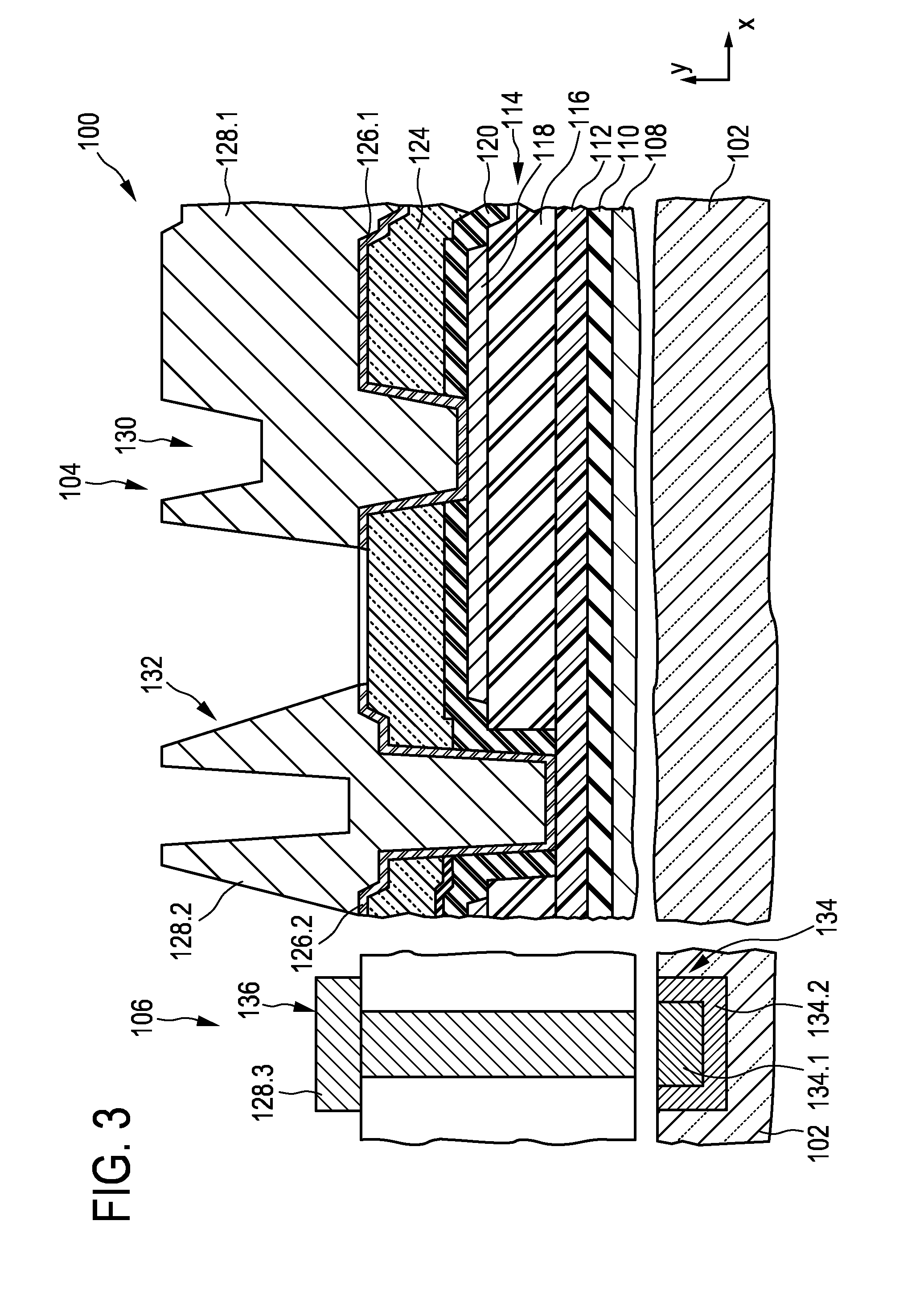
[0013]With the method of the present invention the fabrication of a highly reliable resistor layer on top of an integrated MIM capacitor on a substrate is achieved, that means, the resistor layer can be fabricated to precisely assume a desired electrical resistance. By employing the method of the present invention, the electrical-resistance value of the resistor layer on top of the MIM capacitor is not any more influenced in an uncontrollable manner, as has been observed when employing prior-art fabrication methods. The improved reliability achieved with the method of the present invention is to be understood in the sense that it allows achieving a high accuracy of the electrical resistance for a large number of electronic components fabricated concurrently on a single
wafer, and in different
processing runs, thus improving the fabrication efficiency and lowering the overall
processing cost of the electronic component.
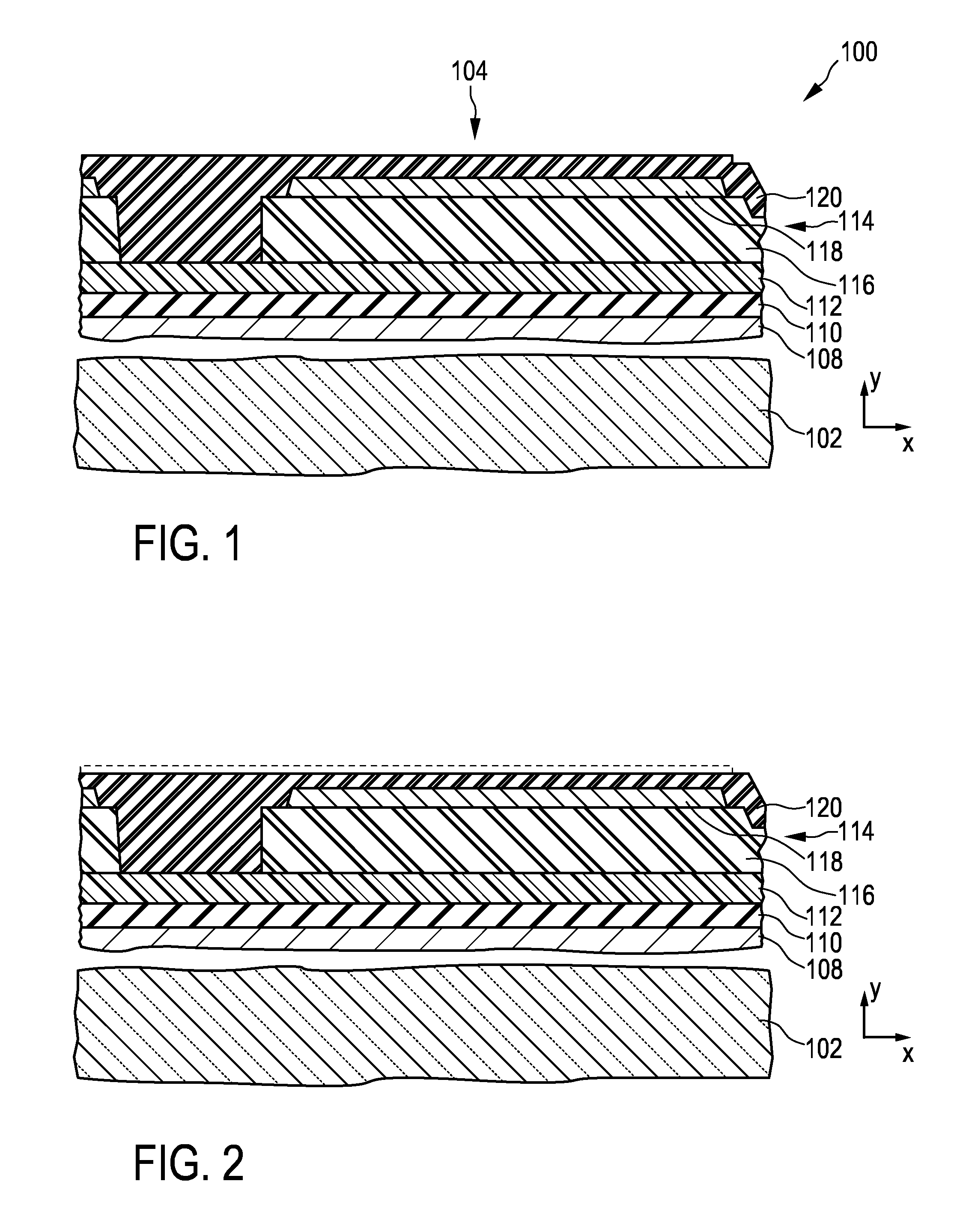
[0014]The method of the invention is based on the recognition that the lead-containing first cover layer is effectively prevented from developing deteriorating effects on the subsequent fabrication of the second cover layer exerted by Pb particles on the surface of the first cover layer formed during the deposition of the second cover layer. Such Pb particles have been found to originate from reduced oxidized Pb species from the lead-containing first cover layer. By
thinning the first cover layer, most of the disturbing Pb particles are removed from the top surface of the lead-containing first cover layer. The
thinning of the first cover layer leads to a more than proportional removal of the lead. Due to this effect the top of the remaining first cover layer is lead poor. This suppresses a
catalytic growth mechanism of nanostructures during the initial growth stages of the fabrication of the second cover layer, which would result in a strong
surface roughness of the second cover layer, which intern would negatively affect the structure and reliability of the resistor layer.
[0017]While the application of the method of the present invention is not restricted to the field of fabricating electronic components with high-K MIM capacitors, they do form a preferred field of application. High-K MIM capacitors are very advantageous for operation under voltages even higher than 10 V. The method of the invention allows improving the advantageous combination of such high-K MIM capacitors with resistors in a stacked arrangement. The term high-K capacitor as used herein refers to capacitors with a high-K capacitor dielectric between the top and bottom electrodes. Such high-K MIM capacitor dielectrics may for instance have a relative
dielectric permittivity of between 100 and 5000. Such high values of the relative
dielectric permittivity are for instance achieved by
magnesium-doped lead niobate,
lead titanate, i.e., PMNPT, or
lead zirconate titanate i.e., PZT, which may or may not be doped. MIM capacitors based on such high-K materials can be used to obtain
capacitance densities up to 100 nF / mm2.
[0019]For embodiments having a lead-containing capacitor dielectric, the lead-containing first cover layer provides a particular
advantage in that the capacitor dielectric achieves a very high dielectric constant, which would in absence of the lead-containing first cover layer be negatively affected and thus be much lower. Using for instance lead-containing
perovskite dielectrics, like PZT for both the capacitor dielectric and for the first cover layer allows achieving a capacitor dielectric with a dielectric constant of up to 1700. Also, the
breakdown voltage of the MIM capacitor can be made particularly high, depending, of course, on the thickness of the capacitor dielectric. The lead-containing first cover layer achieves this
advantage of a high dielectric constant and a high
breakdown voltage also for other lead-containing dielectric materials, such as PLZT or PNMPT.
[0022]The thinning is preferably performed to remove between 10 and 50 nm of the first cover layer. Removing this surface section of the first cover layer effectively avoids the creation of Pb particles originating from reduction processes of
lead oxide, which is reduced to Pb particles during the deposition of the second cover layer.
Thinning leads to a lead-poor surface of the first cover layer. In other words, the thinning will predominantly remove such Pb particles from the surface of the first cover layer.
[0030]The electronic component of the present invention or any of its embodiments disclosed herein is advantageously integrated with at least one active
semiconductor element like a
diode or a
transistor, formed in the same substrate. This way, an electronic device with integrated active and passive circuit elements on the same substrate is fabricated. A particularly high integration density can be obtained for such an electronic device, since the electronic component has the resistors arranged on top of the MIM capacitors, thus allowing considerable savings of
chip area.


 Login to View More
  Login to View More