Unlock instant, AI-driven research and patent intelligence for your innovation.

Photoelectric conversion element and photoelectric conversion element module

a technology of photoelectric conversion element and conversion element, which is applied in the direction of electrolytic capacitors, light-sensitive devices, power plants, etc., can solve the problems of high production cost of thin-film solar cells, high production cost of silicon substrate cells, and foregoing problems have not yet been solved, so as to improve the light-scattering effect of reflective layers and high photoelectric conversion efficiency

Inactive Publication Date: 2014-04-10
SHARP KK
View PDF5 Cites 4 Cited by
  • Summary
  • Abstract
  • Description
  • Claims
  • Application Information

AI Technical Summary

Benefits of technology

This patent describes a method to make a photoelectric conversion element that can better scatter light. This results in higher efficiency of converting light to electricity. The invention also provides a photoelectric conversion element module that utilizes this improved light-scattering effect.

Problems solved by technology

However, the former solar cells have the problem of high production costs of silicon substrates.
The latter thin-film solar cells have the problem of high production costs due to the need to use various types of gases for use in the production of semiconductors and complicated devices.
However, the foregoing problems have not yet been solved.
However, it is difficult to produce a large-area solar cell, for example, a 1 m×1 m square solar cell.
This disadvantageously leads to a decrease in fill factor (FF) in current-voltage characteristics during photoelectric conversion.
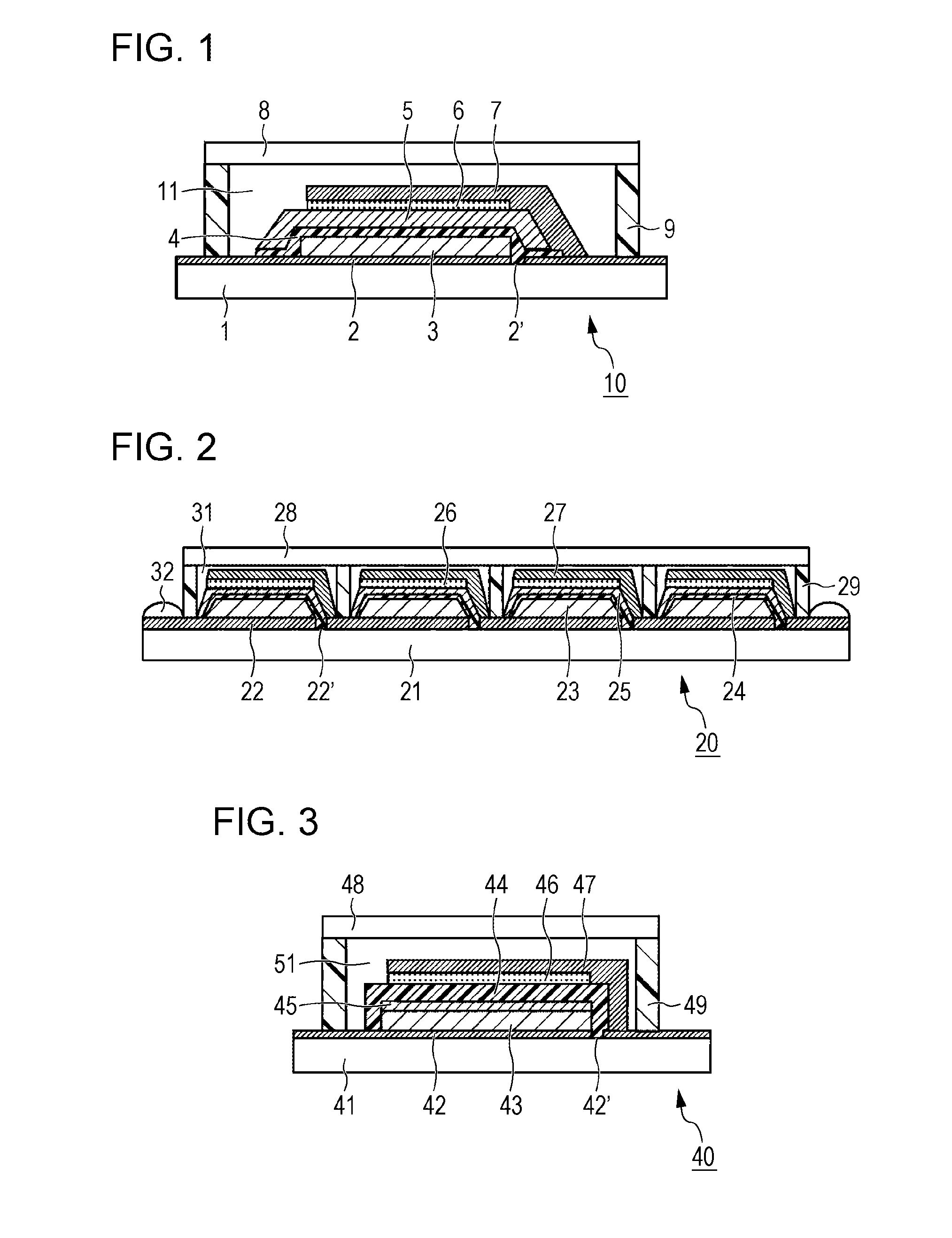
Furthermore, the reflective layer 45 is formed of fine grains having a relatively large size of 100 nm or more and thus has insufficient layer strength.

Method used

the structure of the environmentally friendly knitted fabric provided by the present invention; figure 2 Flow chart of the yarn wrapping machine for environmentally friendly knitted fabrics and storage devices; image 3 Is the parameter map of the yarn covering machine
View more

Image

Smart Image Click on the blue labels to locate them in the text.
Viewing Examples
Smart Image
  • Photoelectric conversion element and photoelectric conversion element module
  • Photoelectric conversion element and photoelectric conversion element module
  • Photoelectric conversion element and photoelectric conversion element module

Examples

Experimental program
Comparison scheme
Effect test

example 1

[0096]In this example, the photoelectric conversion element 10 illustrated in FIG. 1 was produced. A 15 mm×40 mm×1.5 mm thick transparent electrode substrate (glass with a SnO2 film, manufactured by Nippon Sheet Glass Company, Ltd) was prepared. The transparent electrode substrate includes the transparent conductive layer 2 composed of fluorine-doped SnO2 on the transparent substrate 1 composed of glass.

[0097]The transparent conductive layer 2 on the transparent electrode substrate was cut by laser scribing to form the scribe line 2′. A commercially available titanium oxide paste (trade name: D / SP, manufactured by Solaronix) was applied onto the transparent conductive layer 2 with a screen printing machine (Model: LS-150, manufactured by Newlong Seimitsu Kogyo Co., Ltd.) using a screen plate having a 5 mm×30 mm pattern. Leveling was performed at room temperature for 1 hour.

[0098]The resulting coating film of the titanium oxide paste was dried in an oven set at 80° C. for 20 minutes....

examples 2 to 4

[0107]Photoelectric conversion elements of Examples 2 to 4 were produced as in Example 1, except that the thicknesses of the porous insulating layers were different from those in Example 1 as described in Table 1.

example 5

[0108]A photoelectric conversion element of Example 5 was produced as in Example 1, except that the material of the porous insulating layer was changed to silicon oxide.

the structure of the environmentally friendly knitted fabric provided by the present invention; figure 2 Flow chart of the yarn wrapping machine for environmentally friendly knitted fabrics and storage devices; image 3 Is the parameter map of the yarn covering machine
Login to View More

PUM

No PUM Login to View More

Abstract

There are provided a photoelectric conversion element and a photoelectric conversion element module including the photoelectric conversion element, the photoelectric conversion element including a transparent substrate, a transparent conductive layer arranged on the transparent substrate, a photoelectric conversion layer arranged on the transparent conductive layer, a porous insulating layer arranged in contact with the photoelectric conversion layer, a reflective layer arranged in contact with the porous insulating layer, and a catalyst layer and a counter conductive layer that are arranged on the reflective layer, in which the photoelectric conversion layer contains a porous semiconductor, a carrier-transport material, and a photosensitizer, and in which the area of the orthogonal projection of the porous insulating layer onto the transparent substrate and the area of the orthogonal projection of the reflective layer onto the transparent substrate are each larger than the area of the orthogonal projection of the photoelectric conversion layer onto the transparent substrate.

Description

TECHNICAL FIELD[0001]The present invention relates to a photoelectric conversion element and a photoelectric conversion element module.BACKGROUND ART[0002]Solar cells capable of converting sunlight into electric power have been receiving attention as energy sources to replace fossil fuels. Nowadays, solar cells including crystalline silicon substrates and thin-film silicon solar cells are practically used. However, the former solar cells have the problem of high production costs of silicon substrates. The latter thin-film solar cells have the problem of high production costs due to the need to use various types of gases for use in the production of semiconductors and complicated devices. Thus, in any type of solar cell, continuing efforts have been made to reduce the cost per power output by improving photoelectric conversion efficiency. However, the foregoing problems have not yet been solved.[0003]For example, Japanese Patent No. 2664194 (PTL 1) reports, as a new type of solar cel...

Claims

the structure of the environmentally friendly knitted fabric provided by the present invention; figure 2 Flow chart of the yarn wrapping machine for environmentally friendly knitted fabrics and storage devices; image 3 Is the parameter map of the yarn covering machine
Login to View More

Application Information

Patent Timeline
no application Login to View More
IPC IPC(8): H01G9/20
CPCH01G9/2068H01G9/209H01G9/2081H10K85/344Y02E10/542
Inventor KOMIYA, RYOICHIFUKUI, ATSUSHIYAMANAKA, RYOHSUKE
Owner SHARP KK