However, lithium secondary batteries obtained using the above-mentioned conventional lithium metalcomposite oxide as a positive electrode active material are unsatisfactory for applications requiring a high output power at a high current rate, in other words, automotive applications and power tool applications such as electric power tools.
Particularly, they are unsatisfactory below freezing point, and thus an even higher output power is required.
Method used
the structure of the environmentally friendly knitted fabric provided by the present invention; figure 2 Flow chart of the yarn wrapping machine for environmentally friendly knitted fabrics and storage devices; image 3 Is the parameter map of the yarn covering machine
View more
Image
Smart Image Click on the blue labels to locate them in the text.
Viewing Examples
Smart Image
Click on the blue label to locate the original text in one second.
Reading with bidirectional positioning of images and text.
Smart Image
Examples
Experimental program
Comparison scheme
Effect test
example 1
1. Manufacture of Positive Electrode Active Material 1
[0218]Water was introduced into a reaction tank provided with an agitator and an over flow pipe, and thereafter an aqueous sodium hydroxide solution was added.
[0220]Then, while agitating, the mixed raw material solution and an aqueous ammonium sulfate solution were continuously added as a complexing agent into the reaction tank, and an aqueous sodium hydroxide solution was dropped as appropriate such that pH of the solution in the reaction tank becomes 11.7, and nickel cobalt manganese composite hydroxide particles were obtained. The obtained particles were cleaned with water after filtration, and dried at 100° C. to obtain dry powder of the nickel cobalt manganese compos...
example 2
1. Manufacture of Positive Electrode Active Material 2
[0227]A nickel cobalt manganese composite hydroxide was obtained by conducting an operation similar to Example 1 except that pH in the reaction tank was set at 12.6. The BET specific surface area of this nickel cobalt manganese composite hydroxide was 38.5 m2 / g.
[0228]To the dry powder of the nickel cobalt manganese composite hydroxide obtained as described above, lithium carbonate was mixed such that Li: (Ni+Co+Mn) is 1.07:1, and baked while maintaining at 950° C. for 10 hours, and cooled to room temperature to obtain the positive electrode active material 2.
[0235]Composition analysis of the obtained positive electrode active material 3 showed that the molar ratio of Li:Ni:Co:Mn was 1.05:0.34:0.33:0.33.
[0236]The positive electrode active material 3 had a primary particle size and a secondary particle size of 0.19 μm and 2.7 μm, respectively.
[0237]The crystallite sizes calculated from peak A and peak B of the positive electrode active material 3 were 640 Å and 429 Å, respectively.
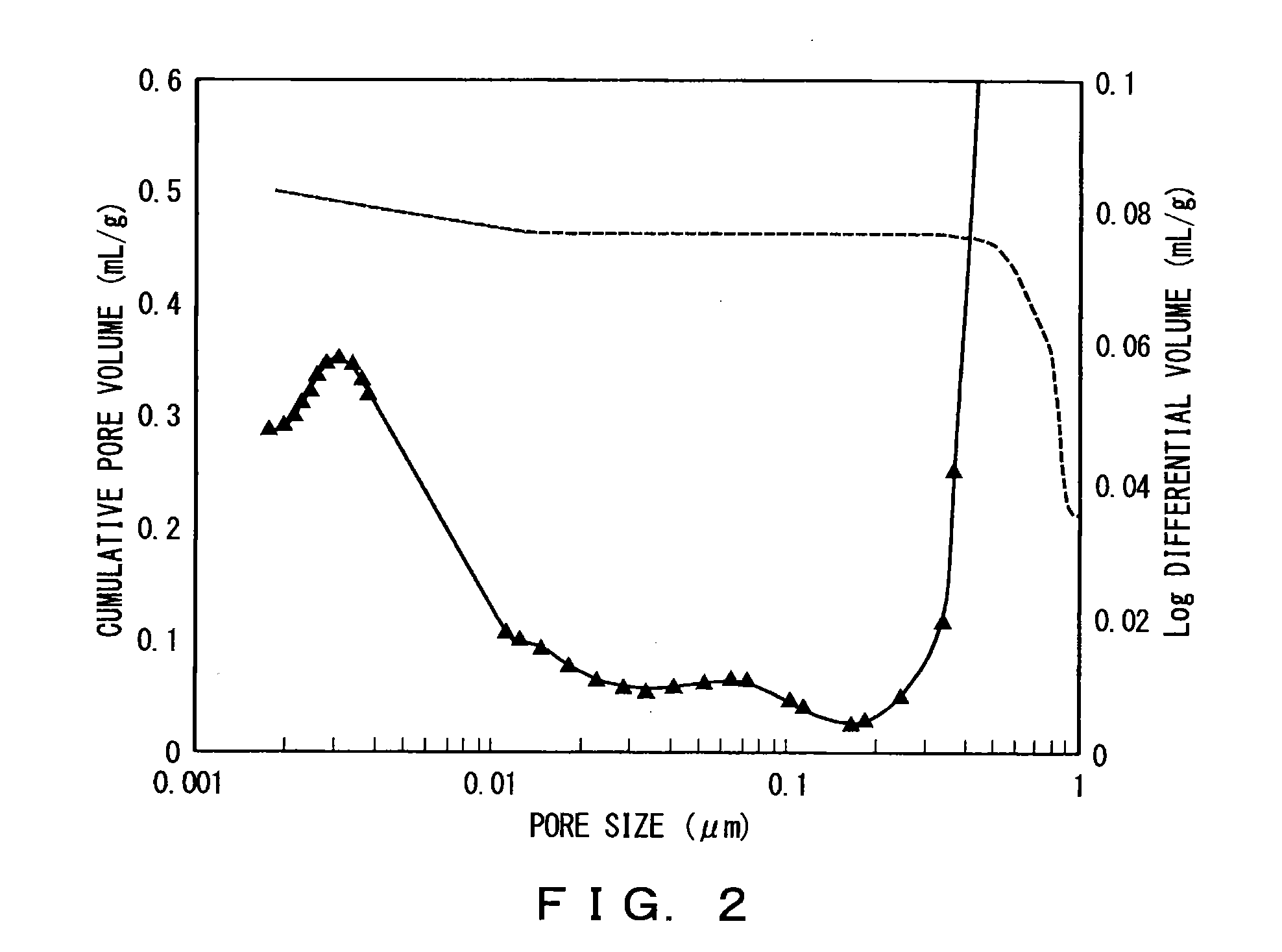
[0238]As can be seen from the pore distribution measurement result, the positive electrode active material 3 had a peak at 95 nm and a pore volume in a range of 10 nm to 200 nm was 0.034 cm3 / g. The BET specific surface area was 2.6 m2 / g.
3. Battery Resistance Measurement of Lithium Secondary Battery at −30° C.
[0239]A coi...
the structure of the environmentally friendly knitted fabric provided by the present invention; figure 2 Flow chart of the yarn wrapping machine for environmentally friendly knitted fabrics and storage devices; image 3 Is the parameter map of the yarn covering machine
Login to View More
PUM
Login to View More
Abstract
Provided is a positive electrode active material which is useful for a lithium secondary battery having a battery resistance lower than that of the conventional positive electrode active material below freezing point. The positive electrode active material for a lithium secondary battery contains at least one element selected from a group consisting of nickel, cobalt and manganese, the positive electrode active material having a layered structure and satisfying all of the following requirements (1) to (3): (1) a primary particle size is 0.1 μm to 1 μm and a secondary particle size is 1 μm to 10 μm; (2) in an X-raypowderdiffraction measurement using CuKα radiation, a crystallite size in the peak within 2θ=18.7±1° is 100 Å to 1200 Å and a crystallite size in the peak within 2θ=44.6±1° is 100 Å to 700 Å; and (3) in a pore distribution obtained by a mercury intrusion method, a pore peak exists in a range where the pore size is 10 nm to 200 nm and a pore volume in the said range is 0.01 cm3 / g to 0.05 cm3 / g.
Description
BACKGROUND[0001]1. Field of the Disclosure[0002]The present disclosure relates to a positive electrode active material for a lithium secondary battery, a positive electrode and a secondary battery.[0003]2. Discussion of the Background Art[0004]Lithiummetal composite oxides are used as a positive electrode active material of secondary batteries such as lithium secondary batteries. Lithium secondary batteries have already been put to practical use as small-sized power supply units for mobile telephones, notebook computers, or the like, and further attempts have been made to use them as middle-sized or large-sized power supply units for automotive applications or for power storage applications.[0005]As a conventional positive electrode active material, Patent Document 1 discloses a positive electrode active material for a lithium secondary battery that is a lithium nickelmanganesecobaltcomposite oxide having a pore radius of 1 μm and a pore volume of 0.55 cm3 / g.DOCUMENT LISTPatent ...
Claims
the structure of the environmentally friendly knitted fabric provided by the present invention; figure 2 Flow chart of the yarn wrapping machine for environmentally friendly knitted fabrics and storage devices; image 3 Is the parameter map of the yarn covering machine
Login to View More
Application Information
Patent Timeline
Application Date:The date an application was filed.
Publication Date:The date a patent or application was officially published.
First Publication Date:The earliest publication date of a patent with the same application number.
Issue Date:Publication date of the patent grant document.
PCT Entry Date:The Entry date of PCT National Phase.
Estimated Expiry Date:The statutory expiry date of a patent right according to the Patent Law, and it is the longest term of protection that the patent right can achieve without the termination of the patent right due to other reasons(Term extension factor has been taken into account ).
Invalid Date:Actual expiry date is based on effective date or publication date of legal transaction data of invalid patent.



 Login to View More
  Login to View More