
Egg-shell type hybrid structure of highly dispersed nanoparticle-metal oxide support, preparation method thereof, and use thereof
a technology of nanoparticles and metal oxides, which is applied in the field of eggshell-type hybrid structure of highly dispersed nanoparticlemetal oxide supports, can solve the problems of increasing particle size and unevenness, complicated preparation processes thereof, and easy sintering, so as to achieve high-yield reaction, disperse heat of reaction, and high dispersion
- Summary
- Abstract
- Description
- Claims
- Application Information
AI Technical Summary
Benefits of technology
Problems solved by technology
Method used
Image


Examples
example 2
Synthesis of Egg-Shell Hybrid Structure of Nickel Oxide / Silica
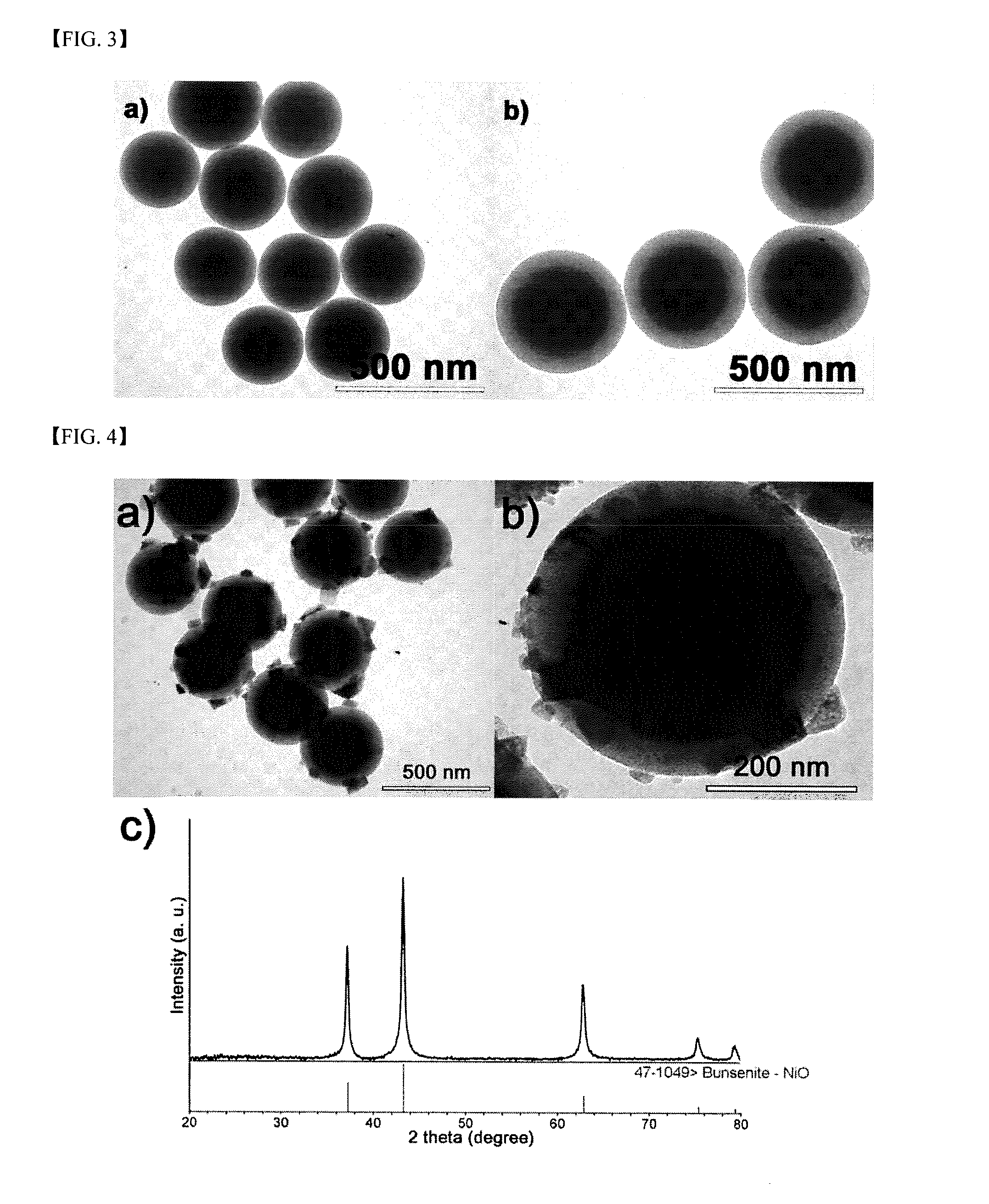
[0069]0.5 g of silica nanoparticles having porous silica shells obtained in Example 1 and 0.275 g of Ni(NO3)2.6H2O salt were uniformly pulverized using a mortar. After sufficient pulverization, the mixed powder was placed in a 30 mL container made of polypropylene, the cap of the container was tightly sealed, and the powder was subjected to curing in a drying oven set to 60° C. for 24 hours. After 24 hours of curing, the powder was cooled at room temperature, which was then calcinated under the atmosphere at 400° C. for 4 hours using a calcination apparatus to obtain an egg-shell type nickel oxide / silica hybrid structure containing 10 wt % nickel. p TEM analysis results of the egg-shell type hybrid structure of nickel oxide / silica (a-b) and X-ray diffraction (XRD) analysis results for qualitative analysis thereof (c) are illustrated in FIG. 4. In FIG. 4, (a) is a TEM image with a magnification of 50,000, and (b) is a TEM ...
example 3
Synthesis of Egg-Shell Hybrid Structures of Cobalt Oxide / Silica
[0071]0.5 g of silica nanoparticles having porous silica shells obtained in Example 1 and 0.274 g of Co(NO3)2.6H2O salt were uniformly pulverized using a mortar. After sufficient pulverization, the mixed powder was placed in a 30 mL container made of polypropylene, the cap of the container was tightly sealed, and the powder was subjected to curing in a drying oven set to 60° C. for 24 hours. After 24 hours of curing, the powder was cooled at room temperature, which was then calcinated under the atmosphere at 300° C. or 400° C. for 4 hours independently using a calcination oven to obtain egg-shell type cobalt oxide / silica hybrid structures containing 10 wt % cobalt.
[0072]TEM analysis results of the egg-shell hybrid structures of cobalt oxide / silica obtained from each calcination temperature are illustrated in FIGS. 5a and 5b, and XRD analysis results for qualitative analysis of the egg-shell hybrid structure of cobalt oxi...
example 4
Synthesis of Egg-Shell Hybrid Structure of Iron Oxide / Silica
[0074]0.5 g of silica nanoparticles having porous silica shells obtained in Example 1 and 0.402 g of Fe(NO3)3.9H2O salt were uniformly pulverized using a mortar. After sufficient pulverization, the mixed powder was placed in a 30 mL container made of polypropylene, the cap of the container was tightly sealed, and the powder was subjected to curing in a drying oven set to 50° C. for 24 hours. After 24 hours of curing, the powder was cooled at room temperature, which was then calcinated under the atmosphere at 500° C. for 4 hours using a calcination oven to obtain an egg-shell type iron oxide / silica hybrid structure containing 10 wt % iron.
[0075]TEM analysis result of the egg-shell type iron oxide / silica hybrid structure obtained above (a) and XRD analysis results for qualitative analysis thereof (b) are illustrated in FIG. 6.
[0076]As can be confirmed in FIG. 6a, numerous iron oxide particles are found inside and on surfaces ...
PUM
| Property | Measurement | Unit |
|---|---|---|
| melting point | aaaaa | aaaaa |
| temperature | aaaaa | aaaaa |
| diameter | aaaaa | aaaaa |
Abstract
Description
Claims
Application Information
 Login to View More