Organic compound and organic electroluminescent device using the same
Pending Publication Date: 2020-08-06
SOLUS ADVANCED MATERIALS CO LTD
View PDF3 Cites 3 Cited by
Summary
Abstract
Description
Claims
Application Information
AI Technical Summary
This helps you quickly interpret patents by identifying the three key elements:
Problems solved by technology
Method used
Benefits of technology
Benefits of technology
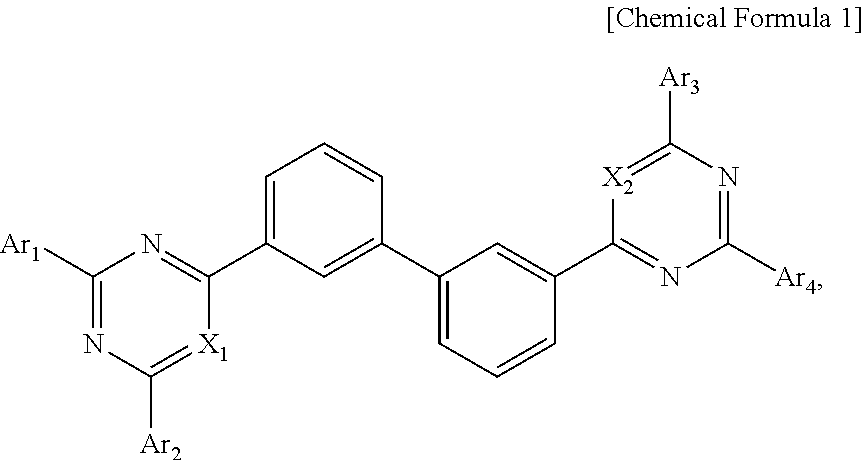
The present invention provides a compound represented by Chemical Formula 1 that can be used as a material for the organic layer of an organic electroluminescent device. This compound has excellent light emitting properties and is stable at high temperatures. When used as a phosphorescent host material or electron transporting material, it can help to create devices that have lower driving voltage, higher current efficiency, and improved performance and lifespan for full-color display panels.
Problems solved by technology
However, conventional luminescent materials have low glass transition temperatures and poor thermal stability, despite of their advantageous luminous characteristics, and thus are not satisfactory in terms of lifespan for organic electroluminescent devices.
Method used
the structure of the environmentally friendly knitted fabric provided by the present invention; figure 2 Flow chart of the yarn wrapping machine for environmentally friendly knitted fabrics and storage devices; image 3 Is the parameter map of the yarn covering machine
View more
Image
Smart Image Click on the blue labels to locate them in the text.
Viewing Examples
Smart Image
Click on the blue label to locate the original text in one second.
Reading with bidirectional positioning of images and text.
Smart Image
Examples
Experimental program
Comparison scheme
Effect test
preparation example 2
[Preparation Example 2] Synthesis of Compound Z-2
Synthesis of 2,4-dichloro-6-(triphenylen-2-yl)-1,3,5-triazine
[0079]
[0080]A solution was prepared by dissolving Mg (0.24 g, 10 mmol) and 12 (0.1 g) in dry THF (30 mL), adding 2-bromotriphenylene (3.07 g, 10 mmol) thereto, and then refluxing the mixture for 2 hours. 2,4,6-trichloro-1,3,5-triazine (1.84 g, 10 mmol) was dissolved in dry THF (30 mL) and cooled to 0° C., the previously prepared solution was then slowly added thereto for 1 hour, and the mixture was stirred for 2 hours. After the reaction was completed, the organic layer was dried over MgSO4, concentrated under reduced pressure, and purified with hexane, thereby obtaining a compound 2,4-dichloro-6-(triphenylen-2-yl)-1,3,5-triazine (2.06 g, yield 55%).
Synthesis of 2-([1,1′:2′,1″-terphenyl]-3-yl)-4-chloro-6-(triphenylen-2-yl)-1,3,5-triazine
[0082]
[0083]A solution was prepared by dissolving Mg (...
preparation example 3
[Preparation Example 3] Synthesis of Compound Z-3
[0088]
[0089]The same process as in [Preparation Example 1] was carried out, except that 2-(4,4,5,5-tetramethyl-1,3,2-dioxaborolan-2-yl)quinoline (2.55 g, 10.0 mmol) was used instead of (9,9-dimethyl-9H-fluoren-2-yl)boronic acid, and that phenanthren-2-ylboronic acid (2.22 g, 10.0 mmol) was used instead of (9-phenyl-9H-carbazol-3-yl)boronic acid, such that the target compound, Compound Z-3 (3.45 g, yield 59%), was obtained.
[0092]The same process as in [Preparation Example 2] was carried out, except that 6-bromo-2-phenylbenzo[d]oxazole (2.74 g, 10.0 mmol) was used instead of 2-bromotriphenylene, and that 2-(4-bromophenyl)-1-phenyl-1H-benzo[d]imidazole (3.49 g, 10.0 mmol) was used instead of 3-bromo-1,1′:2′,1″-terphenyl, such that the target compound, Compound Z-4 (3.78 g, yield 58%), was obtained.
the structure of the environmentally friendly knitted fabric provided by the present invention; figure 2 Flow chart of the yarn wrapping machine for environmentally friendly knitted fabrics and storage devices; image 3 Is the parameter map of the yarn covering machine
Login to View More
PUM
Login to View More
Abstract
The present invention relates to a novel organic compound and an organic electroluminescent device using the same, and more particularly, to a novel compound having excellent electron transport capability and light emitting capability, and an organic electroluminescent device improved in terms of luminous efficiency, driving voltage, lifespan, etc. by including the novel compound in one or more organic layers.
Description
TECHNICAL FIELD[0001]The present invention relates to a novel organic compound and an organic electroluminescent device using the same, and more particularly, to a compound having excellent electron transport capability and light emitting capability, and an organic electroluminescent device improved in terms of luminous efficiency, driving voltage, lifespan, etc. by including the compound in one or more organic layers.BACKGROUND ART[0002]Starting from Bernanose's observation of light emission from organic thin films in the 1950s, the study of organic electroluminescent devices led to blue electroluminescence using anthracene monocrystals in 1965, and Tang suggested in 1987 an organic electroluminescent device in a stack structure which may be divided into functional layers of hole and light-emitting layers. Then, in order to develop high efficiency, long life span organic electroluminescent devices, organic layers each having distinctive characteristics have been introduced in the e...
Claims
the structure of the environmentally friendly knitted fabric provided by the present invention; figure 2 Flow chart of the yarn wrapping machine for environmentally friendly knitted fabrics and storage devices; image 3 Is the parameter map of the yarn covering machine
Login to View More
Application Information
Patent Timeline
Application Date:The date an application was filed.
Publication Date:The date a patent or application was officially published.
First Publication Date:The earliest publication date of a patent with the same application number.
Issue Date:Publication date of the patent grant document.
PCT Entry Date:The Entry date of PCT National Phase.
Estimated Expiry Date:The statutory expiry date of a patent right according to the Patent Law, and it is the longest term of protection that the patent right can achieve without the termination of the patent right due to other reasons(Term extension factor has been taken into account ).
Invalid Date:Actual expiry date is based on effective date or publication date of legal transaction data of invalid patent.


 Login to View More
  Login to View More