
Method for producing slurry for nonaqueous battery electrodes
a non-aqueous battery and slurry technology, which is applied in the direction of cell components, final product manufacturing, sustainable manufacturing/processing, etc., can solve the problems of aggregates, lumps, and slurry accumulation in the electrode, and achieve good cycle characteristics, sufficient binding properties, and reduced internal resistance of the battery
- Summary
- Abstract
- Description
- Claims
- Application Information
AI Technical Summary
Benefits of technology
Problems solved by technology
Method used
Image

Examples
example 1
[0136]
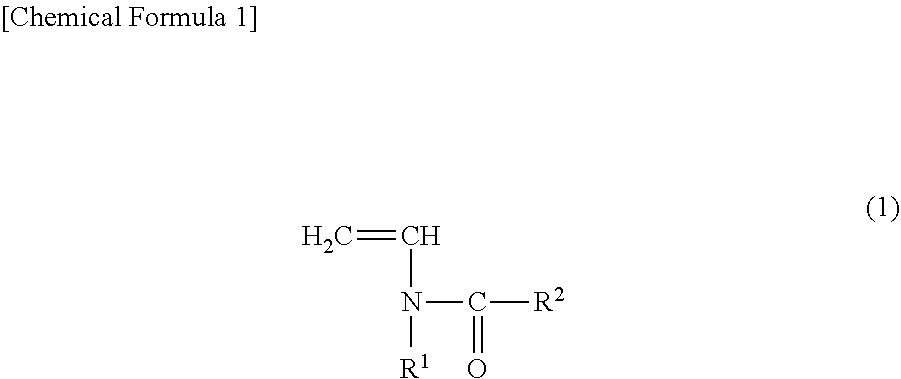
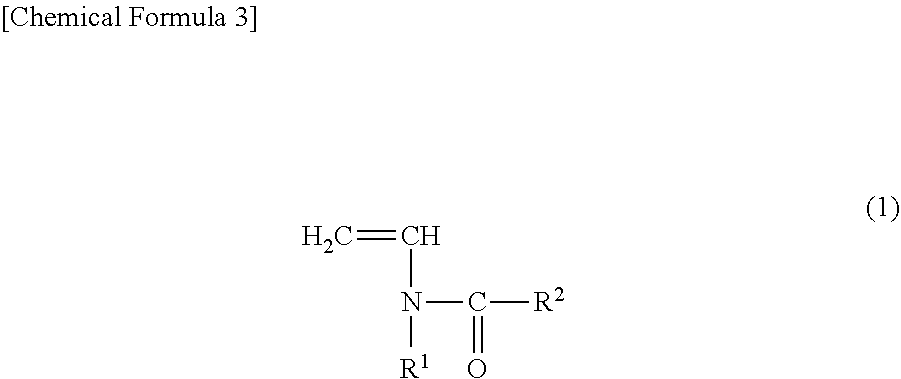
[0137]N-vinylacetamide (NVA) (Manufactured by Showa Denko K.K.) was used as the water-soluble ethylenically unsaturated monomer (A). Sodium acrylate (AaNa) (prepared as a 28.5 mass % aqueous solution) was used as the (meta)acrylate salt monomer (B). V-50 (2,2′-azobis(2-methylpropionamidine) dihydrochloride, manufactured by Wako Pure Chemical Industries, Ltd.) was used as the polymerization catalyst, and ammonium persulfate (manufactured by Wako Pure Chemical Industries, Ltd.) was used as the polymerization initiator.
[0138]A separable flask equipped with a cooling tube, a thermometer, an agitator, and a dropping funnel was charged with 10.0 parts by mass of NVA, 315.8 parts by mass of a 28.5% by mass aqueous solution of AaNa (90.0 parts by mass of AaNa), 0.2 parts by mass of V-50, 0.05 parts by mass of ammonium persulfate, and 9.0 parts by mass of water at 30° C. This was bubbled with nitrogen gas for 1 hour, then the temperature was raised to 80° C., and polymerization was car...
example 2
[0170]In Example 2, a slurry for a nonaqueous battery electrode, a nonaqueous battery electrode, and a nonaqueous battery were obtained in the same manner as in Example 1 except that the solid kneading step was carried out at 2000 rpm for 8 minutes. The evaluation results are shown in Table 1.
examples 3 and 4
, Comparative Examples 1 to 4
[0171]In Examples 3 and 4 and Comparative Examples 1 to 4, slurries for a nonaqueous battery electrode, nonaqueous battery electrodes, and nonaqueous batteries were obtained in the same manner as in Example 1 except that dispersion was performed under the agitating conditions shown in Table 1 in the dispersing step. The evaluation results are shown in Table 1.
PUM
| Property | Measurement | Unit |
|---|---|---|
| particle diameter | aaaaa | aaaaa |
| particle diameter | aaaaa | aaaaa |
| particle diameter | aaaaa | aaaaa |
Abstract
Description
Claims
Application Information
 Login to View More