Check patentability & draft patents in minutes with Patsnap Eureka AI!

Electrolyte for Lithium Ion Batteries

a lithium ion battery, electrolyte technology, applied in the direction of organic electrolytes, electrochemical generators, organic chemistry, etc., can solve the problems of limiting the utilization of propylene carbonate, forming an effective solid electrolyte interphase, and affecting the economic benefits of lithium ion batteries

Inactive Publication Date: 2021-05-13
WESTFALISCHE WILHELMS UNIV MUNSTER
View PDF2 Cites 0 Cited by
  • Summary
  • Abstract
  • Description
  • Claims
  • Application Information

AI Technical Summary

Benefits of technology

The present disclosure aims to provide an electrolyte that overcomes the shortcomings of previous art. It introduces a new compound that helps create a solid electrolyte interphase on graphite, making reversible cycling of propylene carbonate-containing electrolytes possible.

Problems solved by technology

However, the reductive decomposition of the solvent propylene carbonate (IUPAC name 4-methyl-1,3-dioxolan-2-one) does not lead to formation of an effective solid electrolyte interphase.
This limits the utilization of propylene carbonate despite its better thermal and physicochemical properties compared to ethylene carbonate (IUPAC 1,3-dioxolan-2-one) for lithium ion technology.
However, the use of highly concentrated electrolytes, also known as “solvent-in-salt” electrolytes, is not economical since this approach requires a multiple of the normally required amount of electrolyte salt.
In addition, the concentration (usually >3 mol l−1) greatly increases the viscosity of the electrolyte, which leads to a marked decrease in the conductivity and the performance of the battery.
Furthermore, it is to be expected that a decrease in the operating temperature results in the solubility product of the electrolyte salt going below the concentration of the electrolyte salt in the electrolyte solution, which leads to precipitation of the salt in the interior of the batteries.

Method used

the structure of the environmentally friendly knitted fabric provided by the present invention; figure 2 Flow chart of the yarn wrapping machine for environmentally friendly knitted fabrics and storage devices; image 3 Is the parameter map of the yarn covering machine
View more

Image

Smart Image Click on the blue labels to locate them in the text.
Viewing Examples
Smart Image
  • Electrolyte for Lithium Ion Batteries
  • Electrolyte for Lithium Ion Batteries
  • Electrolyte for Lithium Ion Batteries

Examples

Experimental program
Comparison scheme
Effect test

example 1

Determination of the Conductivity of 1,1,2,2-Tetraethoxyethane in Various Electrolytes

[0049]The conductivity of a 1 M solution of LiTFSI (lithium bis(trifluoromethanesulfonyl)imide (LiN(SO2CF3)2) was determined in 1,1,2,2-tetraethoxyethane and in mixtures of 1,1,2,2-tetraethoxyethane (TEE), propylene carbonate (PC) and dimethyl carbonate (DMC).

[0050]To produce the electrolytes, 1,1,2,2-tetraethoxyethane, a mixture of 50% by weight of 1,1,2,2-tetraethoxyethane and 50% by weight of propylene carbonate or a mixture of 1,1,2,2-tetraethoxyethane, propylene carbonate and dimethyl carbonate in a weight ratio of 1:1:1 were initially charged. The respective required amount of LiTFSI or LiFSI (LiN(SO2F)2) was dissolved in these so that a concentration of 1 M of the lithium salt was obtained. In the same way, comparative electrolytes containing 1 M LiTFSI or LiPF6 in propylene carbonate were produced.

[0051]The conductivity of the electrolytes was examined in a temperature range from −35° C. to...

example 2

Determination of the Conductivity of 1,1,2,2-Tetramethoxyethane in Various Electrolytes

[0053]The conductivity of electrolytes containing 1,1,2,2-tetramethoxyethane (TME) was examined in a temperature range from −35° C. to +60° C. as described in example 1 using a 2-electrode conductivity measurement cell (RHD Instruments, GC / Pt).

[0054]The conductivity of a 1 M solution of LiTFSI in 1,1,2,2-tetramethoxyethane (TME) and in mixtures of in each case 50% by weight of TME and PC and also mixtures of TME, PC and DMC in a weight ratio of 1:1:1 and 1:2:2 was determined. Table 2 below shows the conductivity in the temperature range from −35° C. to +60° C. in the corresponding solvents.

TABLE 2Conductivity of 1M LiTFSI in various mixturescontaining 1,1,2,2-tetramethoxyethane (TME)LiTFSI inLiTFSI inLiTFSI inLiTFSI inTME:PCTME:PC:DMCTME:PC:DMCTTME(1:1 w / w)(1:1:1 w / w)(1:2:2 w / w)[° C.][σ / mS cm−1][σ / mS cm−1][σ / mS cm−1][σ / mS cm−1]−350.20.40.81.0−300.30.61.11.5−200.51.11.72.3−100.81.72.63.201.12.43.64...

example 3

Determination of the Reductive Electrochemical Stability and Cyclability of 1,1,2,2-Tetramethoxyethane and 1,1,2,2-Tetraethoxyethane Using a Graphite Electrode

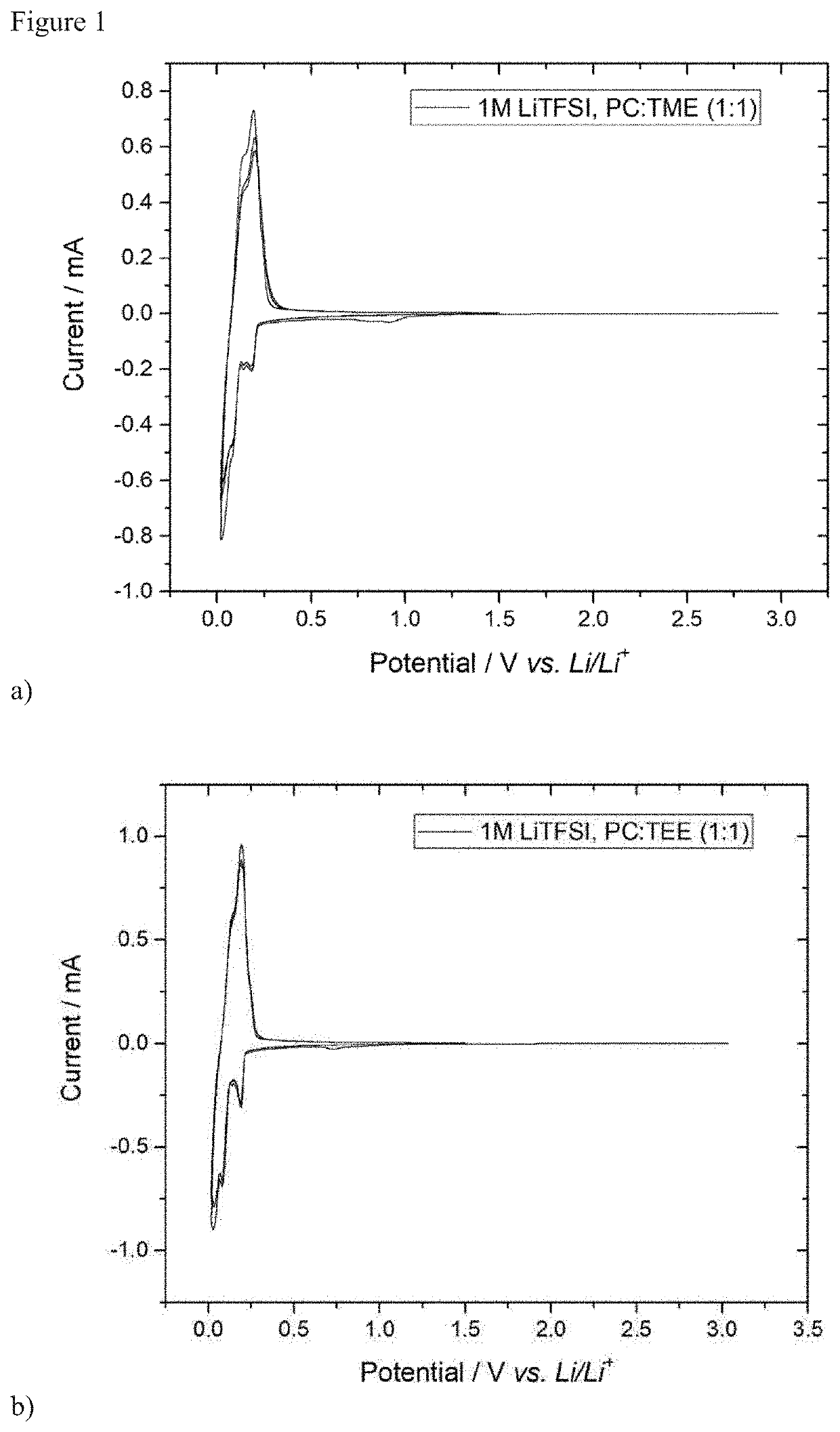
[0056]The determination of the stability of the electrolytes in half cells was carried out by means of cyclic voltammetry. In this method, the electrode voltage is continuously changed cyclically. A three-electrode cell (Swagelok® type) having a graphite composite electrode (96%, 350 mAh / g; 1.1 mAh cm−2) as working electrode and lithium foil as counterelectrode and reference electrode was used for this purpose. A glass fiber nonwoven was used as separator.

[0057]To determine the reductive stability and cyclability, the potential between working electrode and reference electrode was firstly lowered from the equilibrium potential (OCP) to 0.025 V vs. Li / Li+ and subsequently increased again from 0.025 V to 1.5 V vs. Li / Li+. The cyclic potential change procedure between 0.025 V and 1.5 V vs. Li / Li+ was repeated twice. The rate of a...

the structure of the environmentally friendly knitted fabric provided by the present invention; figure 2 Flow chart of the yarn wrapping machine for environmentally friendly knitted fabrics and storage devices; image 3 Is the parameter map of the yarn covering machine
Login to View More

PUM

PropertyMeasurementUnit
temperaturesaaaaaaaaaa
Login to View More

Abstract

The disclosure relates to an electrolyte for an energy store comprising a conducting salt and a solvent. The solvent comprises at least one compound according to the general formula (1), as indicated in the following: wherein R1, R2, R3, R4 are, identically or independently of each other, selected from the group comprising linear or branched C1-6-alkyl, C2-6-alkenyl C3-6-cycloalkyl and / or phenyl, each unsubstituted or mono- or polysubstituted by a substituent selected from the group comprising F, CN and / or C1-2-alkyl, mono- or polysubstituted with fluorine.

Description

INTRODUCTION[0001]The disclosure relates to the field of lithium ion batteries.[0002]Lithium ion batteries (secondary batteries) are at present the leading technology in the field of rechargeable batteries, especially in the field of portable electronics. Conventional lithium ion batteries usually employ a graphite anode. Charge transport occurs via an electrolyte which comprises a lithium salt dissolved in a solvent. Various electrolytes and electrolyte salts are known in the prior art. Conventional lithium ion batteries at present usually employ lithium hexafluorophosphate (LiPF6).[0003]During operation of graphite anodes, reductive decomposition of the electrolyte occurs. The reaction products can form an adhering and electronically insulating but lithium ion-conducting film on the electrode. Suitable electrolytes induce the formation of a solid electrolyte interphase (SEI) on the electrode. The solid electrolyte interphase subsequently prevents the graphite from reacting further...

Claims

the structure of the environmentally friendly knitted fabric provided by the present invention; figure 2 Flow chart of the yarn wrapping machine for environmentally friendly knitted fabrics and storage devices; image 3 Is the parameter map of the yarn covering machine
Login to View More

Application Information

Patent Timeline
no application Login to View More
Patent Type & Authority Applications(United States)
IPC IPC(8): H01M10/0569H01M10/0525C07C43/13
CPCH01M10/0569H01M2300/0028C07C43/135H01M10/0525H01M10/052H01M10/0567H01M2300/0025Y02E60/10C07C43/03H01G11/64
Inventor ROESER, STEPHANKASNATSCHEEW, JOHANNESWAGNER, RALFATIK, JASCHARBRUNKLAUS, GUNTHERWINTER, MARTIN
Owner WESTFALISCHE WILHELMS UNIV MUNSTER
Features
  • R&D
  • Intellectual Property
  • Life Sciences
  • Materials
  • Tech Scout
Why Patsnap Eureka
  • Unparalleled Data Quality
  • Higher Quality Content
  • 60% Fewer Hallucinations
Social media
Patsnap Eureka Blog
Learn More