Residue number system arithmetic circuits with built-in self test

a number system and arithmetic circuit technology, applied in the field of electronic circuits, can solve the problems of other operations, base extension, and the effect of reducing the speed of the circuit, and achieve the effect of simple circuitry

a number system and arithmetic circuit technology, applied in the field of electronic circuits, can solve the problems of other operations, base extension, and the effect of reducing the speed of the circuit, and achieve the effect of simple circuitry

US6886123B1Inactive Publication Date: 2005-04-26STMICROELECTRONICS SRL

Image

Smart Image Click on the blue labels to locate them in the text.
Viewing Examples
Smart Image
  • Residue number system arithmetic circuits with built-in self test
  • Residue number system arithmetic circuits with built-in self test
  • Residue number system arithmetic circuits with built-in self test

Examples

Experimental program
Comparison scheme
Effect test

Embodiment Construction

[0035]Preferred embodiments of the present invention will be described in detail hereinbelow with reference to the attached drawings.

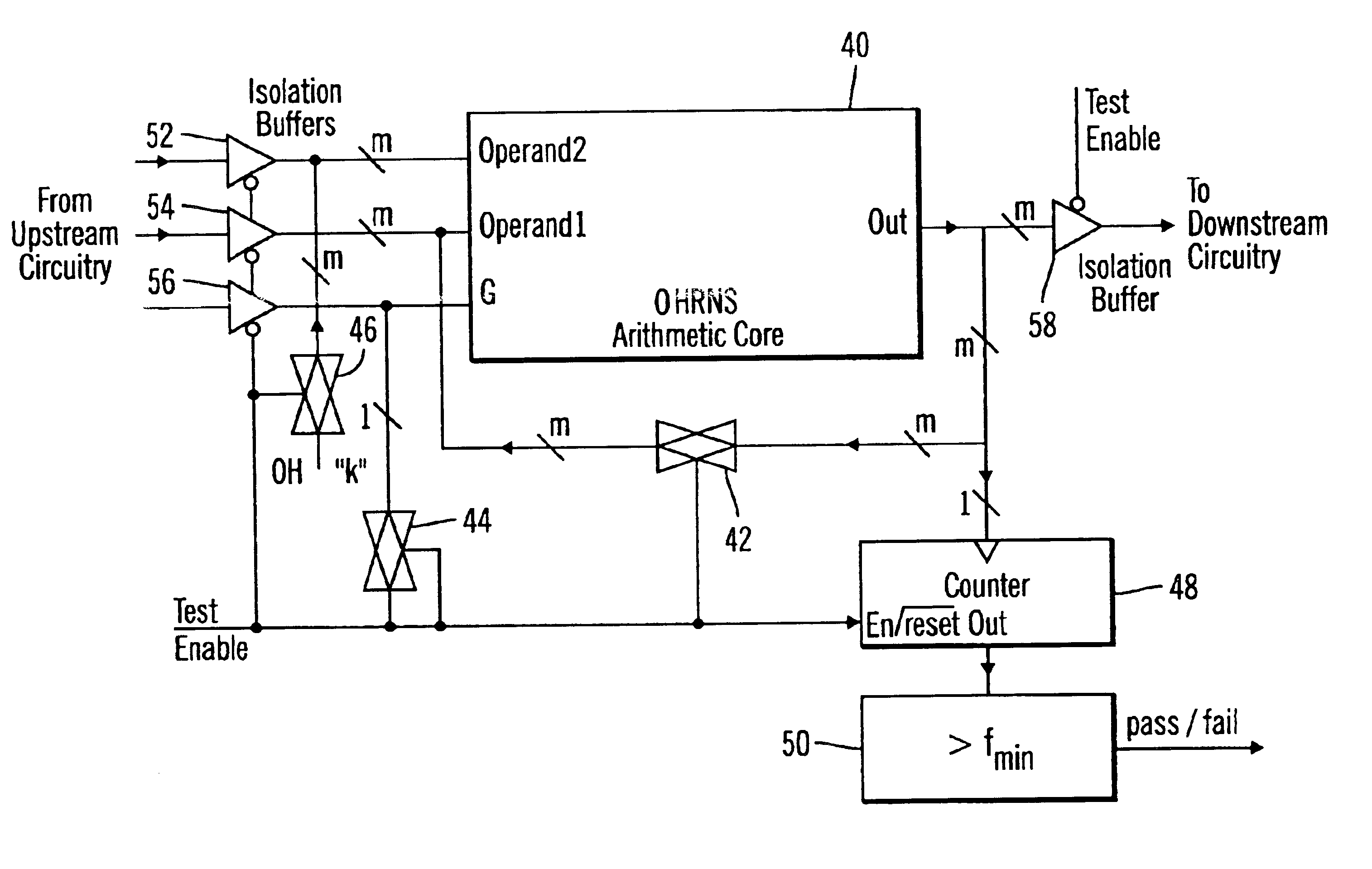
[0036]The core circuits used to perform OHRNS arithmetic operations have the advantageous property that input-to-output timing is identical for all inputs and outputs. The present invention takes advantage of this property to enable verification of the timing of the circuit with simple built-in self test circuitry. In preferred embodiments, the input-to-output delay of an OHRNS arithmetic circuit is tested using Oscillation Built-In Self Test (OBIST). More specifically, the circuit is made to oscillate by feeding the output back to the input, and the frequency of oscillation of the circuit is measured. Because the frequency of oscillation is inversely proportional to the input-to-output delay of the circuit, the measured frequency can be used to ascertain whether or not the delay of the circuit is within specification. (A general explanation of OBIST c...

the structure of the environmentally friendly knitted fabric provided by the present invention; figure 2 Flow chart of the yarn wrapping machine for environmentally friendly knitted fabrics and storage devices; image 3 Is the parameter map of the yarn covering machine
Login to View More

PUM

No PUM Login to View More

Abstract

An arithmetic circuit for use with an RNS is provided. The arithmetic circuit includes an arithmetic core, test circuitry, and logic circuitry. The arithmetic core performs an RNS arithmetic operation, and the test circuitry verifies proper circuit delay by inducing oscillation at the output of the arithmetic core during testing. The logic circuitry produces a pass / fail signal based on whether the oscillation frequency of the arithmetic core is at least equal to a minimum threshold value. In one preferred embodiment, the logic circuitry includes a counter that counts oscillations of the output of the arithmetic core during testing, and a comparator that compares the output of the counter after a predetermined test period with the minimum threshold value. Also provided is a method for testing the propagation delay of an RNS arithmetic circuit having an arithmetic core.

Description

BACKGROUND OF THE INVENTION[0001]1. Field of the Invention[0002]The present invention relates to electronic circuits, and more specifically to arithmetic circuits having built-in self testing for use with the residue number system.[0003]2. Description of Related Art[0004]Power consumption is now a very important consideration in integrated circuit design. This has compelled circuit designers to consider reducing power consumption through changes in many different levels of the design process, such as the system, technology, algorithm, physical, and circuit levels. For example, system level approaches for reducing power consumption include power supply voltage scaling, clock gating, and subsystem sleep (or power down) modes. Technology level techniques include using dynamic threshold MOSFETs, and algorithm level techniques include using alternate number systems and state encoding. Further, physical level methods include transistor reordering, and circuit level methods include self-ti...

Claims

the structure of the environmentally friendly knitted fabric provided by the present invention; figure 2 Flow chart of the yarn wrapping machine for environmentally friendly knitted fabrics and storage devices; image 3 Is the parameter map of the yarn covering machine
Login to View More

Application Information

Patent Timeline
26 Apr 2005
Publication
US6886123B1
IPC
G01R31/28; G01R31/30
CPC
G01R31/3016
Inventors
CHREN, JR., WILLIAM A.