
Process for synthesizing beta-lactam
a technology of beta-lactam and cyclohexyl methyl methyl, which is applied in the field of synthesizing beta-lactam, can solve the problems of long reaction time, complex reaction process, and no direct, simple and efficient cyclization method of -amino acids, and achieve accurate identification, type and purity can be confirmed, and the contents of these compounds are determined accurately
- Summary
- Abstract
- Description
- Claims
- Application Information
AI Technical Summary
Benefits of technology
Problems solved by technology
Method used
Image

Examples
example 1
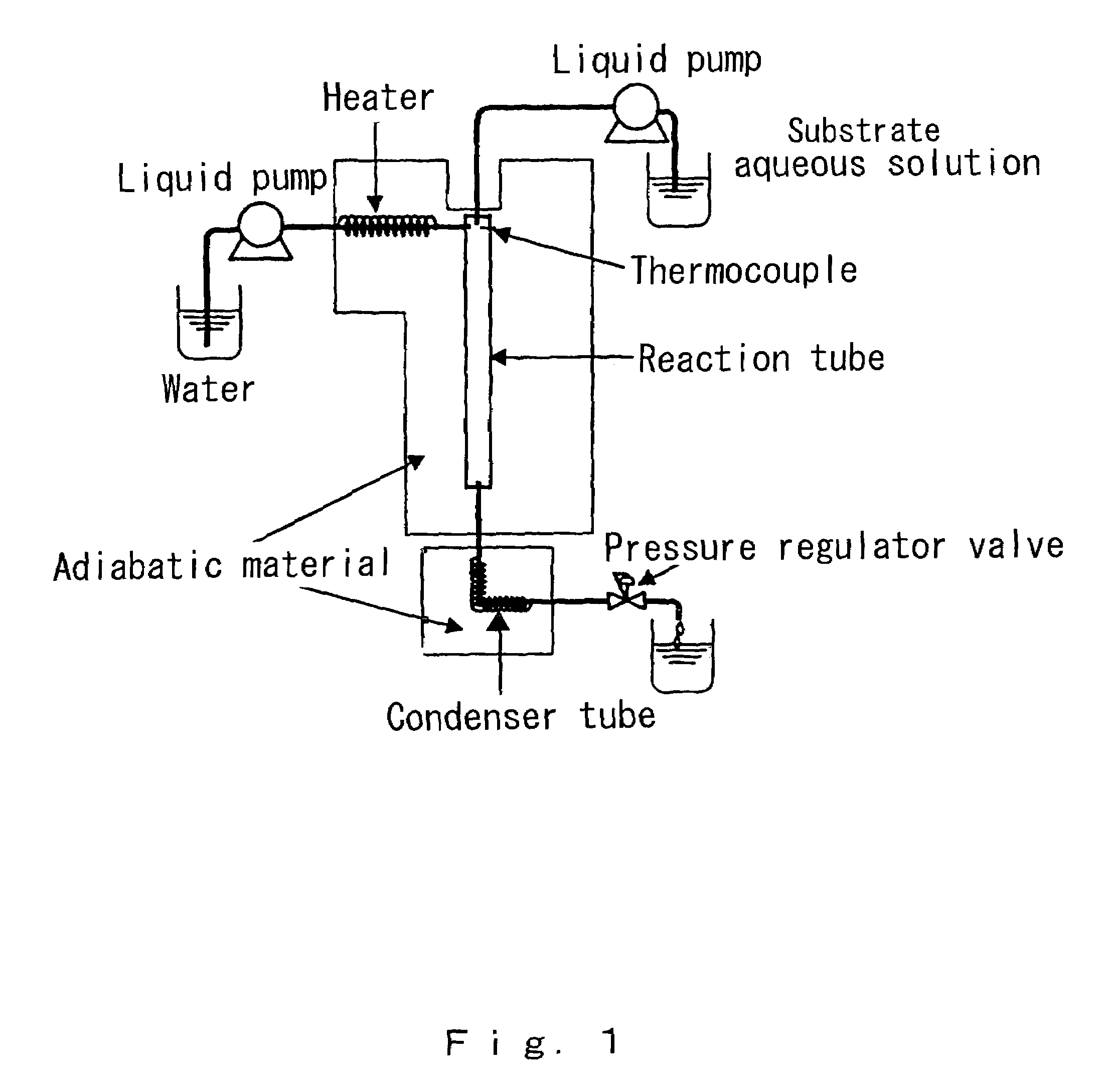
[0051]The continuous synthesis of β-propiolactam by a cyclization reaction was attempted by reacting β-alanine (manufactured by Nakaraitekusu K.K.) under high-temperature high-pressure water conditions in which temperature 374° C., pressure 30 MPa and density 0.558 g / cm3 using the continuous type reaction apparatus shown in FIG. 1.
[0052]The material of the reaction vessel was alloy C-276. The internal diameter of the reaction vessel was 0.65 mm and the length of the reaction vessel was 25 cm; accordingly, the volume of the reaction vessel was calculated as 0.083 cm3. The respective prepared solutions that were introduced were injected by means of a high-pressure pump. The water used in the reaction was distilled water. The carrier water from which solute oxygen was driven out by bubbling with nitrogen gas was caused to flow through at a flow velocity of 10.3 ml / min. Similarly, using distilled water that had been subjected to a deoxygenation treatment, a substrate solution containing...
example 2
[0053]β-Propiolactam was continuously synthesized from β-alanine for 1 hour under exactly the same conditions as in Example 1. The reaction solution thus obtained was passed through a cation exchange resin (50W-X8 manufactured by Dow Chemical Co.) column, so that the raw-material β-alanine and the β-propiolactam that was produced were separated. After the solution containing β-propiolactam was concentrated, 4.6 of the product of the present invention was obtained. It was confirmed from FTIR absorption spectrum results and NMR measurement results that the product of the present invention thus obtained was high-purity β-propiolactam that contained almost no impurities.
example 3
[0054]The continuous synthesis of β-propiolactam from β-alanine was attempted by performing a reaction in the same manner as in Example 1. However, the reaction conditions were altered as shown below.
[0055]Altered Reaction Conditions
[0056]Reaction temperature: 400° C.
[0057]Reaction pressure: 15 MPa
[0058]High-temperature high-pressure water density: 0.064 g / cm3
[0059]Carrier water flow velocity: 22 ml / min
[0060]Substrate solution flow velocity: 3 ml / min
[0061]The β-alanine concentration prior to introduction into the reaction vessel was 60 mM. The reaction time was 0.013 seconds, and when the aqueous solution following the reaction was investigated using a high-performance liquid chromatography mass analysis apparatus, it was confirmed that β-propiolactam had been produced. The concentration of β-propiolactam in the solution was 36.7 mM, and the reaction yield was 61.2%.
PUM
| Property | Measurement | Unit |
|---|---|---|
| temperature | aaaaa | aaaaa |
| pressure | aaaaa | aaaaa |
| pressure | aaaaa | aaaaa |
Abstract
Description
Claims
Application Information
 Login to View More