[0006]Objects of the present invention are to provide an improved filter installation and a method for its operation which, while being able to ensure highly effective decontamination of
biological materials, are reliable even over long periods of use without forming toxic by-products and without possible
corrosion being promoted, and guarantee effective, economical cleaning.
[0007]These objects are basically achieved by a filter installation and a method where the agents for biological
contamination have active ingredients such as
inert gases and special metals which can be placed in the filter housing. Toxic impurities cannot occur, and the active substances used, in contrast to chemically produced fungicides and herbicides, are environmentally compatible by their being found directly in nature in this way without harmful intermediate
decomposition products. The indicated active substances according to the present invention are also chosen such that
corrosion damage can be avoided. Especially when using special metals, effective corrosion protection can build up, even if the metals themselves specifically kill the indicated living organisms, including
plant material.
[0008]In one preferred embodiment of the filter installation according to the present invention, the
inert gas is
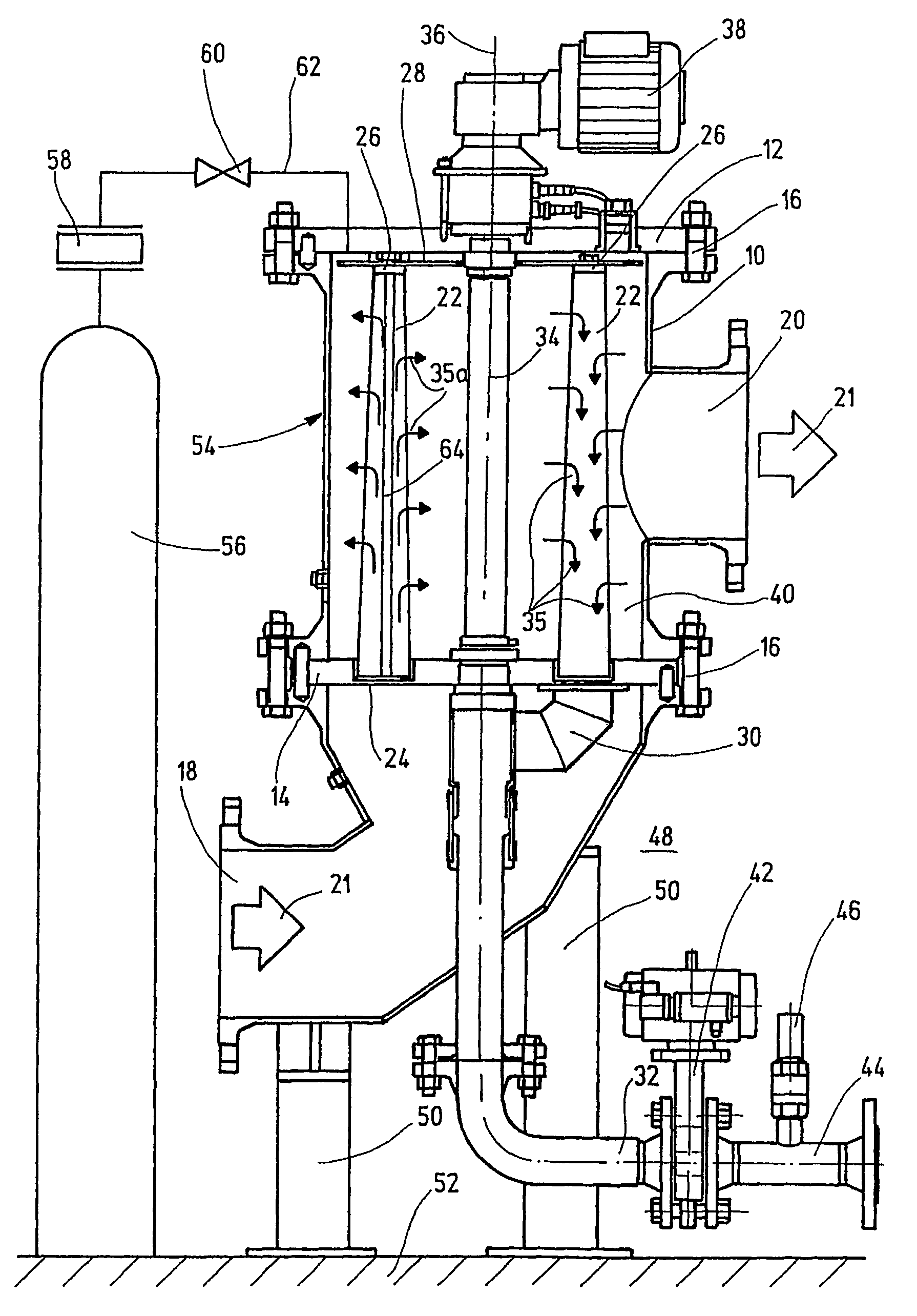
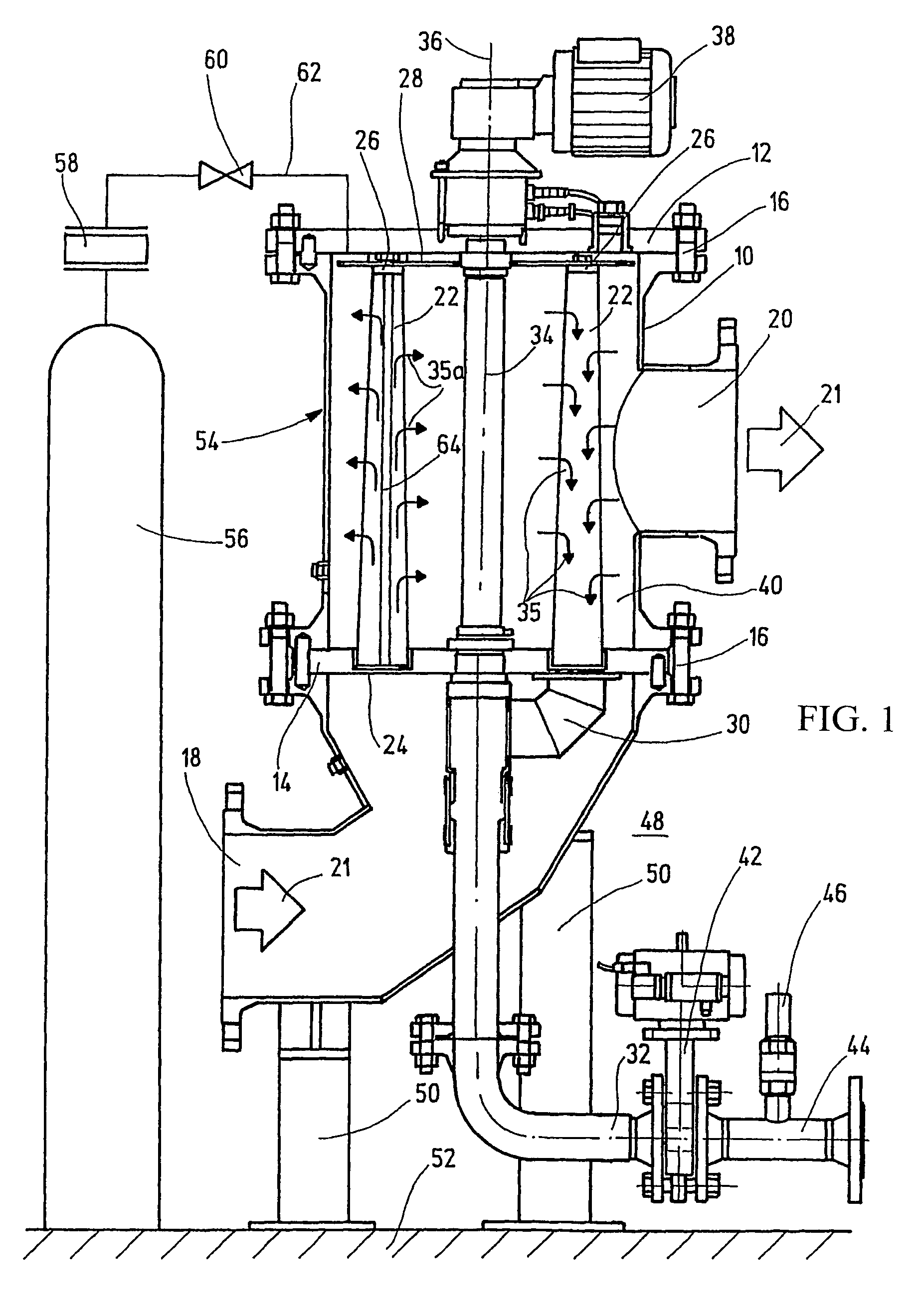
nitrogen gas which can be taken from at least one storage
bottle. Preferably, after completion of the actual
filtration, the
nitrogen can be flushed into the interior of the filter housing with the
filter element. The
inert gas nitrogen within the filter housing creates a dry,
oxygen-free environment used to kill living organisms. This
nitrogen gas can be very easily managed using devices. It is easily economically available worldwide as a refill gas, and effectively controls the danger of corrosion. Instead of
nitrogen gas, the filter could optionally be flushed in a less desirable version with
compressed air. Since
compressed air is generally available aboard ship, its use however does not lead to an
oxygen-free environment and thus it can be used only as an emergency measure. Preferably, the
inert gas in the associatable storage
bottle is provided with
high pressure such that the filter housing can also be flushed empty if the filter housing is still filled with seawater of a definable pressure (
ambient pressure).
[0009]In another preferred embodiment of the filter installation according to the present invention, in the filter housing
copper is used as the special
metal in the form of at least one sacrificial
anode. Since
copper occurs in the environment and is not environmentally harmful at a correspondingly high
dilution by seawater, it is especially well suited for the indicated use, especially with respect to killing of the indicated living microorganisms. Due to the configuration as a sacrificial
anode, the
copper removal in this respect also counteracts the continually prevailing corrosion. In an especially space-saving manner, the sacrificial
anode can be accommodated in the filter housing if it is part of the filter elements used. By integrating the copper sacrificial anode into the filter elements, the fluid flow behavior within the filter housing is not hindered. This arrangement benefits overall operation of the
system in terms of energy.
[0010]In one especially preferred embodiment of the filter installation according to the present invention, the design ensures ordinary filtering operation and, at the same time, allows backflushing for some of the filter elements to be able to use the cleaned filter elements for new
filtration operations. Preferably, the fluid outlet of the filter is provided with a triggerable
check valve. In the fluid flow direction following in the fluid line, a non-return valve is used such that in the opened position the exterior is connected to the associatable fluid line. As a result of the fluid lines which are very long in ships and power plants, water hammers can be avoided with the
check valve blocked by the
ambient air being able to flow after into the fluid lines via the non-return valve. Air volumes which may form in this way in the fluid line can be used then in the opposite direction as a damping element if water hammers in operation of the
system can be expected in the opposite direction.



 Login to View More