Check patentability & draft patents in minutes with Patsnap Eureka AI!

Resin composition and film made of same

a technology of composition and film, applied in the field of resin composition and film made of same, can solve the problems of insufficient flex resistance and impact resistance at low temperature, inability to use some applications, and inability to use products in applications, etc., and achieve excellent barrier properties and flex resistance and impact resistance.

Active Publication Date: 2011-12-27
KURARAY CO LTD
View PDF18 Cites 0 Cited by
  • Summary
  • Abstract
  • Description
  • Claims
  • Application Information

AI Technical Summary

Benefits of technology

The resin composition achieves excellent barrier properties, flex resistance, and impact resistance at low temperatures, making it suitable for applications such as flexible containers and films that require these properties.

Problems solved by technology

An ethylene-vinyl alcohol copolymer, which henceforth may be abbreviated as EVOH, is a resin excellent in gas barrier properties, but it cannot be used for some applications due to its insufficient flexibility.
However, the flex resistance and impact resistance at low temperature are still insufficient and therefore in some cases such products cannot be used in applications where flexing or impact is applied at low temperature.
However, the flex resistance and impact resistance at low temperature were insufficient.
When, however, dynamically crosslinking it while kneading, it is impossible to make dispersed particles small enough and, as a result, the flex resistance and impact resistance at low temperature are insufficient.

Method used

the structure of the environmentally friendly knitted fabric provided by the present invention; figure 2 Flow chart of the yarn wrapping machine for environmentally friendly knitted fabrics and storage devices; image 3 Is the parameter map of the yarn covering machine
View more

Image

Smart Image Click on the blue labels to locate them in the text.
Viewing Examples
Smart Image
  • Resin composition and film made of same
  • Resin composition and film made of same
  • Resin composition and film made of same

Examples

Experimental program
Comparison scheme
Effect test

synthesis example 1

[0090]Synthesis of Styrene-hydrogenated Butadiene-styrene Triblock Copolymer (f-1) Having a Boronic Acid Ester Group

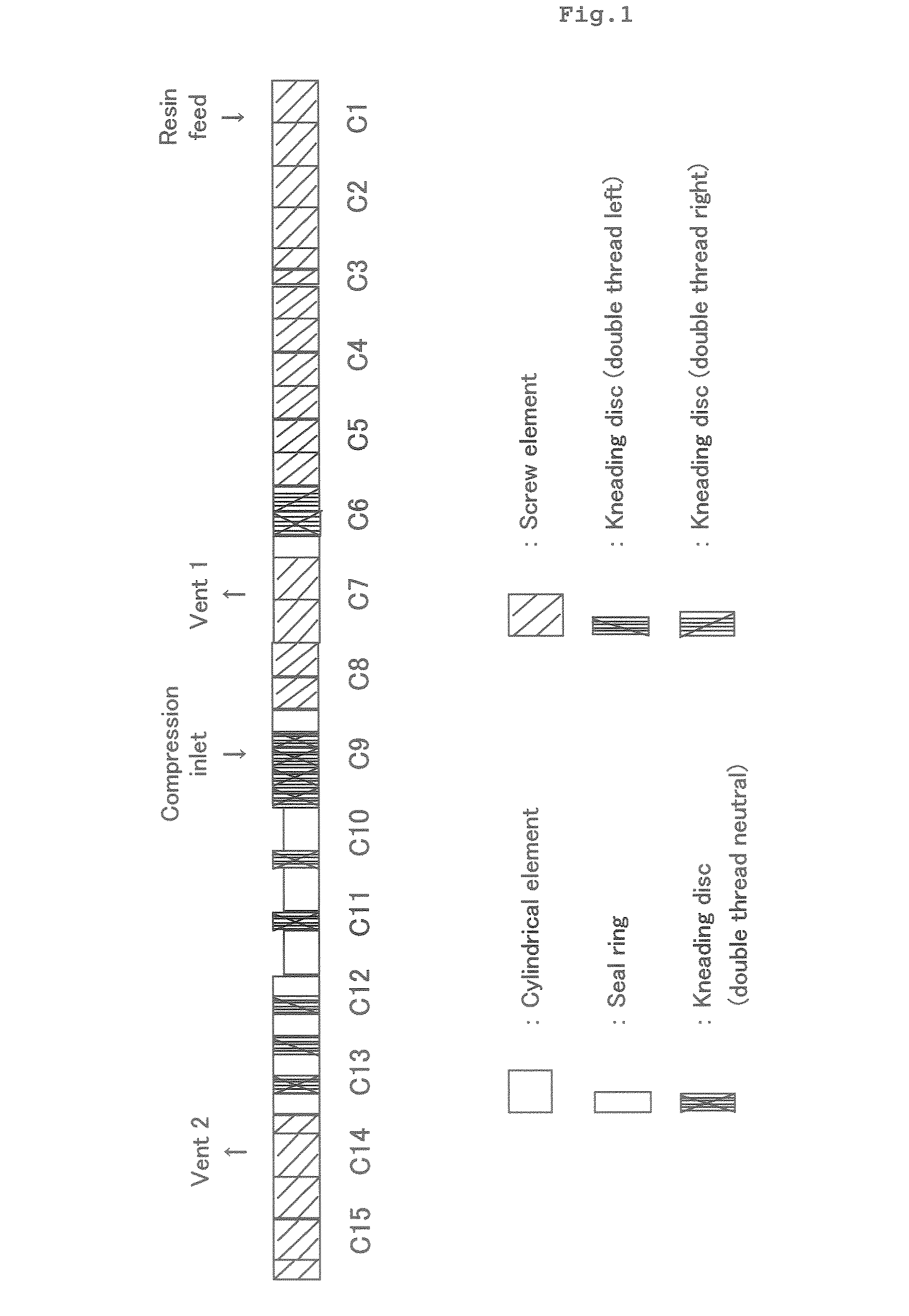
[0091]The styrene-hydrogenated butadiene-styrene triblock copolymer (weight average molecular weight=100400, styrene / hydrogenated butadiene=18 / 82 (weight ratio), 1,2-bond / 1,4-bond molar ratio of butadiene units=47 / 53, a hydrogenation ratio of butadiene units of 97%, double bond amount: 430 μeq, melt index: 5 g / 10 min (230° C., 2160 g load), density: 0.89 g / cm3) was fed to a co-rotating twin-screw extruder TEM-35β (manufactured by Toshiba Machine Co., Ltd.) at a rate of 7 kg / hour while ventilating the feed port using 1 L / min nitrogen. Subsequently, while feeding a mixed solution of borane-triethylamine complex (TEAB) and boric acid 1,3-butanediol ester (BBD) (TEAB / BBD=29 / 71, weight ratio) from a liquid feeder 1 at a rate of 0.6 kg / hour and 1,3-butanediol from a liquid feeder 2 at a rate of 0.4 kg / hour, melt-kneading was carried out continuously. During the kneading, the...

synthesis example 2

[0103]Preparation of Very Low Density Polyethylene (f-2) having an Ethylene Glycol Boronate Group at an End Thereof

[0104]An object product (f-2) was obtained by using a very low density polyethylene {MFR: 17 g / 10 min (210° C., 2160 g load), density: 0.89 g / cm3, terminal double bond amount: 0.048 meq / g} instead of the styrene-hydrogenated butadiene-styrene triblock copolymer. The amount of boronic acid 1,3-butanediol ester groups of this modified resin was 48 μeq / g. The Young's modulus thereof at 23° C., 50% RH was within the range from 30 to 50 MPa. The oxygen transmission rate at 20° C., 65% RH was 4000 cc·20 μm / m2·day·atm.

synthesis example 3

[0105]Synthesis of Modified Ethylene-vinyl Alcohol Copolymer (c-1)

[0106]Into a polyethylene bag, introduced was 5 kg of pellets of an EVOH having an ethylene content of 44 mol %, a degree of saponification of 99.8%, an intrinsic viscosity of 0.096 L / g and an MFR of 5 g / 10 min (at 190° C. under a load of 2160 g) {acetic acid content: 53 ppm, sodium content: 1 ppm in terms of metal element, potassium content: 8 ppm in terms of metal element, phosphoric acid compound content: 20 ppm in terms of phosphate radical}. Then, an aqueous solution was prepared by dissolving 27.44 g (0.125 mol) of zinc acetate dihydrate and 15 g (0.1 mol) of trifluoromethanesulfonic acid in 500 g of water. The aqueous solution was added to the EVOH in the bag. The EVOH to which a catalyst solution had been added in the way described above was heated at 90° C. for 5 hours under occasional shaking with the bag closed. Thus the EVOH was impregnated with the catalyst solution. The resulting EVOH was dried at 90° C....

the structure of the environmentally friendly knitted fabric provided by the present invention; figure 2 Flow chart of the yarn wrapping machine for environmentally friendly knitted fabrics and storage devices; image 3 Is the parameter map of the yarn covering machine
Login to View More

PUM

PropertyMeasurementUnit
RHaaaaaaaaaa
particle diameteraaaaaaaaaa
Young's modulusaaaaaaaaaa
Login to View More

Abstract

A resin composition is provided which comprises from 50 to 95% by weight of a modified ethylene-vinyl alcohol copolymer (C) obtained by reacting an ethylene-vinyl alcohol copolymer (A) with a monovalent epoxy compound (B) having a molecular weight of 500 or less, and from 5 to 50% by weight of a soft resin (F) that has at least one functional group able to react with a hydroxyl group and has a Young's modulus at 23° C., 50% RH of 500 MPa or less, wherein the soft resin (F) is dispersed with an average particle diameter of 0.1 μm or less in a matrix of the modified ethylene-vinyl alcohol copolymer (C). This resin composition is excellent in barrier properties and also in flex resistance and impact resistance at low temperature.

Description

TECHNICAL FIELD[0001]The present invention relates to resin compositions comprising modified ethylene-vinyl alcohol copolymers and soft resins and to films comprising the same.BACKGROUND ART[0002]An ethylene-vinyl alcohol copolymer, which henceforth may be abbreviated as EVOH, is a resin excellent in gas barrier properties, but it cannot be used for some applications due to its insufficient flexibility. Therefore, improvement in flexibility has been attempted through modification of EVOH or blending of soft resins to EVOH.[0003]Patent Reference 1 discloses a resin composition comprising EVOH and a thermoplastic resin having a boronic acid group or a boron-containing group capable of being converted into a boronic acid group in the presence of water. As such a thermoplastic resin having a boron-containing group, soft resins such as an ethylene-propylene copolymer and a hydrogenated styrene-isoprene-styrene block copolymer are also used. It is disclosed that incorporation of such soft...

Claims

the structure of the environmentally friendly knitted fabric provided by the present invention; figure 2 Flow chart of the yarn wrapping machine for environmentally friendly knitted fabrics and storage devices; image 3 Is the parameter map of the yarn covering machine
Login to View More

Application Information

Patent Timeline
no application Login to View More
Patent Type & Authority Patents(United States)
IPC IPC(8): C08L29/04
CPCB32B25/08C08L23/26C08L23/0861B32B25/14B32B27/08B32B27/306B32B2439/70B32B2439/46B32B2307/7242B32B2307/558Y10T428/1307Y10T428/13B32B2270/00B32B2274/00B32B2307/54C08L2666/04Y10T428/31931Y10T428/31924Y10T428/31917Y10T428/31909Y10T428/31913
Inventor ISOYAMA, KOUTASHINDOME, HIROYUKIKATAOKA, NAOKIWATANABE, TOMOYUKI
Owner KURARAY CO LTD
Features
  • R&D
  • Intellectual Property
  • Life Sciences
  • Materials
  • Tech Scout
Why Patsnap Eureka
  • Unparalleled Data Quality
  • Higher Quality Content
  • 60% Fewer Hallucinations
Social media
Patsnap Eureka Blog
Learn More