
Hydroisomerization catalyst, method of dewaxing hydrocarbon oil, process for producing base oil, and process for producing lube base oil
a hydrocarbon oil and catalyst technology, applied in the direction of catalyst activation/preparation, physical/chemical process catalysts, petroleum chemical modifications, etc., can solve the problems of difficult to obtain a desired fraction with a good yield, high operation cost, and low yield. , to achieve the effect of suppressing cracking activity, high isomerization activity and high yield
- Summary
- Abstract
- Description
- Claims
- Application Information
AI Technical Summary
Benefits of technology
Problems solved by technology
Method used
Image

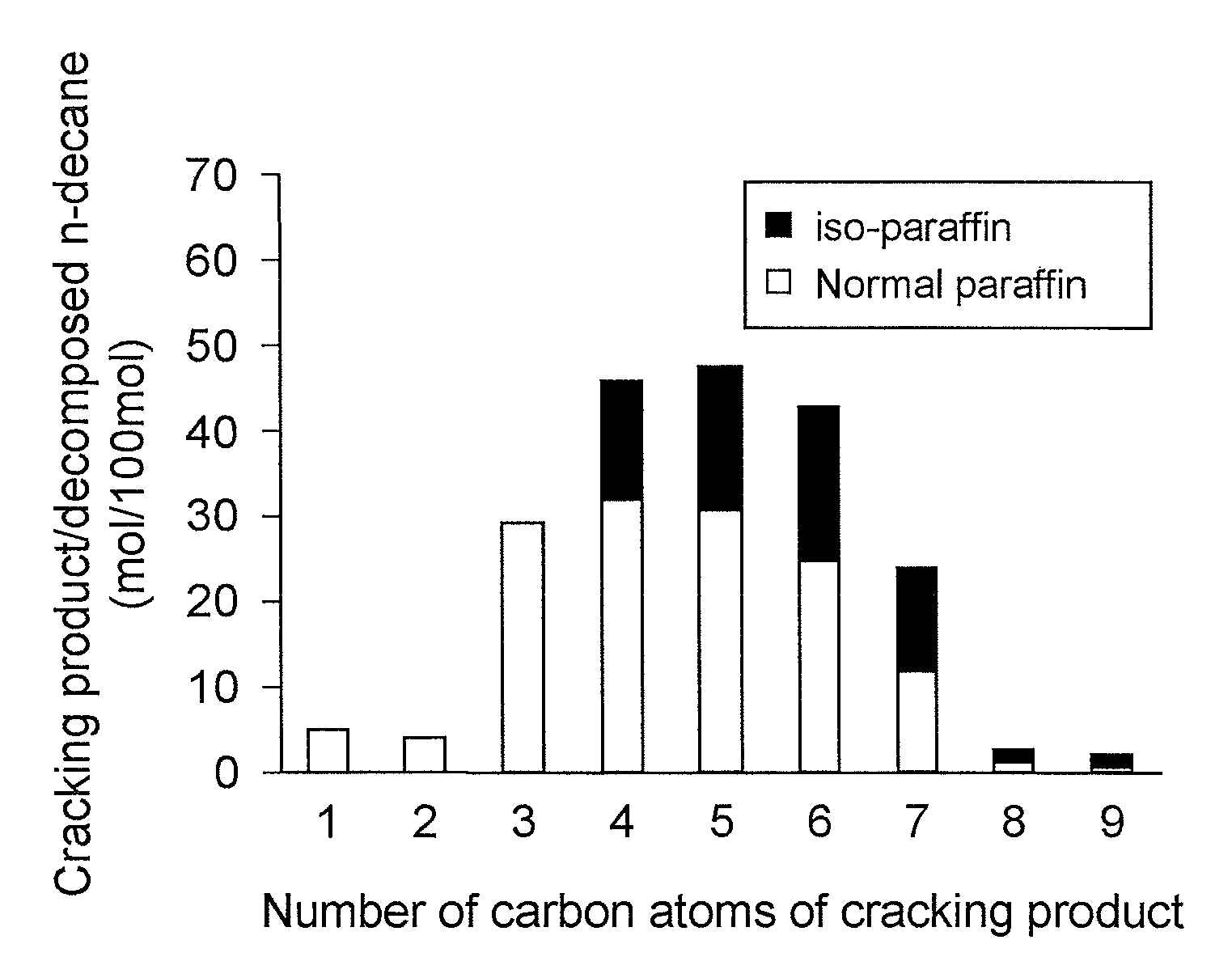
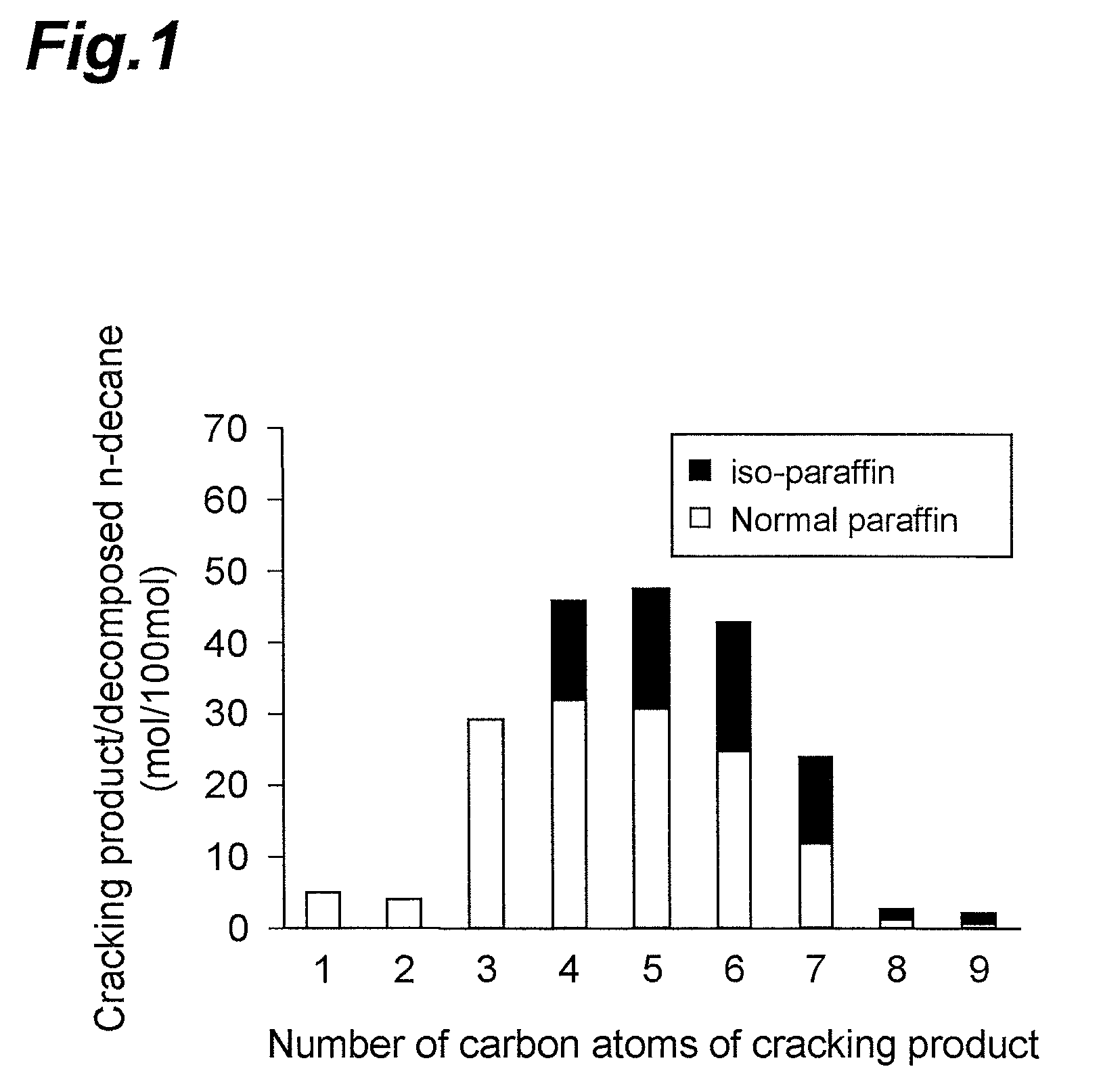
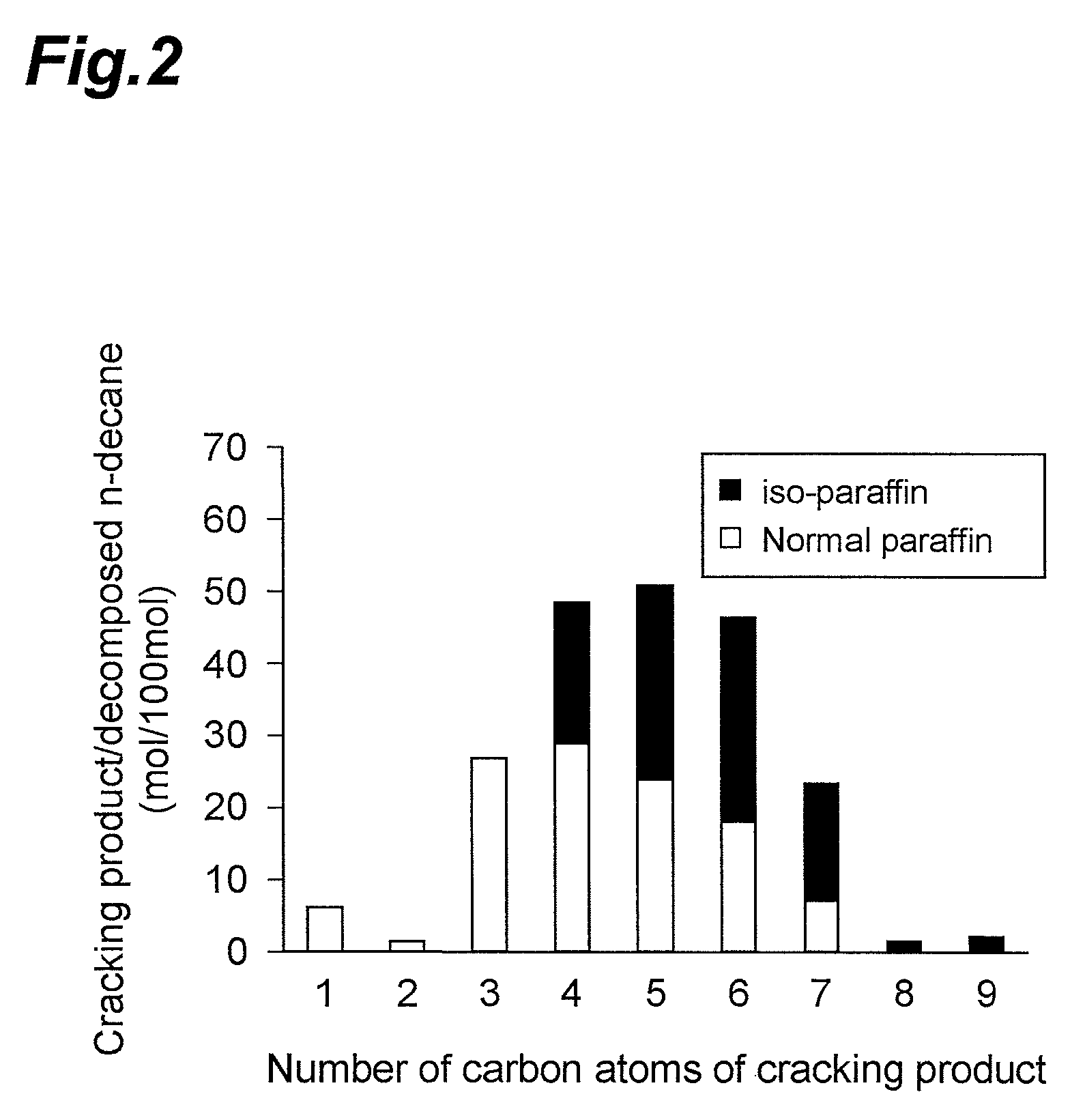
Examples
example 1
[0239](Manufacturing of Catalyst)
[0240]Silica as a molding binder was added to the NH4-ZSM-22 [45] IE that was manufactured in the aforementioned method at a weight ratio of ZSM-22 / silica of 70 / 30. In addition, a small amount of water was added thereto and sufficiently mixed in a mortar. The obtained mixture was charged into an extrusion molding apparatus to be molded into a cylindrical shape having a diameter of about 1.5 mm and a length of about 5 mm. The molded body was dried in drying unit at 120° C. under air stream for 3 hours and, subsequently, calcined in an electric furnace at 550° C. in the atmospheric ambience for 3 hours.
[0241]Then, tetraamminedichloro platinum (II) (Pt (NH3)4Cl2) was dissolved in a minimum amount of ion-exchanged water and the solution was impregnated in the obtained molded body by an initial wetting method to load 0.3 wt % platinum with respect to a weight of the crystalline aluminosilicate. Next, the resulting product was dried in a drying unit at 60°...
example 2
Manufacturing of Catalyst
[0247]A catalyst containing Pt / H-ZSM-23 [45] IE was manufactured by using the same procedures as those of Example 1 except the NH4-ZSM-23 [45] IE manufactured by using the aforementioned method was used instead of the NH4-ZSM-22 [45] IE.
[0248](Dewaxing of Wax)
[0249]The isomerization reaction of the wax was performed in the presence of hydrogen of the wax by using the same procedures as those of Example 1 except that the molded catalyst precursor containing Pt / H-ZSM-23 [45] IE was used instead of the molded catalyst precursor containing Pt / H-ZSM-22 [45] IE as a catalyst precursor. The conversion of the normal paraffins in the wax at a reaction temperature of 340° C. was 100%, and the all components of the carbon number of 21 or more in the resulting product were isoparaffins. In addition, by performing fractional distillation of the obtained reaction product, lube-oil base oils corresponding to SAE-10 and 70 Pale were obtained. In the properties of the base o...
PUM
| Property | Measurement | Unit |
|---|---|---|
| molar ratio | aaaaa | aaaaa |
| temperature | aaaaa | aaaaa |
| temperature | aaaaa | aaaaa |
Abstract
Description
Claims
Application Information
 Login to View More