

Plasmids and phages for homologous recombination and methods of use
- Summary
- Abstract
- Description
- Claims
- Application Information
AI Technical Summary
Benefits of technology
Problems solved by technology
Method used
Image

Examples
example 1
Generation of Plasmid Constructs
[0218]Plasmid with phage genes were cloned and generated by a gap repair mechanism which entails the retrieval of Red genes along with the λ regulatory elements from a defective lambdoid prophage into linear PCR amplified origin of replication sequences of the plasmids. This method eliminates standard cloning technology for the phage DNA and importantly the cloned segment is not replicated in vitro by PCR. Thus, the chances of extraneous changes occurring in the sequence are reduced.
[0219]A prophage lambda derivative was created from the recombineering strain DY330 in which the N through kil genes were deleted using an oligonucleotide of sequence 5′ to 3′ as follows:[0220]ACGAAACGAAGCATTGGCCGTAAGTGCGATTCCGGATTACTAATC GCCCGGCATTTCGCGGGCGATATTTTCACAGC (SEQ ID NO: 32; the deletion junction is illustrated, wherein base 33132 (no underlining, last A in regular text) is next to base 35445 of phage λ, first base of underlined sequence)),
and deleting lambda p...
example 2
Exemplary Plasmids
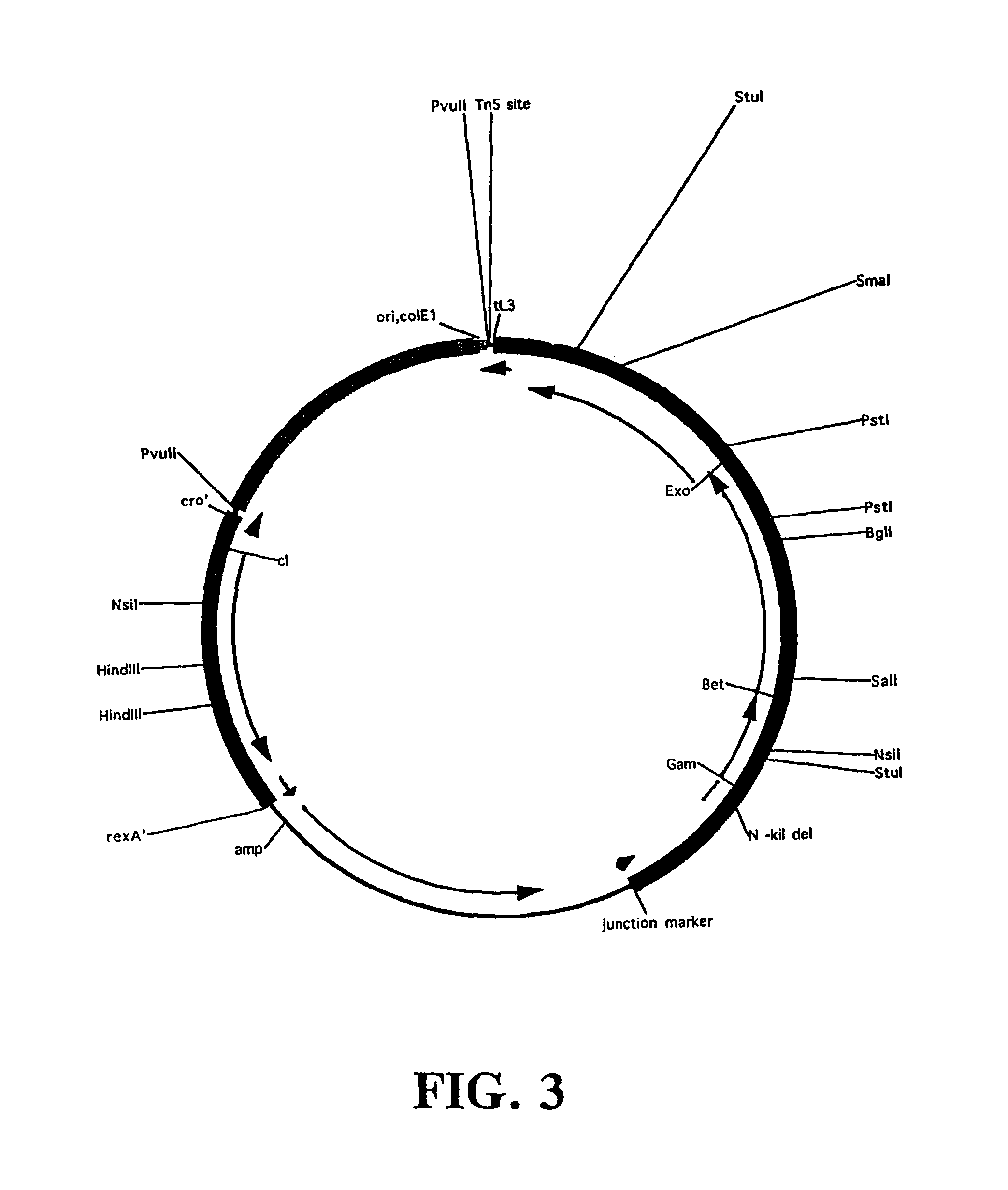
[0225]One plasmid / prophage system was generated that has a temperature sensitive pSC101 replication origin (pSIM5 is CmR; pSIM6 is AmpR). This plasmid catalyzes Red recombination as efficiently as does the defective prophage in E. coli; the level of unwanted induced background recombination is also as low as that of the single copy prophage (see Table 1). A comparison of the chromosomal defective system and the plasmid defective prophage systems described here and the pBAD plasmid expression system of Datsenko and Wanner (Proc. Natl. Acad. Sci. USA. 97:6640-5, 2001) is presented in Table 1.
[0226]The same minimal prophage has also been combined with a temperature sensitive RK2 (pSIM9, CmR) origin of replication to make another broad host range, low copy number vector. Low copy number reduces undesirable background recombination: a colE1-based plasmid (pUC) origin lacking copy number control and carrying the same minimal prophage gives an unacceptably high number of ...
example 3
Recombineering Using galKAmp PCR Product for Either E. coli or typhimurium galK Sequence
1. Linear Drug Cassettes and Single-Strand Oligonucleotides Used for Recombineering:
[0227]The ampicillin resistant (ApR) cassette amp used to replace the galK gene of E. coli and Salmonella typhimurium was amplified from pBluescript SK (+) (Stratagene) with primers SD3, SD4 and SD5, SD6, respectively (Table 1). The primers contain two parts: a 5′ end homologous to the flanking regions of galK of E. coli or Salmonella and a 3′ end that primes the cassette for replication (indicated in italics, Table 1).
[0228]The ssDNA oligo used for recombineering was supplied by Invitrogen as salt free but otherwise unpurified. The sequence of the 70-mer Oligo 144 which corrects the TAG stop codon of E. coli galK gene to a TAC tyrosine codon is:
[0229]
(SEQ ID NO: 33)5′AAGTCGCGGTCGGAACCGTATTGCAGCAGCTTTACCATCTGCCGCTGGACGGCGCACAAATCGCGCTTAA-3′.
2. Preparation of Cells for Recombineering:
[0230]The strains carrying the ...
PUM
| Property | Measurement | Unit |
|---|---|---|
| Temperature | aaaaa | aaaaa |
| Length | aaaaa | aaaaa |
| Electrical resistance | aaaaa | aaaaa |
Abstract
Description
Claims
Application Information
 Login to View More