Unlock instant, AI-driven research and patent intelligence for your innovation.

Method for production of polyester copolymer using recombinant microorganism

a technology of polyester copolymer and recombinant microorganisms, which is applied in the direction of microorganisms, microorganisms, bacteria, etc., can solve the problems of poor shock resistance, hard and fragile phb, and physical properties, and achieves low production cost, high la production, and efficient production

Active Publication Date: 2013-10-22
TOYOTA JIDOSHA KK
View PDF30 Cites 0 Cited by
  • Summary
  • Abstract
  • Description
  • Claims
  • Application Information

AI Technical Summary

Benefits of technology

This method efficiently produces polyester copolymers using inexpensive carbon sources, reducing production costs and allowing for precise control of monomer unit content, thereby enhancing polymer properties.

Problems solved by technology

At the same time, PHB is hard and fragile because of its high crystallinity.
That is to say, it has poor shock resistance, which is problematic in terms of physical properties.
However, a method for synthesizing polyhydroxyalkanoate with the addition of a monomer component such as lactate or decenoic acid to a medium is disadvantageous in terms of cost of starting materials.
Further, in general, the polymer productivity and the carbon source yield become low in the case of production of a polyester copolymer using a microorganism.

Method used

the structure of the environmentally friendly knitted fabric provided by the present invention; figure 2 Flow chart of the yarn wrapping machine for environmentally friendly knitted fabrics and storage devices; image 3 Is the parameter map of the yarn covering machine
View more

Image

Smart Image Click on the blue labels to locate them in the text.
Viewing Examples
Smart Image
  • Method for production of polyester copolymer using recombinant microorganism
  • Method for production of polyester copolymer using recombinant microorganism
  • Method for production of polyester copolymer using recombinant microorganism

Examples

Experimental program
Comparison scheme
Effect test

example 1

Production of a Polyester Copolymer with the Use of Escherichia Coli Capable of High LA Accumulation

(1) Production of a Recombinant Microorganism

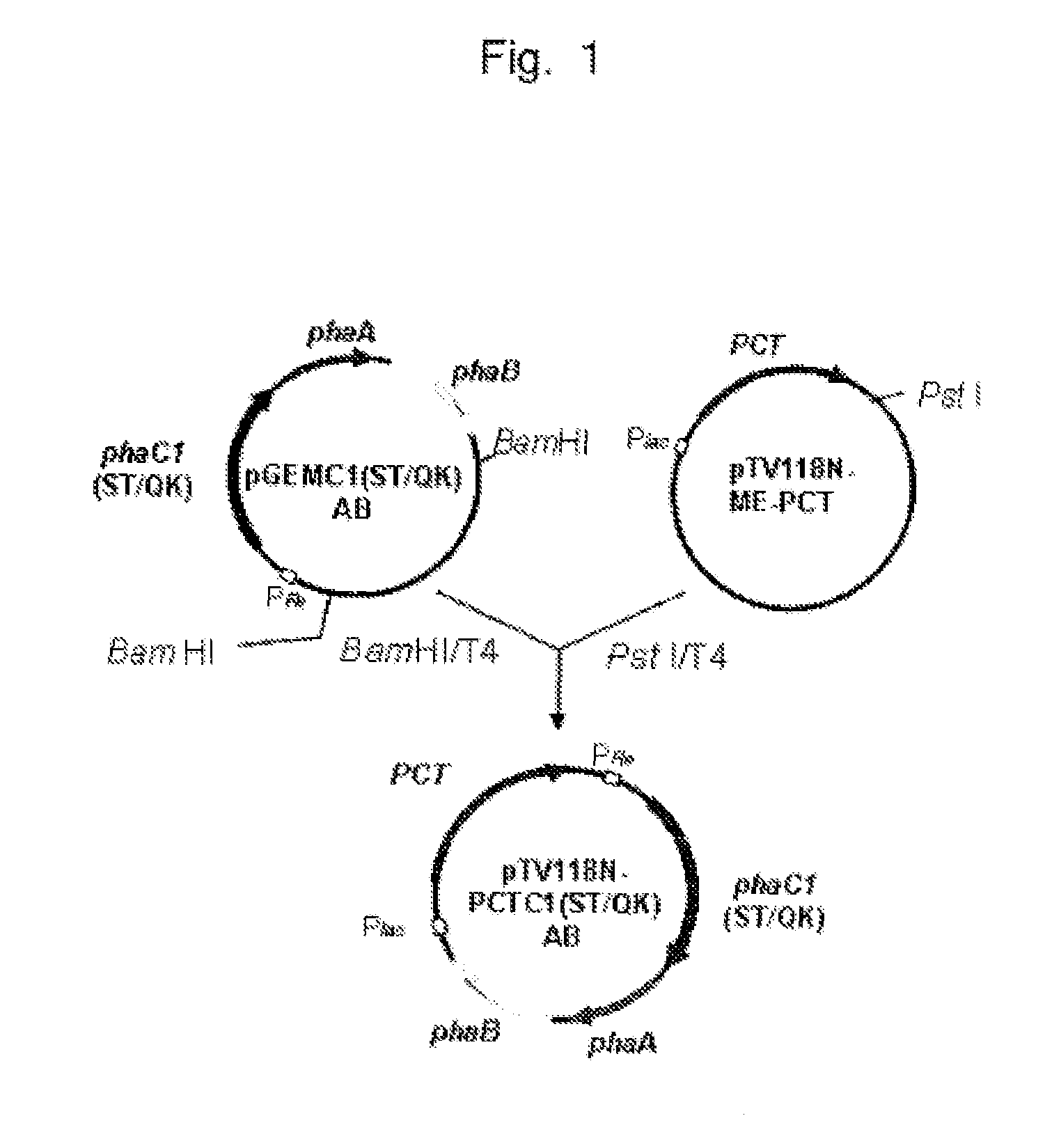
[0177]Genomic DNA was extracted from M. elsdenii (ATCC17753) with the use of a DNeasy Tissue Kit (Qiagen). Subsequently, primer DNA of a forward primer comprising the EcoRI recognition sequence and that of a reverse primer comprising the PstI recognition sequence were synthesized in order to amplify a nucleic acid encoding propionyl CoA transferase (accession No. J04987) by PCR. PCR reaction was performed for 1 cycle of 94° C. for 2 minutes and 30 cycles of 94° C. for 15 seconds, 55° C. for 30 seconds, and 68° C. for 2 minutes in a reaction solution containing KOD-Plus-DNA polymerase (1U), PCR buffer, 1 mM MgSO4, the primers (15 pmol each), and 0.2 mM dNTPs (each produced by TOYOBO Co., Ltd.) by means of iCycler (BioRad) with the use of the genomic DNA as a template. Then, an amplified fragment with a size of approximately 1,500 by was coll...

example 2

Production of a Microorganism Capable of High LA Accumulation

(1) Polymer Production

[0222]The Jw2293, Jw0885, and Jw0886 strains of Escherichia coli capable of high LA accumulation were transformed with the use of pTV118NPCTC1(ST / QK)AB1 prepared in (1) of Example 1.

[0223]An LB medium (1000 mL) containing 100 μg / mL ampicillin, 2% glucose, and 10 mM pantothenic acid was inoculated with a different one of the obtained transformants, followed by culture at 37° C. for 72 hours. After culture, centrifugation was performed at 4° C. at 3,100 rpm for 15 minutes to collect bacterial cells. The bacterial cells were suspended in a 10 mM Tris hydrochloride buffer solution (pH 7.5) and centrifuged again under the above conditions, followed by lyophilization for 2 days.

[0224]The dried bacterial cells were placed in a pressure-proof glass reaction tube. Chloroform (40 mL) was added thereto to result in a suspension. The suspension was retained in a heat block at 100° C. for 3 hours, followed by cool...

example 3

Production of a Polyester Copolymer by Culture Under Anaerobic Conditions

(1) Vector Construction

[0255]PCR was performed using pTV118NPCTC1(ST / QK)AB prepared in (1) of Example 1 as a template in a manner allowing linear plasmid lacking the gene encoding β KT and the gene encoding AACoA-R to be obtained. Ring closure was carried out for the obtained amplified fragment. Thus, plasmid pTV118NpctC1(ST / QK) comprising pTV118N having the gene encoding pct and the gene encoding PhaCm (FIG. 16, left) was prepared.

[0256]A DNA fragment having approximately 3,200 base pairs obtained by digesting pGEMC1AB prepared in (1) of Example 1 with BamHI (restriction enzyme) was ligated to a linear vector plasmid obtained by digesting a low-copy plasmid pACYC177DNA with BamHI (restriction enzyme). The gene encoding β KT and the gene encoding AACoA-R were introduced into the BamHI site of pACYC177DNA. Thus, plasmid pACYC177AB was obtained (shown in FIG. 16, right).

[0257](2) Polymer Production

[0258]The Esche...

the structure of the environmentally friendly knitted fabric provided by the present invention; figure 2 Flow chart of the yarn wrapping machine for environmentally friendly knitted fabrics and storage devices; image 3 Is the parameter map of the yarn covering machine
Login to View More

PUM

PropertyMeasurementUnit
melting temperatureaaaaaaaaaa
mol %aaaaaaaaaa
mole fractionaaaaaaaaaa
Login to View More

Abstract

The object of the present invention is to provide a method for efficiently producing a polyester copolymer consisting of 3-hydroxybutyrate and lactate via microbial fermentation with the use of a sugar as a starting material. The method may comprise culturing a recombinant microorganism expressing: a protein capable of catalyzing the transfer of CoA to propionic acid and / or lactate; a protein capable of catalyzing the formation of acetoacetyl-CoA from two acetyl-CoA molecules; a protein capable of catalyzing acetoacetyl-CoA reduction; and a protein capable of catalyzing polyhydroxyalkanoate synthesis. According to the production method, a polyester copolymer consisting of 3-hydroxybutyrate and lactate can be efficiently produced using an inexpensive carbon source as a starting material, and thus the production cost of a biodegradable plastic can be reduced.

Description

TECHNICAL FIELD[0001]The present invention relates to a method for producing a polyester copolymer using a recombinant microorganism.BACKGROUND ART[0002]Many microorganisms have been reported to have the ability to produce a polyester using a sugar as a carbon source (Non-Patent Document 1). Polyesters produced by microorganisms have been gaining attention as biodegradable plastics that can be readily degraded in nature or as “green” plastics that can be synthesized from renewable carbon resources such as sugars or plant oils.[0003]A representative example of a biodegradable plastic produced by a microorganism is poly-3-hydroxybutyrate (polyhydoroxybutyrate (PHB)) consisting of 3-hydroxybutyrate (3HB) monomers. PHB is a thermoplastic polymer having a melting temperature of approximately 180° C. PHB has excellent melting processability as well as biodegradability, which is advantageous. At the same time, PHB is hard and fragile because of its high crystallinity. That is to say, it ha...

Claims

the structure of the environmentally friendly knitted fabric provided by the present invention; figure 2 Flow chart of the yarn wrapping machine for environmentally friendly knitted fabrics and storage devices; image 3 Is the parameter map of the yarn covering machine
Login to View More

Application Information

Patent Timeline
no application Login to View More
Patent Type & Authority Patents(United States)
IPC IPC(8): C12P7/62C12N1/20C12N1/00
CPCC12P7/62C12N15/52
Inventor TAGUCHI, SEIICHITAJIMA, KENJISATOH, YASUHARUMATSUMOTO, KEN'ICHIROYAMADA, MIWAOBATA, SHUSEIKAMBE, HIROMIKOHDA, KATSUNORIOHNO, KATSUHIROSHIMAMURA, TAKASHI
Owner TOYOTA JIDOSHA KK