Method for producing aminopeptidase
a technology of aminopeptidase and aminopeptide, which is applied in the field of aminopeptidase production, can solve the problems of expensive testing, and achieve the effect of increasing the efficiency of aminopeptidase production and increasing production efficiency
- Summary
- Abstract
- Description
- Claims
- Application Information
AI Technical Summary
Benefits of technology
Problems solved by technology
Method used
Image

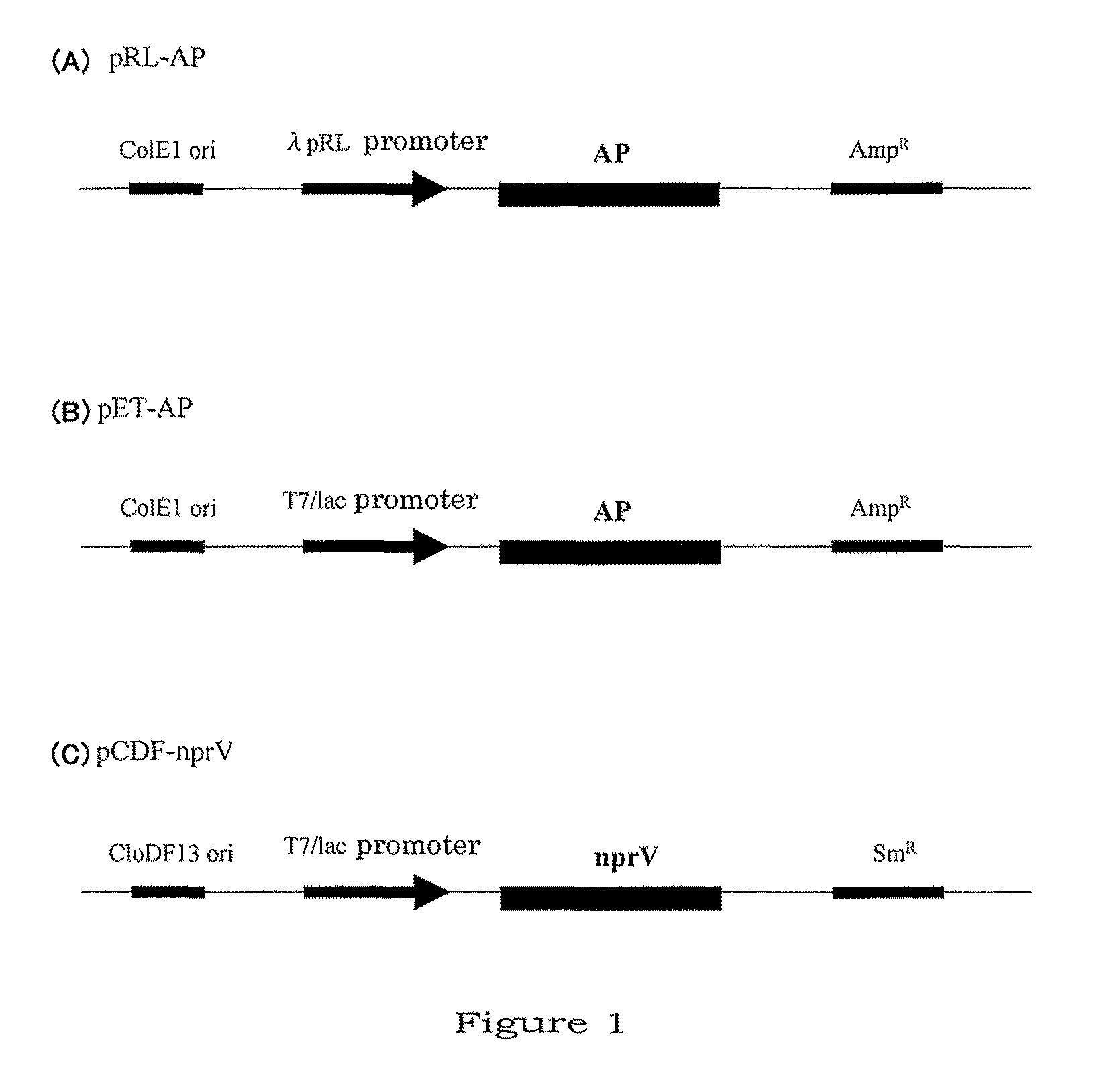
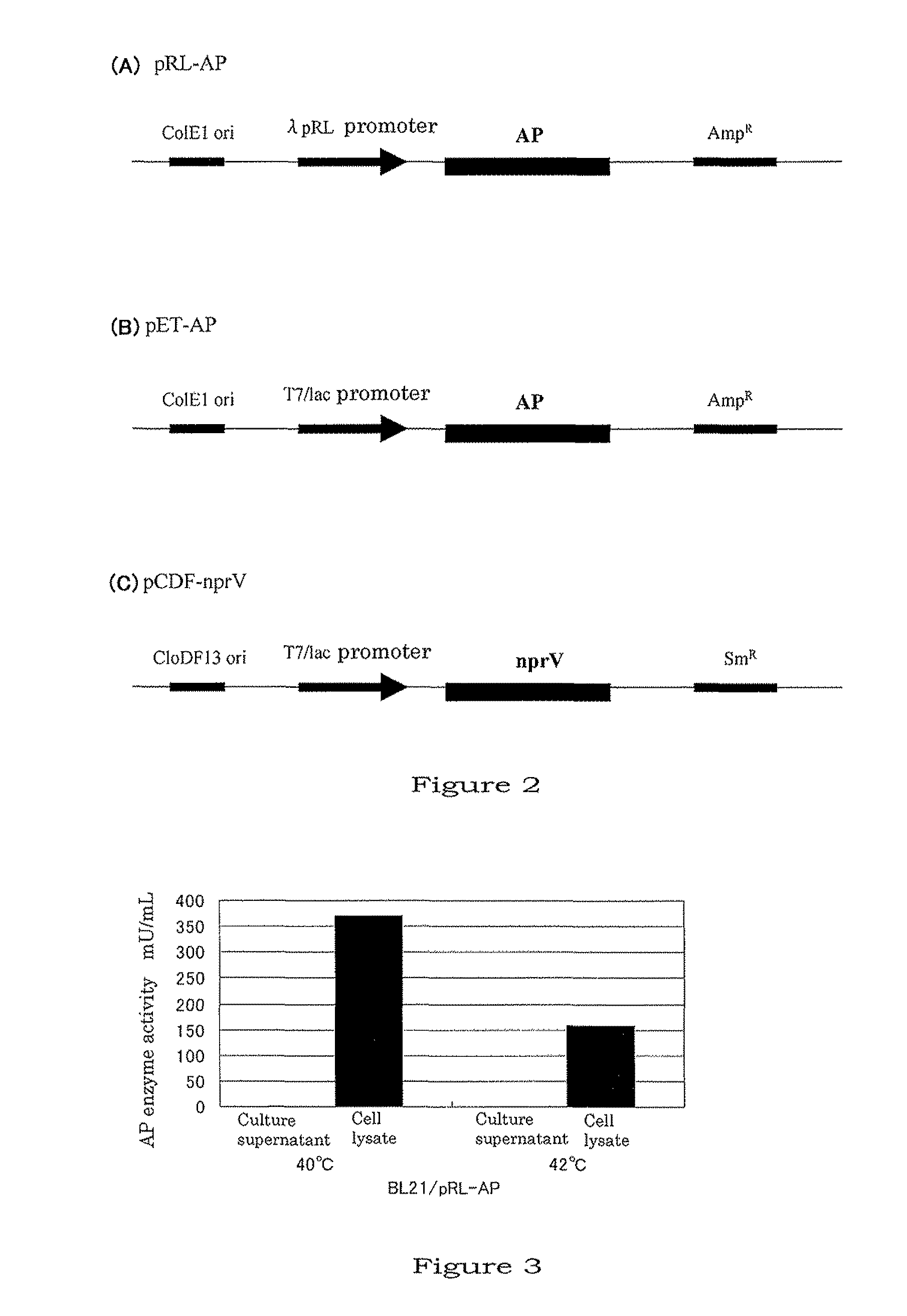
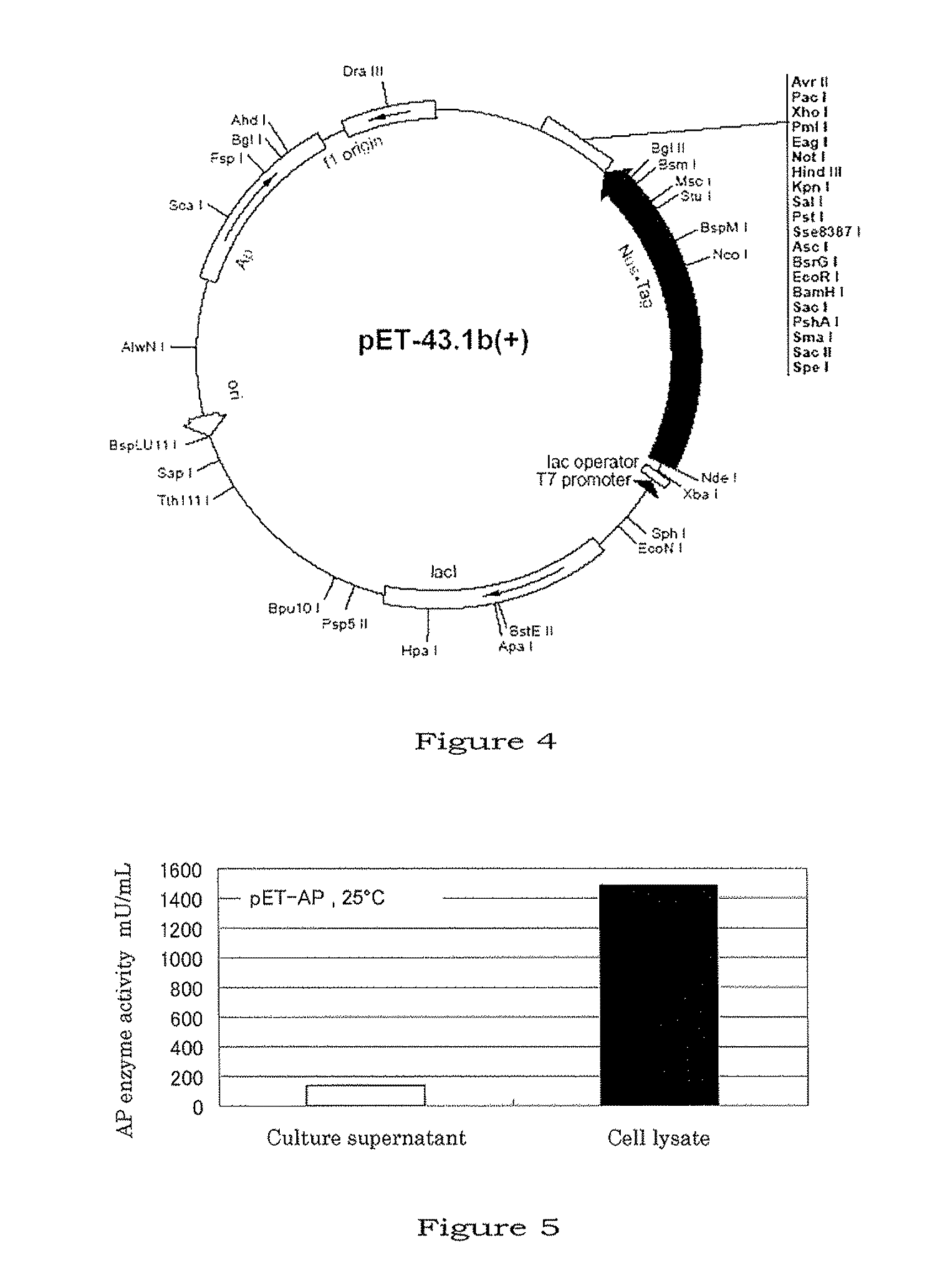
Examples
reference example 1
Production of Aminopeptidase Using Transformant E. coli
[0057]Genome DNA was prepared from V. proteolyticus, and aminopeptidase (AP) gene was cloned in the following manner.
[0058](1) Cloning of Aminopeptidase Gene
[0059]Using “GenElute Bacterial Genomic DNA kit” (Sigma, No. NA2100), genome DNA was extracted from 3.0 mL of the culture of V. proteolyticus cells which had been cultured overnight (14 hrs) at 26° C. in a medium containing 0.8% Nutrient Broth (Difco, No. 234000) and 3.0% NaCl (for specific procedures, the instruction included in the kit was followed). Using the genome DNA thus extracted as a template, aminopeptidase (AP) gene was amplified by PCR using two primers (below) (reaction conditions: 94° C.: 2 min, then 30 cycles of 94° C.: 15 sec, 55° C.: 30 sec, and 68° C.: 90 sec; and then 68° C.: 7 min), and the amplification product thus obtained was ligated to the cloning vector pGEM-T easy (mftd. by Promega).
[0060]
primer BaRBFL41:(SEQ ID NO: 1)CGGGATCCTAAGGAGGTTATCATATGAAA...
example 1
Co-Expression of Neutral Protease and Aminopeptidase
[0082]The present inventors attempted to let nprV and AP co-express in E. coli in the following manner.
[0083](1) Cloning of Vibriolysin (nprV) Gene
[0084]The nucleotide sequence encoding the neutral protease nprV (preproprotein) is shown as SEQ ID NO:11, and the corresponding amino acid sequence as SEQ ID NO:12, respectively. In SEQ ID NO:11, nucleotides 1-72 encode the signal sequence, nucleotides 73-588 the propeptide sequence, and nucleotides 589-1830 the mature protein, respectively. In SEQ ID NO:12, amino acids 1-24 constitute the signal sequence, amino acids 25-196 the propeptide, and amino acids 197-609 the protein claimed herein, respectively.
[0085]Using the genome DNA prepared in the section “(1) Cloning of aminopeptidase gene” as a template, nprV gene was cloned by PCR in the following manner. PCR was performed using Blend Taq-plus (TOYOBO, BTQ-201). The oligonucleotides of the following sequences were used as primers.
[008...
example 2
Co-Expression of Mutant-Type Neutral Protease and Aminopeptidase
[0097](1) Preparation of Mutant-Type Neutral Protease
[0098]Mutation was randomly introduced into nprV to obtain a mutant-type nprV which can be steadily expressed in E. coli as in an active form (named nprV-R). That is, an XL1-Red mutant strain (Stratagene, Cat #200129) in which mutation can be induced in vivo was used for performing random introduction of mutation. The XL1-Red mutant strain was transformed with pCDF-nprV, which was the nprV expression vector prepared above, and with thus obtained transformant, the agar+40 μg / mL Sm plates were inoculated. After a 24-hr culture at 37° C., 300 colonies were picked up and planted in 10 mL of LB+40 μg / mL Sm, and following an 18-hour culture at 37° C., plasmids were purified by the alkali-SDS method. BL21(DE3) cells were transformed with these plasmids, and LB agar+1.5% skimmed milk+40 μg / mL Sm+1 mM IPTG plates were inoculated with the cells (15 mm plate×2). After a 16-hour ...
PUM
| Property | Measurement | Unit |
|---|---|---|
| temperature | aaaaa | aaaaa |
| temperature | aaaaa | aaaaa |
| temperature | aaaaa | aaaaa |
Abstract
Description
Claims
Application Information
 Login to View More
 - R&D
- Intellectual Property
- Life Sciences
- Materials
- Tech Scout
- Unparalleled Data Quality
- Higher Quality Content
- 60% Fewer Hallucinations
Browse by: Latest US Patents, China's latest patents, Technical Efficacy Thesaurus, Application Domain, Technology Topic, Popular Technical Reports.
© 2025 PatSnap. All rights reserved.Legal|Privacy policy|Modern Slavery Act Transparency Statement|Sitemap|About US| Contact US: help@patsnap.com