Unlock instant, AI-driven research and patent intelligence for your innovation.

Synthesis of nanoparticles by an emulsion-gas contacting process

a technology of emulsion gas and nanoparticles, which is applied in the direction of colloidal chemistry, sulfur compounds, selenium/tellurium compunds, etc., can solve the problems of inability to isolate particles with specific, pre-determined particle sizes, and inability to control particle size distribution in such reactors. achieve easy scale-up for industrial production, and precise control of nanoparticle size

Active Publication Date: 2014-10-14
THE RES FOUND OF STATE UNIV OF NEW YORK
View PDF48 Cites 0 Cited by
  • Summary
  • Abstract
  • Description
  • Claims
  • Application Information

AI Technical Summary

Benefits of technology

The processes described in this patent have advantages over current methods for creating nanoparticles and nanoparticle-loaded emulsions. These advantages include precise control over nanoparticle size, easy incorporation of functional units, and scalability. The nanoparticles created can have properties that make them useful in various applications, such as in bioengineering, pharmaceutics, and optical data storage and processing. Overall, this patent presents a unique method for synthesizing nanoparticles and related materials with controlled size, functionalization, and scalability.

Problems solved by technology

Most of these techniques suffer from lack of precision in controlling particle size and properties.
It is difficult to control particle size distributions in such reactors and almost impossible to isolate particles with a specific, pre-determined particle size.
Using this approach, post-processing and functionalization requires many additional steps that can compromise the quality of the particles.
Further, the technique cannot be scaled-up easily for industrial production.
Such conditions are difficult to achieve and selective precipitation techniques are used after synthesis to narrow down the size distribution of the nanocrystals (Murray et al., Annu. Rev. Mater. Sci.

Method used

the structure of the environmentally friendly knitted fabric provided by the present invention; figure 2 Flow chart of the yarn wrapping machine for environmentally friendly knitted fabrics and storage devices; image 3 Is the parameter map of the yarn covering machine
View more

Image

Smart Image Click on the blue labels to locate them in the text.
Viewing Examples
Smart Image
  • Synthesis of nanoparticles by an emulsion-gas contacting process
  • Synthesis of nanoparticles by an emulsion-gas contacting process
  • Synthesis of nanoparticles by an emulsion-gas contacting process

Examples

Experimental program
Comparison scheme
Effect test

example 1

Synthesis and Size-Control of Luminescent ZnSe Nanocrystals by a Microemulsion-Gas Contacting Technique

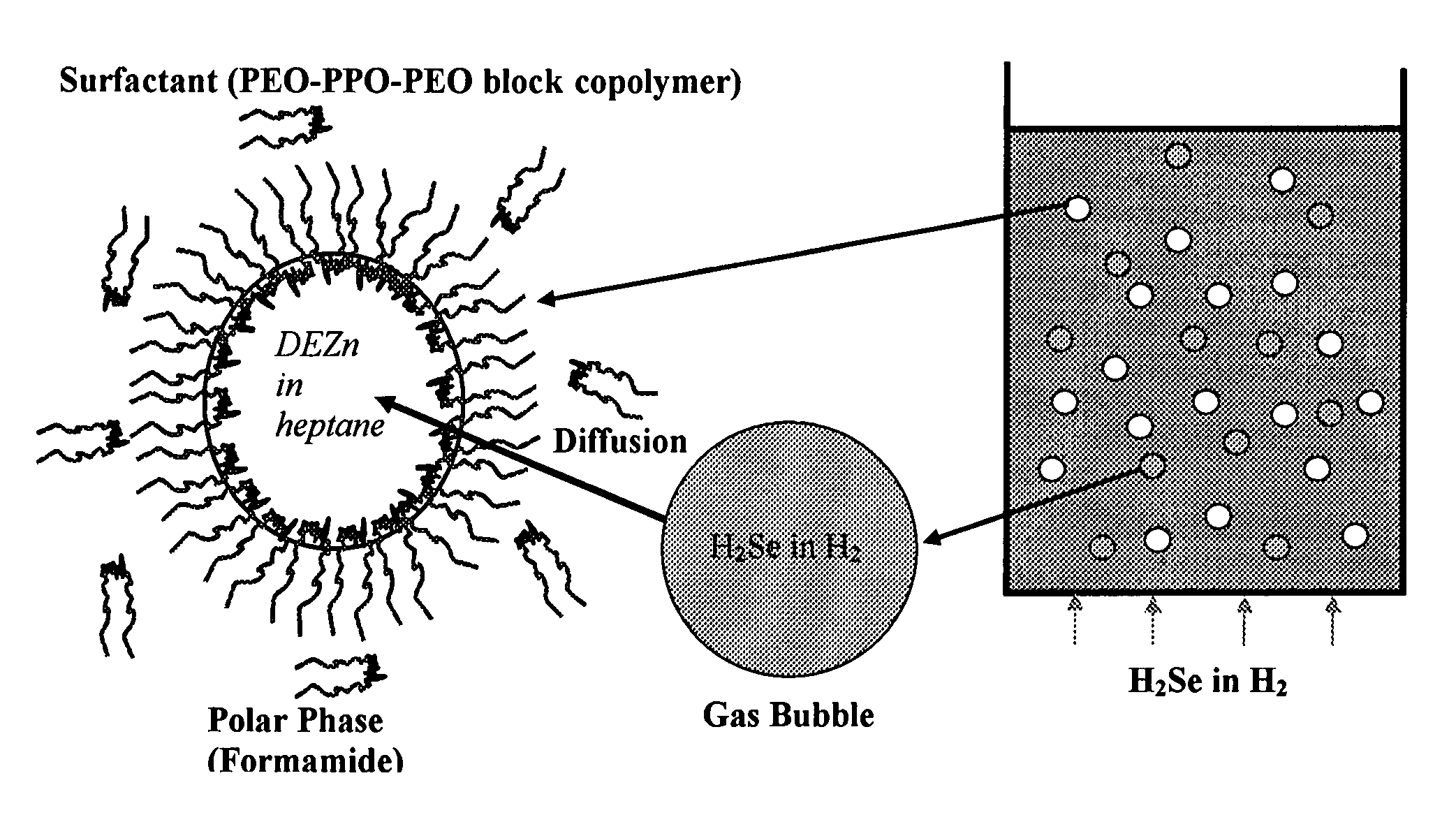
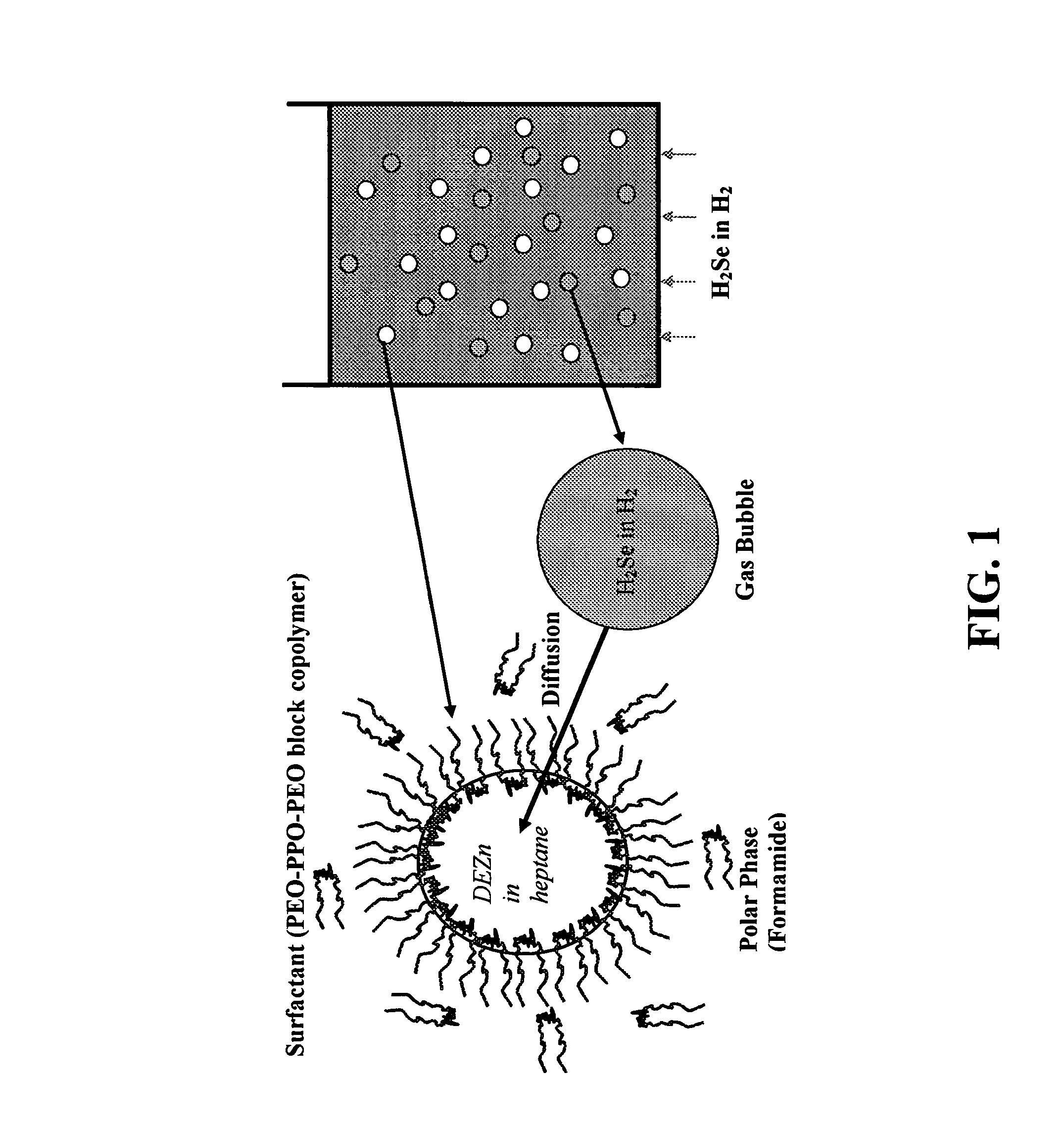
[0049]A schematic representation of one embodiment of emulsion-gas contacting technique of the present invention is shown in FIG. 1. A microemulsion was formed by self assembly using a solution of diethylzinc ((C2H5)2Zn) in n-heptane (n-C7H16) as the dispersed oil phase, formamide (CH3NO) as the polar continuous phase, and an amphiphilic block copolymer, poly(ethylene oxide)-poly(propylene oxide)-poly(ethylene oxide) or PEO-PPO-PEO, as the surfactant. PEO is the formamide-soluble block and PPO the heptane-soluble block (Alexandridis et al., Macromolecules 33:3382 (2000), which is hereby incorporated by reference in its entirety). PEO-PPO block copolymers represent an exciting class of amphiphilic molecules with high versatility, in terms of self-assembly and corresponding practical applications (Alexandridis et al., Eds. Amphiphilic Block Copolymers: Self-Assembly and Applications,...

example 2

Evaluation of Synthesis and Size-Control of Luminescent CdSe Nanocrystals by a Microemulsion-Gas Contacting Technique

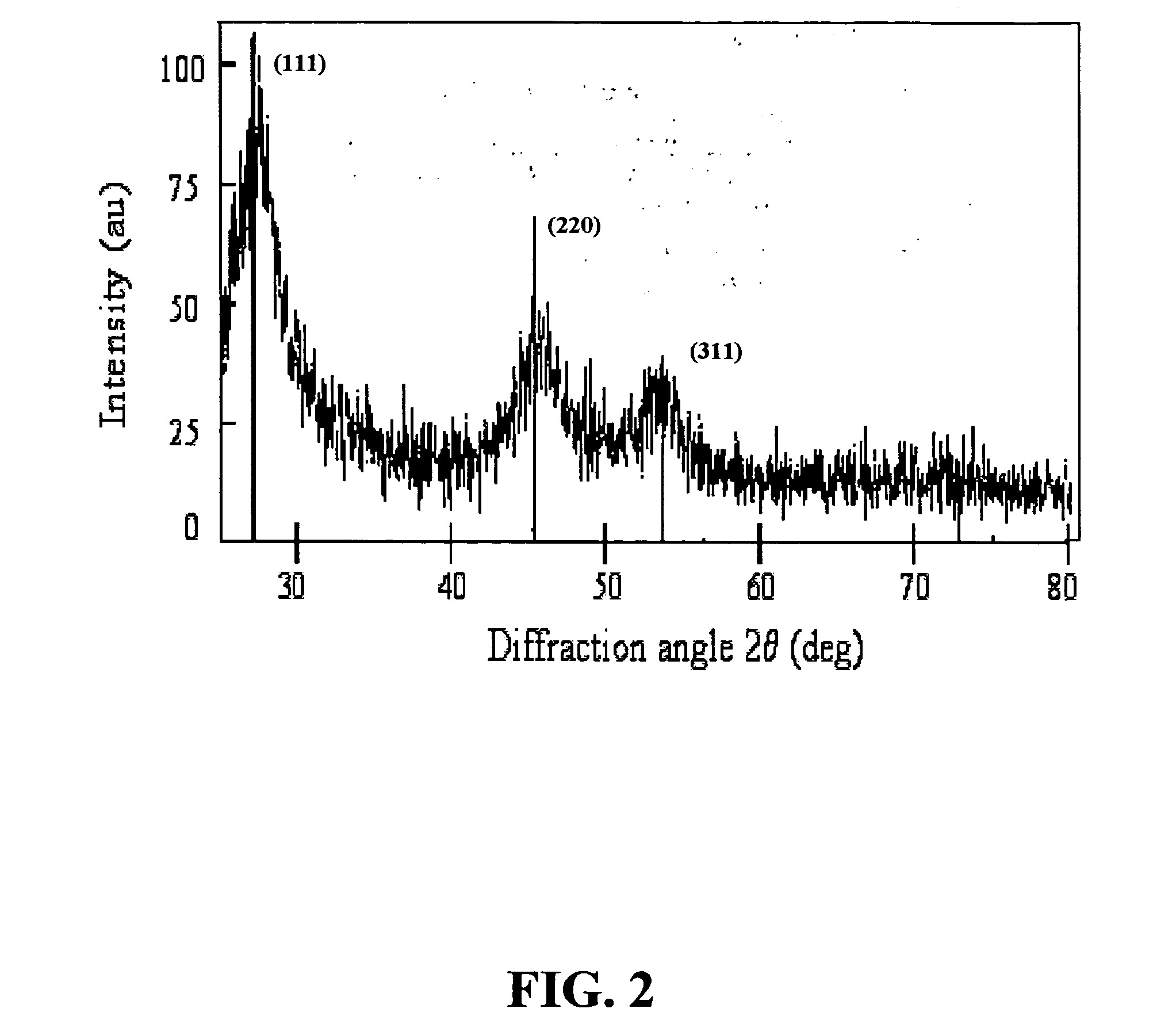
[0059]The microemulsion-gas contacting technique of the present invention has been extended to CdSe nanocrystal synthesis. X-ray diffraction patterns obtained from CdSe particles synthesized by bubbling hydrogen selenide diluted in hydrogen through a dimethylcadmium solution in heptane at room temperature confirm the formation of cubic CdSe. A microemulsion was formed by self assembly using a solution of dimethylcadmium ((CH3)2Cd) in n-heptane (n-C7H16) as the dispersed oil phase, formamide (CH3NO) as the polar continuous phase, and an amphiphilic block copolymer, poly(ethylene oxide)-poly(propylene oxide)-poly(ethylene oxide) or PEO-PPO-PEO, as the surfactant. PEO is the formamide-soluble block and PPO the heptane-soluble block (Alexandridis et al., Macromolecules 33:3382 (2000), which is hereby incorporated by reference in its entirety). PEO-PPO block copolymers rep...

the structure of the environmentally friendly knitted fabric provided by the present invention; figure 2 Flow chart of the yarn wrapping machine for environmentally friendly knitted fabrics and storage devices; image 3 Is the parameter map of the yarn covering machine
Login to View More

PUM

PropertyMeasurementUnit
diameteraaaaaaaaaa
diameteraaaaaaaaaa
diameteraaaaaaaaaa
Login to View More

Abstract

The present invention is directed to a process for synthesizing nanoparticles. This process involves providing a stable emulsion containing a plurality of droplets suspended in a continuous phase. The droplets, which are encapsulated by an interfacially-active material, contain a first reactant dissolved in a dispersed phase. The process also involves contacting a gas phase containing a second reactant diluted in a carrier gas with the stable emulsion under conditions effective to permit the first reactant and second reactant to react and form nanoparticles. The present invention further relates to nanoparticle-loaded emulsions and their uses in formulations for various purposes.

Description

[0001]This application claims the benefit of U.S. Provisional Patent Application Ser. No. 60 / 467,975, filed May 5, 2003, which is hereby incorporated by reference in its entirety.FIELD OF THE INVENTION[0002]The present invention relates to a process for synthesizing nanoparticles using an emulsion-gas contacting process.BACKGROUND OF THE INVENTION[0003]A great variety of techniques are being used for the synthesis of nanoparticles of inorganic compounds. Most of these techniques suffer from lack of precision in controlling particle size and properties. The current state of the art in the synthesis of semiconductor nanocrystals involves the use of high temperature batch reactors. This process uses a hot coordinating solvent, such as hexadecylamine and trioctyl-phosphine, in which the reactants are injected with a syringe. Particles grow as a function of time and samples are taken at specific times to obtain populations of a certain average size. It is difficult to control particle si...

Claims

the structure of the environmentally friendly knitted fabric provided by the present invention; figure 2 Flow chart of the yarn wrapping machine for environmentally friendly knitted fabrics and storage devices; image 3 Is the parameter map of the yarn covering machine
Login to View More

Application Information

Patent Timeline
no application Login to View More
Patent Type & Authority Patents(United States)
IPC IPC(8): A61K9/14B82Y5/00C01B17/00B01J13/02B82Y30/00C01B19/00C01G1/02C01G1/12C01G9/08C01G11/02C01G21/21
CPCB82Y30/00C01G1/02C01G9/08C01B19/007C01G21/21C01G11/02B01J13/02C01G1/12C01P2004/64C01P2004/62C01P2002/72C01P2004/04Y10S977/70
Inventor MOUNTZIARIS, TRIANTAFILLOS J.ALEXANDRIDIS, PASCHALIS
Owner THE RES FOUND OF STATE UNIV OF NEW YORK