Check patentability & draft patents in minutes with Patsnap Eureka AI!

Automated sample-to-microarray apparatus and method

a microarray and automatic technology, applied in the field of biological sample processing and identification, can solve the problems of microarray technology requiring costly and cumbersome equipment, bioterrorism adding the threat, and limited number of pathogens to d

Inactive Publication Date: 2015-02-24
THE UNITED STATES OF AMERICA AS REPRESENTED BY THE SECRETARY OF THE NAVY
View PDF4 Cites 0 Cited by
  • Summary
  • Abstract
  • Description
  • Claims
  • Application Information

AI Technical Summary

Benefits of technology

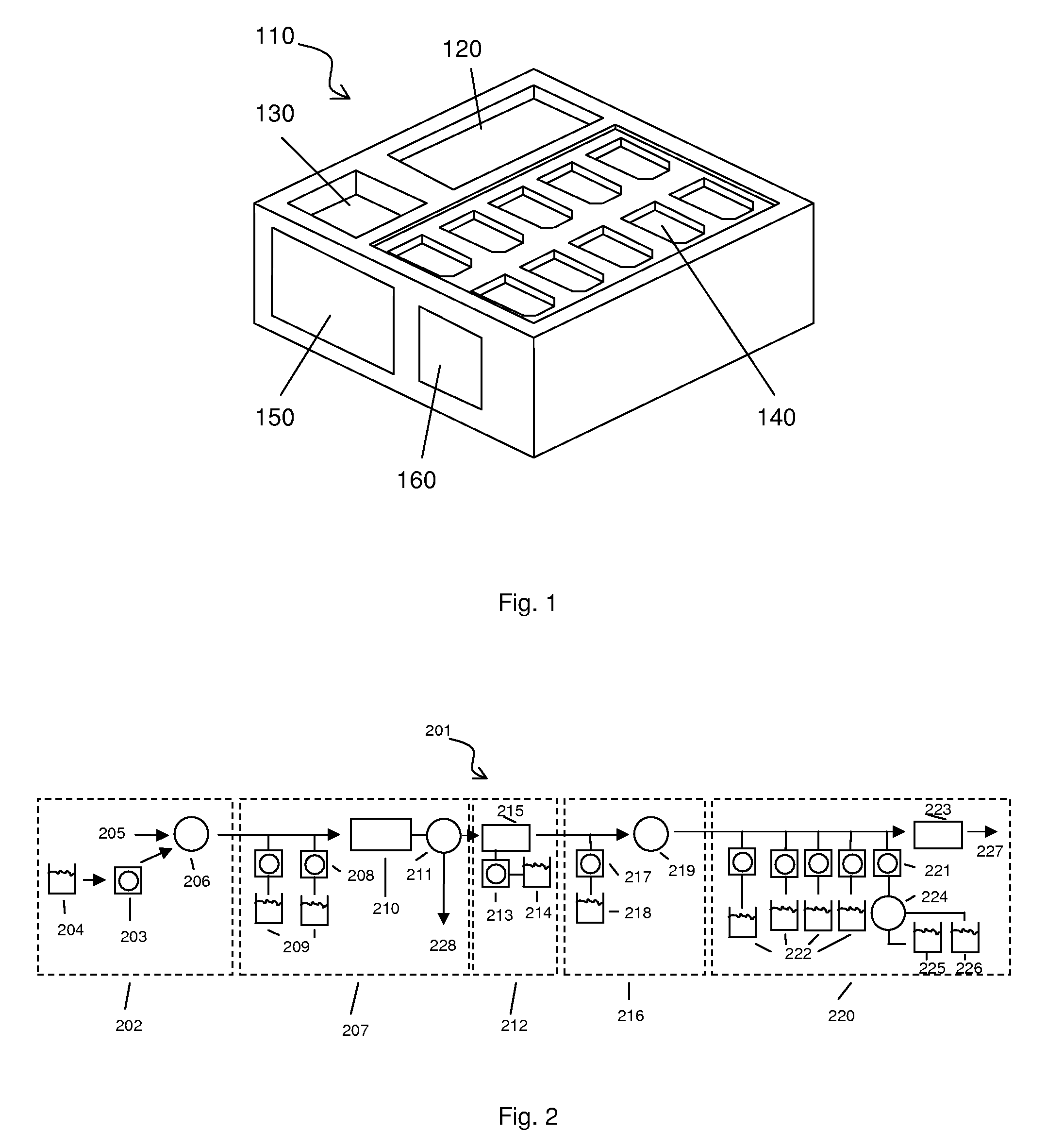
The invention is a device that is capable of processing liquid biological samples to detect and analyze their content. The device includes a housing, various components for accessing and processing the sample, and a microarray for detecting specific molecules. The device can also be connected to a pumping system to transfer the processed sample to other components. Overall, the device provides a convenient and efficient way to process and analyze liquid samples for research and diagnostic purposes.

Problems solved by technology

In addition to naturally occurring pathogens, bioterrorism adds the threat from unexpected pathogens which can masquerade as a common respiratory infection.
High density nucleic acid microarrays can have hundreds of thousands of spots, so that the number of pathogens possible to detect becomes limited by the ability to perform generic or highly multiplexed PCR amplifications.
Microarray technology can require costly and cumbersome equipment to perform assays and significant technical expertise from the operators.
Handling exposed GeneChips in the field can be difficult, especially when transferring them outside of the device between the hybridization and scanning steps.
The automated hybridization, washing, and staining steps were not suitable for the point-of-care diagnostic applications for a number of reasons.
First, the hybridization demonstrated by Liu et al. required 18 hours, which is far too long for rapid diagnostics.
Furthermore, significant evaporative losses were incurred by the mixing process used in this device, resulting in the loss of hybridization stringency and requiring the use of a high humidity atmosphere to minimize losses.
Finally, the feature size of the CombiMatrix chips is limited, and they do not possess the re-sequencing capabilities that other commercial platforms do.
However, this device did not perform any downstream operations such as PCR or analysis.

Method used

the structure of the environmentally friendly knitted fabric provided by the present invention; figure 2 Flow chart of the yarn wrapping machine for environmentally friendly knitted fabrics and storage devices; image 3 Is the parameter map of the yarn covering machine
View more

Image

Smart Image Click on the blue labels to locate them in the text.
Viewing Examples
Smart Image
  • Automated sample-to-microarray apparatus and method
  • Automated sample-to-microarray apparatus and method
  • Automated sample-to-microarray apparatus and method

Examples

Experimental program
Comparison scheme
Effect test

example 1

Hybridization, Staining, and Washing

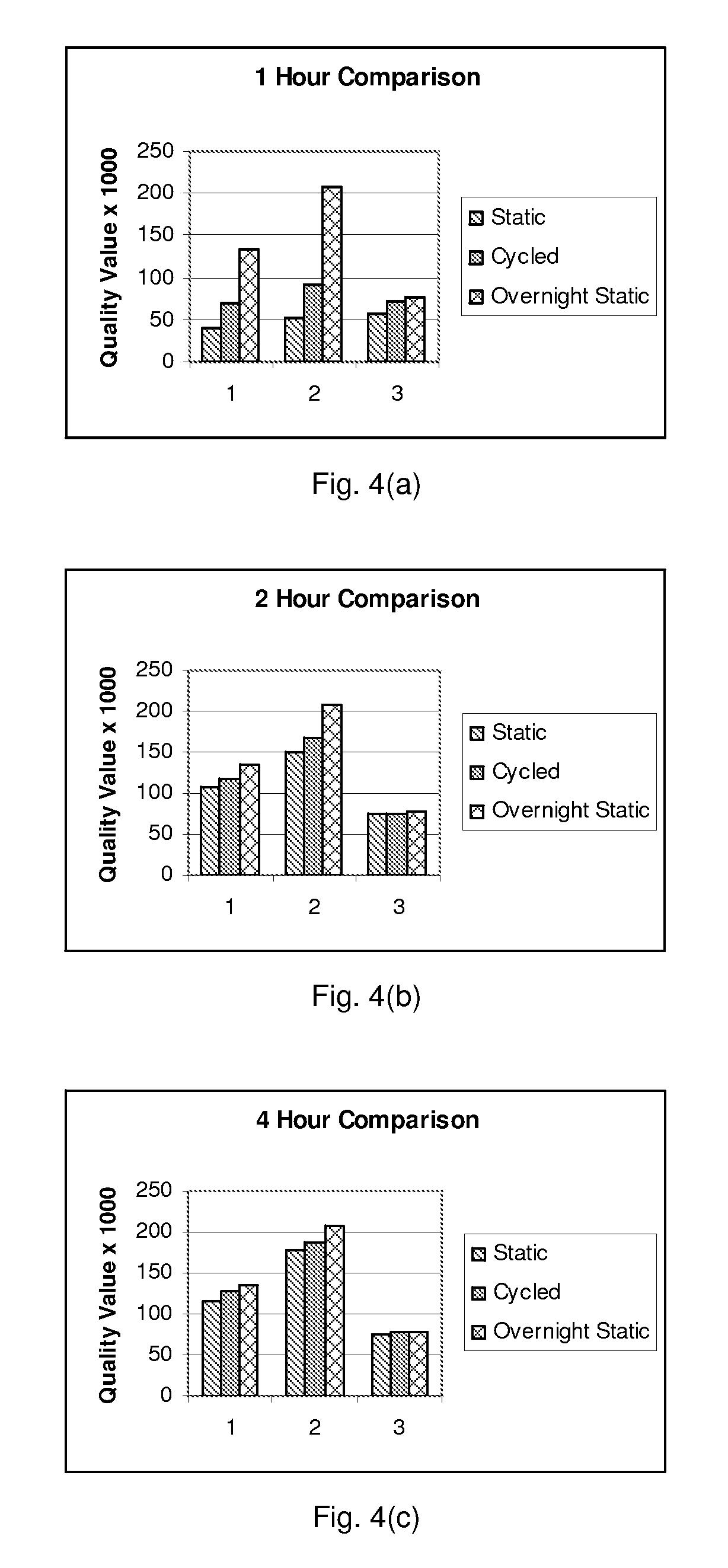
[0073]A “hyb-wash-stain component”, has been demonstrated to expedite the processing of commercial microarrays. Affymetrix resequencing GeneChips designed for the detection of upper respiratory pathogens were used. The normal procedure for processing these chips is as follows: (1) Inject a sample containing biotinylated DNA and incubate in an Affymetrix rotisserie oven for 2-16 hours. Mixing is accomplished as an air bubble tumbles across the surface of the microarray. (2) Remove the hybridization mixture. (3) Stain and wash using a 3-step staining procedure in an Affymetrix wash station for 1.5 hours. (4) Image on a confocal scanner. While these protocols are acceptable for large centralized laboratories with trained technicians, they may not be optimal for portable devices for point-of-care diagnostics. If commercially produced nucleic acid microarrays are to be used in portable biosensors, it may be useful to design miniaturized and integrated ...

example 2

Lysis and Purification of Nucleic Acids

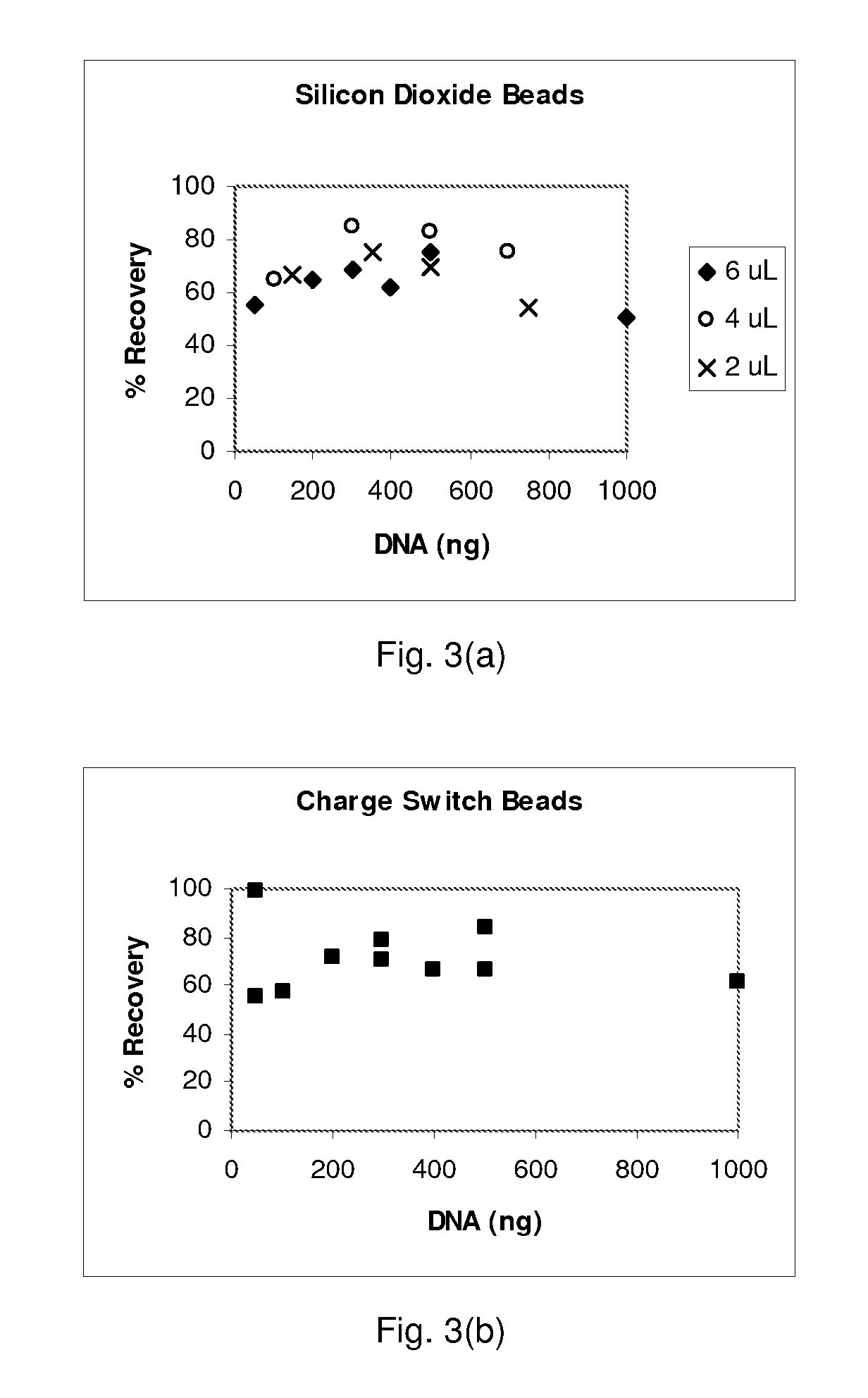
[0087]Reagents and materials: Binding buffer PB was obtained from Qiagen. PBS was made by mixing a powder packet from Sigma into 1 liter of nuclease-free water. MasterPure DNA purification kits came from Epicentre and were used according to the manufacture's recommended protocols. SDS solutions were made from a 10% SDS stock from Ambion. Human genomic DNA (Roche) used for testing bead extraction was first subjected to a restriction enzyme digestion (MCrBC enzyme, reagents, and protocol from a New England Biolabs kit). Three types of beads were tested: silicon dioxide powder with a size range from 200 nm to 10 μm (approximately 80% between 1-5 μm) obtained from Sigma, spherical silica gel with a size range of 40-75 μm obtained from Silicycle, and glass beads with a size range of 30-50 μm obtained from Polysciences. Nasal wash in sterile PBS was obtained from human volunteers and was not screened for other pathogens. The Sybr-green kit (Molecular...

example 3

Disposable Devices

[0104]FIGS. 5 and 6 schematically illustrate disposable components that are placed on a base device. The base contains the components for sonicating, pumping, and heating the sample in the various parts of the disposable device. The disposable device contains all the chambers, ports, and possibly reagent reservoirs or inputs. The fluidic paths are shown by arrows. The added reagents are labeled as follows. “Sample” is the sample input stream. “W” is a wash input line. “E” is the elution input line. “Waste” is one of the outlet lines from any module. “R1” is an input line for reverse transcriptase reagents. “R2” is an input line for PCR reagents and primers. “R3” is an input line for Fragmentation enzymes and buffers. “R4” is an input line for labeling reagents and buffers. “Prehyb” is an input line for the prehybridization buffer. “Hyb” is a cocktail containing the hybridization reagents. “W” is an input line for the wash buffer. “S1” is an input line for stain 1. ...

the structure of the environmentally friendly knitted fabric provided by the present invention; figure 2 Flow chart of the yarn wrapping machine for environmentally friendly knitted fabrics and storage devices; image 3 Is the parameter map of the yarn covering machine
Login to View More

PUM

PropertyMeasurementUnit
wt %aaaaaaaaaa
poweraaaaaaaaaa
powersaaaaaaaaaa
Login to View More

Abstract

An apparatus having within or as part of a housing; a sample port; a microarray port; a lysis module; a purification module for containing a solid phase for binding of oligonucleotides; a thermocycling module for containing a polymerase chain reaction; a fragmentation module; and a microarray module for holding a microarray and a liquid in contact with the microarray. The apparatus is configured to be coupled to a device for: pumping a liquid through, in order, the lysis, purification, thermocycling, fragmentation, and microarray modules; sonicating any contents of the lysis module; thermocycling the thermocycling module to perform the polymerase chain reaction; heating the fragmentation module to fragment any oligonucleotides contained therein; circulating a fluid over the surface of the microarray; and performing one or more washing or staining steps on the microarray.

Description

[0001]This application claims priority to U.S. Provisional Patent Application Nos. 60 / 735,876 filed on Nov. 14, 2005; 60 / 735,824 filed on Nov. 14, 2005; and 60 / 743,639, filed on Mar. 22, 2006, all incorporated herein by reference. This application is a continuation-in-part application of U.S. patent application Ser. No. 11 / 177,647, filed Jul. 2, 2005; Ser. No. 11 / 177,646, filed Jul. 2, 2005; Ser. No. 11 / 268,373, filed on Nov. 7, 2005; Ser. No. 11 / 422,425, filed on Jun. 6, 2006; and Ser. No. 11 / 422,431, filed on Jun. 6, 2006, all incorporated herein by reference. These nonprovisional applications claim priority to U.S. Provisional Patent Application Nos. 60 / 590,931, filed on Jul. 2, 2004; 60 / 609,918, filed on Sep. 15, 2004; 60 / 626,500, filed on Nov. 5, 2004; 60 / 631,437, filed on Nov. 29, 2004; 60 / 631,460, filed on Nov. 29, 2004; and 60 / 691,768, filed on Jun. 16, 2005, all incorporated herein by reference.FIELD OF THE INVENTION[0002]The invention is generally related to biological sam...

Claims

the structure of the environmentally friendly knitted fabric provided by the present invention; figure 2 Flow chart of the yarn wrapping machine for environmentally friendly knitted fabrics and storage devices; image 3 Is the parameter map of the yarn covering machine
Login to View More

Application Information

Patent Timeline
no application Login to View More
Patent Type & Authority Patents(United States)
IPC IPC(8): G06F19/20C12Q1/68C12M1/34B01L3/00B01L7/00G01N35/00
CPCB01L3/5027B01L7/52B01L2200/10B01L2300/0636B01L2300/087B01L2300/1827B01L2400/0481B01L2400/0487G01N2035/00158
Inventor LIGLER, FRANCES SSTENGER, DAVID AERICKSON, JEFFARCHER, MARIE
Owner THE UNITED STATES OF AMERICA AS REPRESENTED BY THE SECRETARY OF THE NAVY
Features
  • R&D
  • Intellectual Property
  • Life Sciences
  • Materials
  • Tech Scout
Why Patsnap Eureka
  • Unparalleled Data Quality
  • Higher Quality Content
  • 60% Fewer Hallucinations
Social media
Patsnap Eureka Blog
Learn More