
Semiconductor nanocrystal-polymer composite, method of preparing the same, and composite film and optoelectronic device including the same
a technology of semiconductor nanocrystal and composite film, which is applied in the field of semiconductor nanocrystalpolymer composite, composite film and optoelectronic device including the same, can solve the problems of reducing device efficiency, ligand loss on the surface of semiconductor nanocrystal, and undesirable aggregate of semiconductor nanocrystal, so as to improve device efficiency and thermal stability
- Summary
- Abstract
- Description
- Claims
- Application Information
AI Technical Summary
Benefits of technology
Problems solved by technology
Method used
Image

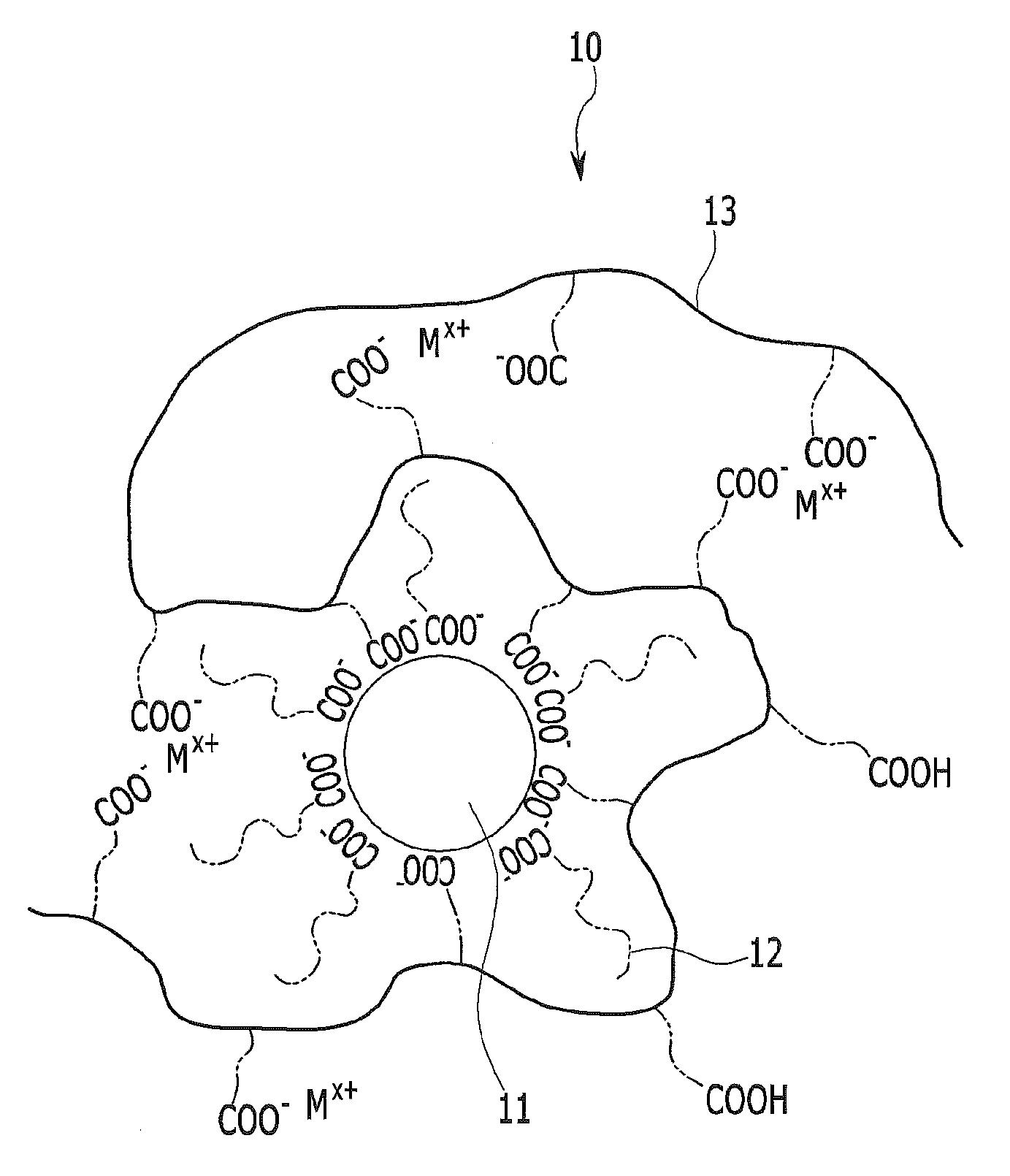
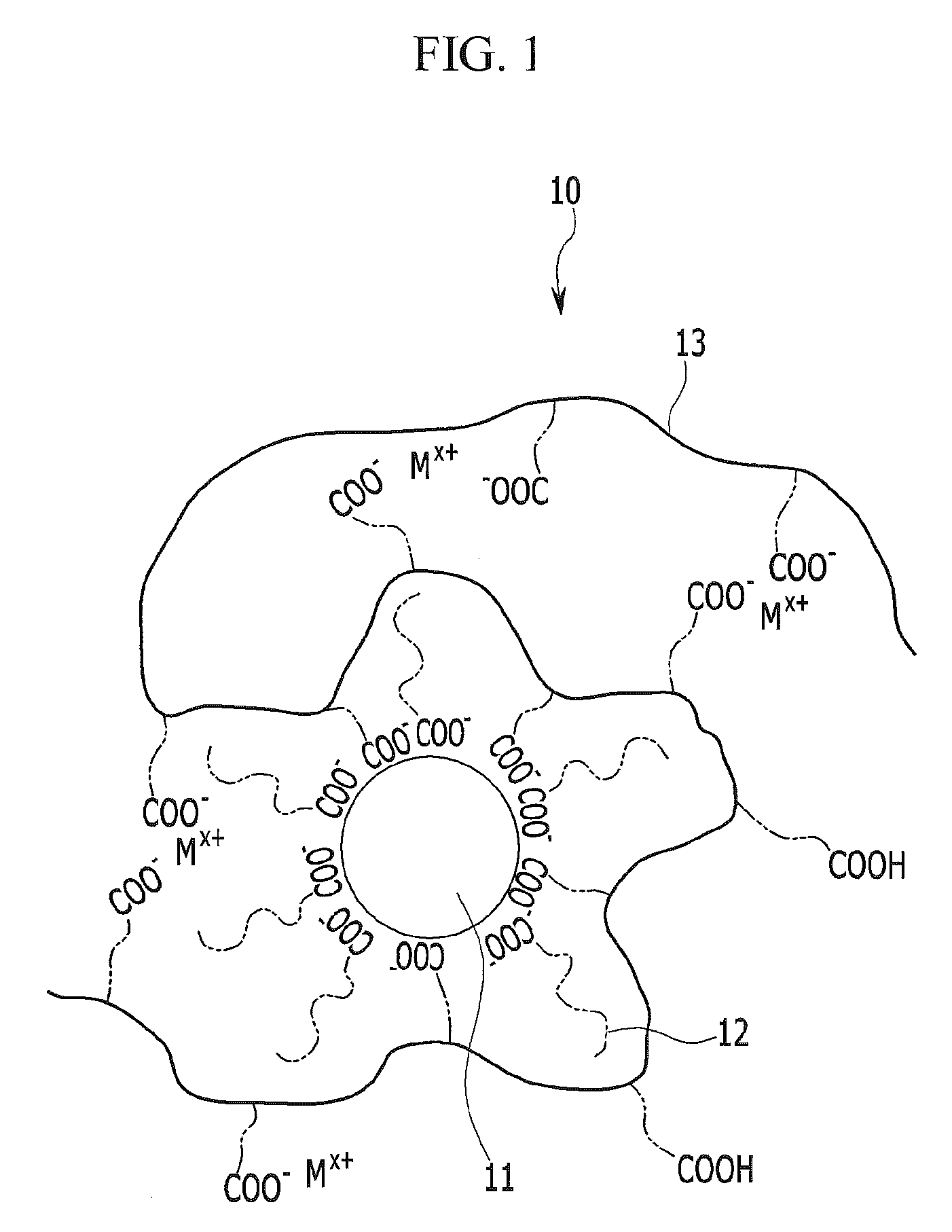
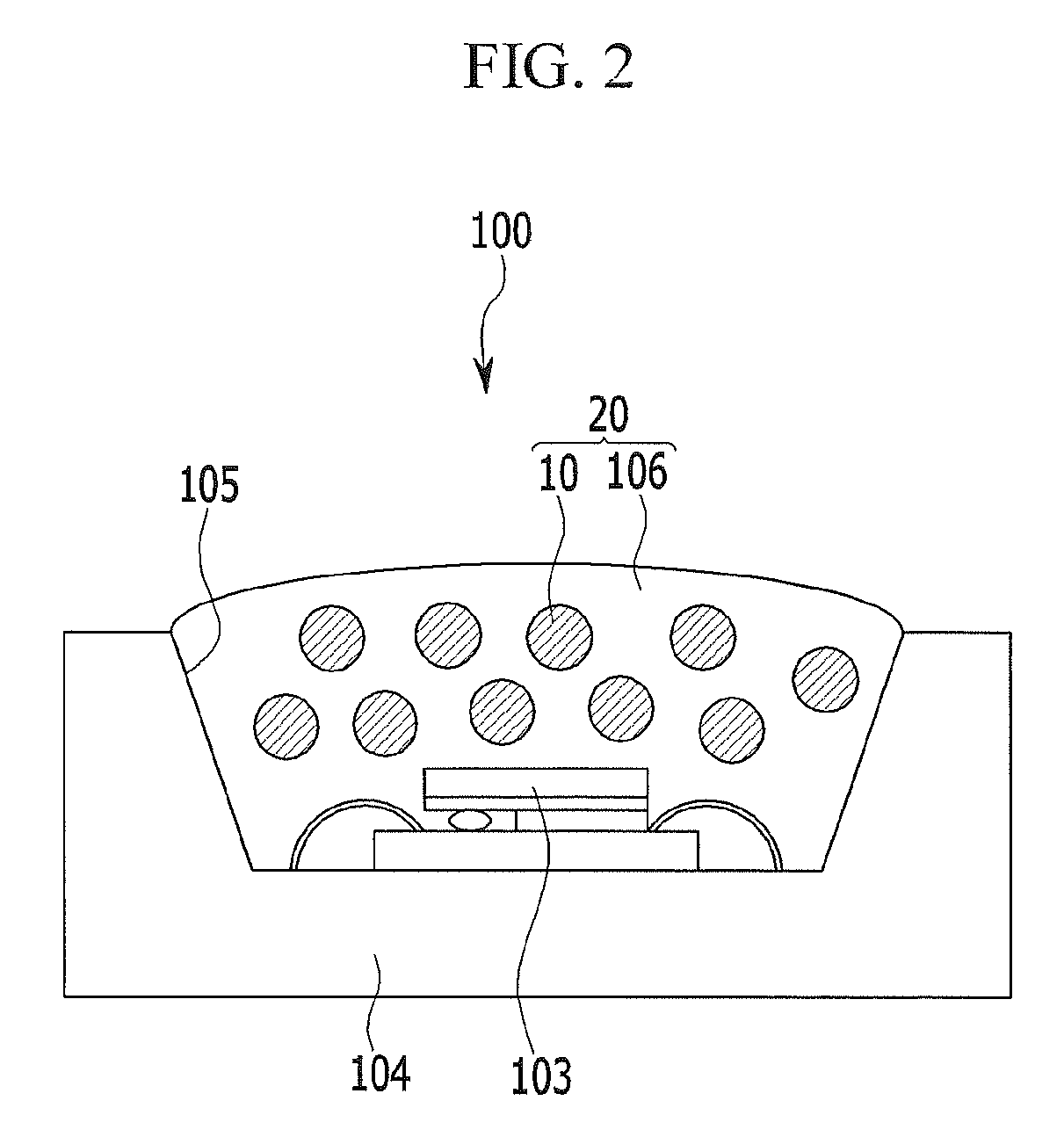
Examples
preparation example 1
Synthesis of Semiconductor Nanocrystal
[0214]About 16 grams (g) of trioctylamine (hereinafter referred to as “TOA”), about 0.3 g of octadecyl phosphonic acid, and 0.4 millimole (mmol) of cadmium oxide are simultaneously introduced into a 125 milliliter (mL) flask mounted with a reflux condenser and under vacuum while undergoing agitation, and heated to about 120° C. Then, after the temperature reaches about 120° C., nitrogen is flowed therein and the reaction temperature is controlled to about 300° C.
[0215]Separately, Se powder is dissolved in trioctylphosphine (TOP) to provide a 2 molar (M) Se-TOP complex solution. About 2 mL of the 2 M Se-TOP complex solution is quickly injected into the reaction mixture that is agitated at about 300° C. and reacted for about 2 minutes.
[0216]After completing the reaction, the temperature of the reaction mixture is cooled as quickly as possible to room temperature, ethanol (a non-solvent) is added, and the mixture centrifuged. The supernatant of the...
example 1
Preparation of Semiconductor Nanocrystal-Polymer Composite
[0221]1 g of poly(ethylene-co-acrylic acid) polymer (containing 5 wt % of polyacrylic acid units) and having a weight average molecular weight of 2000 Da is introduced in a flask with 4 mL of toluene and the mixture heated at 100° C. to provide a polymer dispersion. A CdSe / / ZnS / CdSZnS green semiconductor nanocrystal is dispersed in 40 mL of toluene until the absorption of the first absorption maximum wavelength has an optical density (OD) of 0.069 in a UV-Vis absorption spectrum to provide a semiconductor nanocrystal dispersion. 4 mL of the semiconductor nanocrystal dispersion is added into the polymer dispersion in a dropwise fashion and further reacted for 30 minutes. Then 5 mL of a solution, in which diethyl zinc (Zn(Et)2) is dissolved in toluene at a concentration of 0.2 M, is added in a dropwise fashion and the resulting mixture further heated for 30 minutes. The diethyl zinc solution is added such that Zn cations from Z...
example 2
Preparation of Semiconductor Nanocrystal-Polymer Composite
[0225]1 g of poly(ethylene-co-acrylic acid) polymer (containing polyacrylic acid units in an amount of 5 wt % of the polymer) having a weight average molecular weight of 2000 Da is introduced into a flask with 4 mL of trioctylamine (TOA) and heated at 120° C. to provide a polymer dispersion. A CdSe / / ZnS / CdSZnS green semiconductor nanocrystal is dispersed in 40 mL of trioctylamine until the absorption of the first absorption maximum wavelength has an optical density (OD) of 0.069 in a UV-Vis absorption spectrum to provide a semiconductor nanocrystal dispersion. 4 mL of the semiconductor nanocrystal dispersion is added into the polymer dispersion in a dropwise fashion and further reacted for 30 minutes. Then 5 mL of a solution in which diethyl zinc (Zn(Et)2) is dissolved in toluene at a concentration of 0.2 M is added in a dropwise fashion and the resulting mixture further heated for 30 minutes. The diethyl zinc solution is add...
PUM
| Property | Measurement | Unit |
|---|---|---|
| Tm | aaaaa | aaaaa |
| Tm | aaaaa | aaaaa |
| atomic numbers | aaaaa | aaaaa |
Abstract
Description
Claims
Application Information
 Login to View More