Method of depositing a ruthenium metal thin film or ruthenium oxide thin film
a technology of ruthenium oxide, which is applied in the field of depositing ruthenium metal thin film or ruthenium oxide thin film, can solve the problems of inapplicability to large-scale production, and achieve the effects of high step coverage, superior thermal stability, and high vapor pressur
- Summary
- Abstract
- Description
- Claims
- Application Information
AI Technical Summary
Benefits of technology
Problems solved by technology
Method used
Image

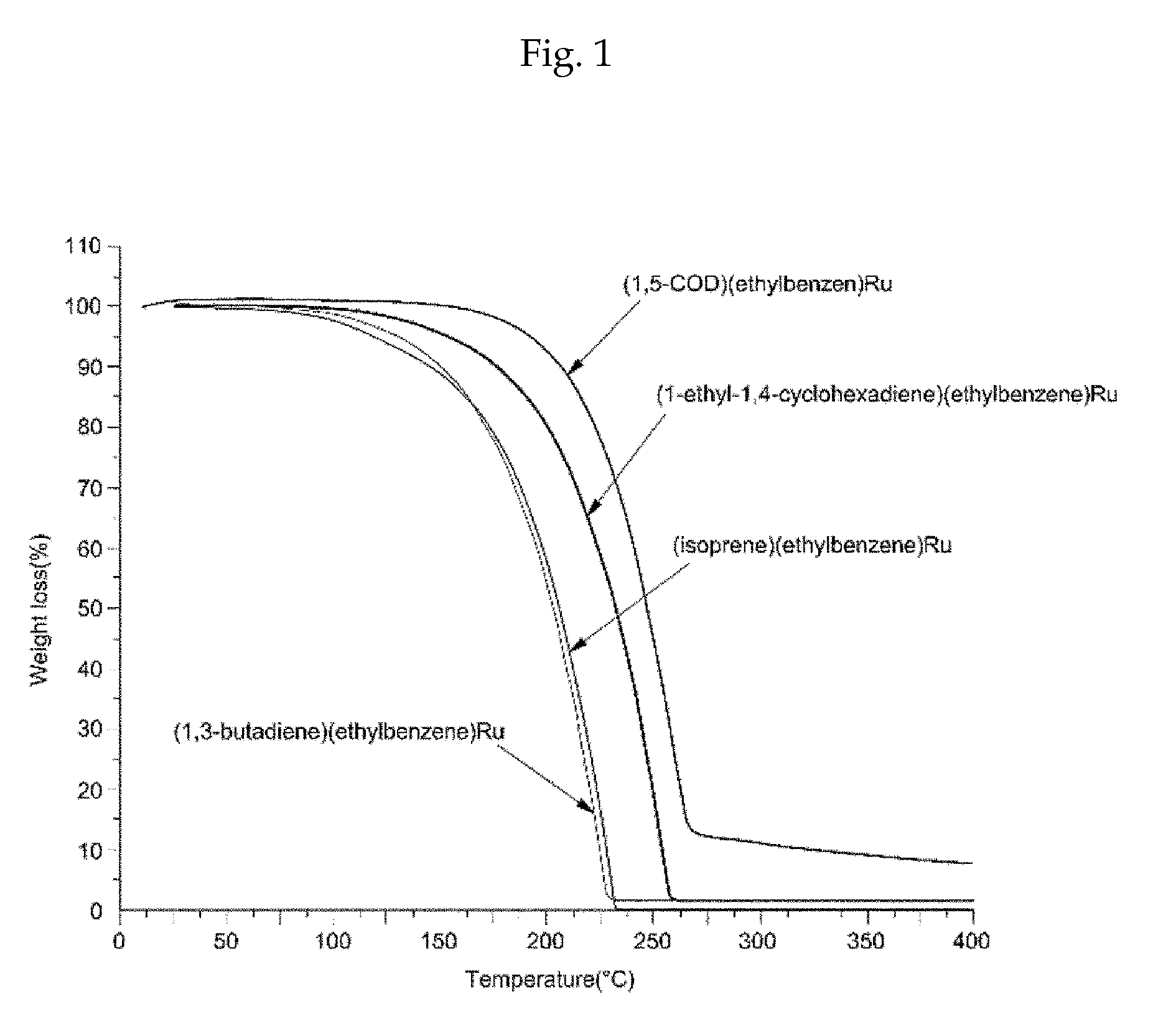
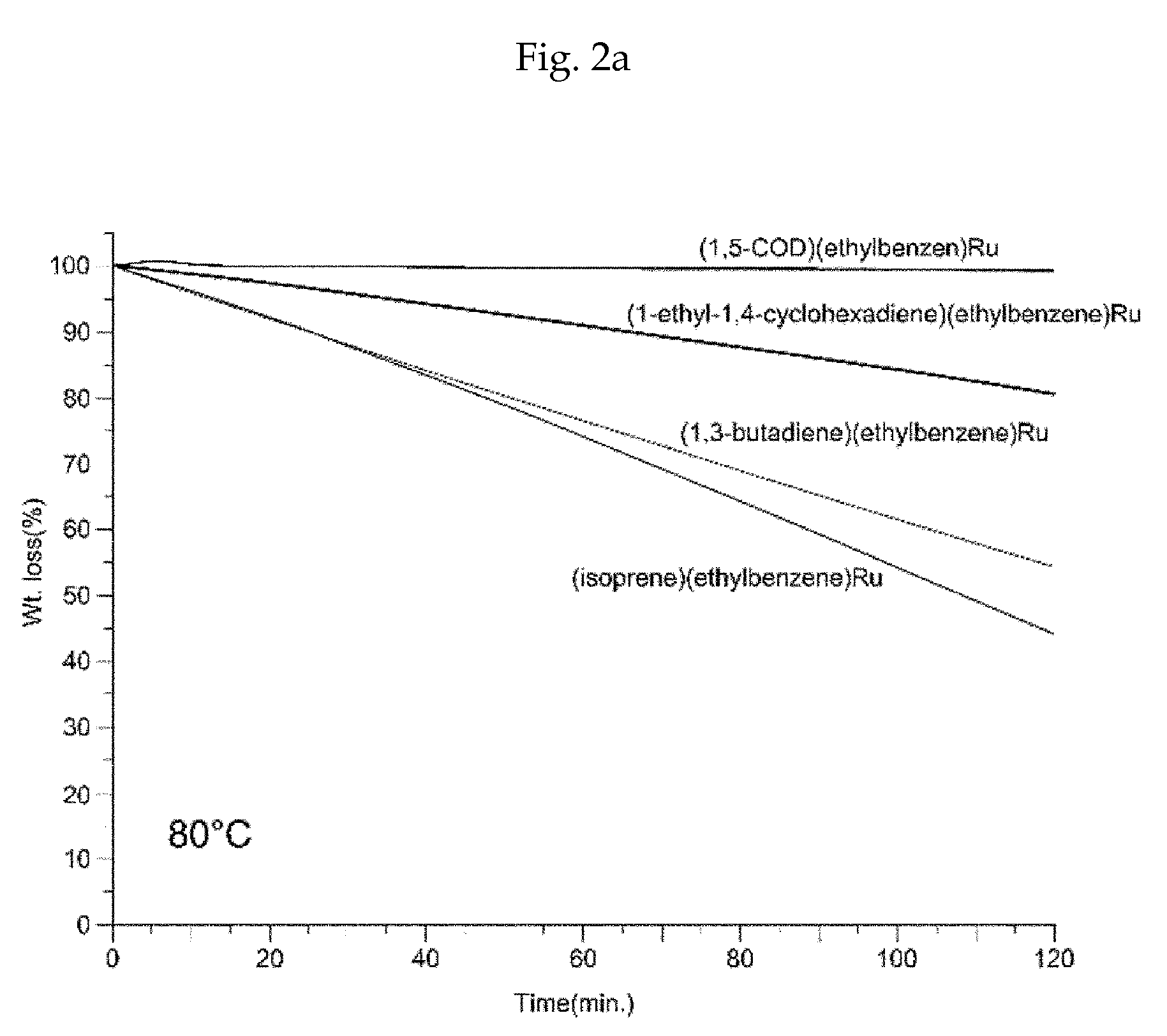
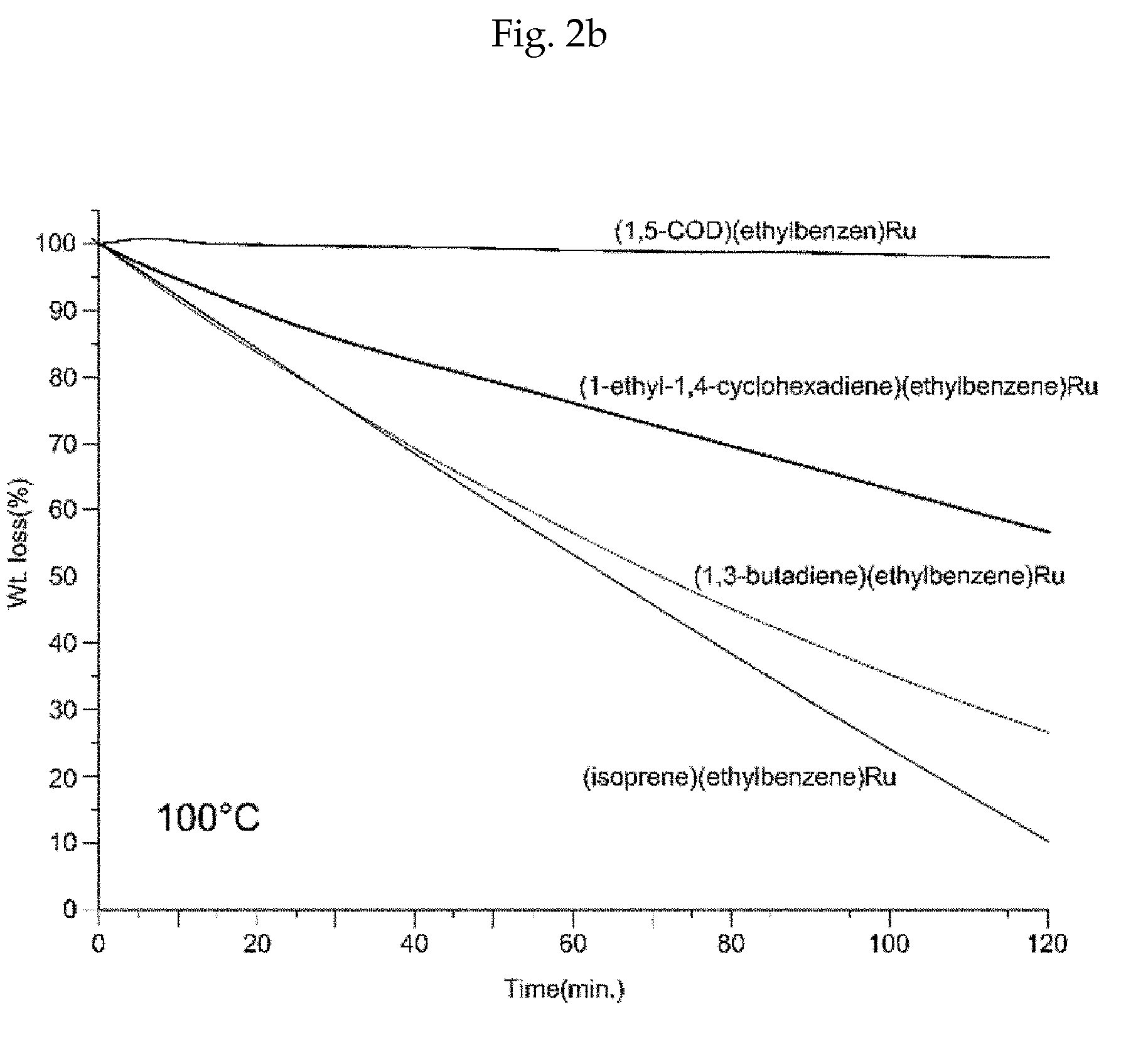
Examples
example 1
Preparation of (1-ethyl-1,4-cyclohexadiene)(ethylbenzene)ruthenium
[0033]The dimer ethylbenzene ruthenium dichloride (150 g, 0.27 mol) and sodium carbonate (Na2CO3) (284 g, 2.68 mol) were weighed into a 2-L branched round flask. After adding 2-propanol (1000 mL) and stirring, 1-ethyl-1,4-cyclohexadiene (116 g, 1.07 mol) was added dropwise to the resulting mixture using a dropping funnel. Then, reaction was conducted for 10 hours under reflux using a reflux condenser. Upon completion of the reaction, the resulting solution was filtered and the solvent and a volatile byproduct were removed under reduced pressure. After extraction with hexane, the solvent and the volatile byproduct were removed again under reduced pressure to obtain a viscous, dark reddish-brown solution. This liquid was distilled under reduced pressure to obtain 139 g (yield: 82%) of (1-ethyl-1,4-cyclohexadiene)(ethylbenzene)ruthenium as viscous yellow liquid.
[0034]Boiling point (b.p.): 116° C. / 0.23 torr.
[0035]Vapor pr...
example 2
Preparation of (1,3-butadiene)(ethylbenzene)ruthenium
[0037]The dimer ethylbenzene ruthenium dichloride (100 g, 0.18 mol) and sodium carbonate (Na2CO3) (114 g, 1.08 mol) were weighed into a 1-L branched round flask. After adding 2-propanol (500 mL) and stirring, 1,3-butadiene (250 g, 4.62 mol) was bubbled into the resulting mixture. Then, reaction was conducted for 2 days under reflux using a reflux condenser. Upon completion of the reaction, the resulting solution was filtered and the solvent and a volatile byproduct were removed under reduced pressure. After extraction with hexane, the solvent and the volatile byproduct were removed again under reduced pressure to obtain a viscous, dark reddish-brown solution. This liquid was distilled under reduced pressure to obtain 59 g (yield: 57%) of (1,3-butadiene)(ethylbenzene)ruthenium as viscous yellow liquid.
[0038]Boiling point (b.p.): 88° C. / 1.2 torr.
[0039]1H-NMR (C6D6, ppm): δ 0.286 ([CH2═CHCH═CH2]—Ru, d, 2H), 0.958 ([CH3CH2C6H5]—Ru, tr...
example 3
Preparation of (isoprene)(ethylbenzene)ruthenium
[0040]The dimer ethylbenzene ruthenium dichloride (20 g, 0.036 mol) and sodium carbonate (Na2CO3) (13.09 g, 0.12 mol) were weighed into a 1-L branched round flask. After adding 2-propanol (150 mL) and stirring, isoprene (12.36 g, 0.18 mol) was added dropwise to the resulting mixture using a dropping funnel. Then, reaction was conducted for a day under reflux using a reflux condenser. Upon completion of the reaction, the resulting solution was filtered and the solvent and a volatile byproduct were removed under reduced pressure. After extraction with hexane, the solvent and the volatile byproduct were removed again under reduced pressure to obtain a viscous, dark reddish-brown solution. This liquid was distilled under reduced pressure to obtain (8.51 g, yield: 37%) of (isoprene)(ethylbenzene)ruthenium as viscous yellow liquid.
[0041]Boiling point (b.p.): 118° C. / 0.5 torr.
[0042]1H-NMR (C6D6, ppm): δ 0.175 ([CH2═CHCH3C═CH2]—Ru, d, 1H), 0.3...
PUM
| Property | Measurement | Unit |
|---|---|---|
| temperature | aaaaa | aaaaa |
| melting point | aaaaa | aaaaa |
| melting point | aaaaa | aaaaa |
Abstract
Description
Claims
Application Information
 Login to View More
 - R&D
- Intellectual Property
- Life Sciences
- Materials
- Tech Scout
- Unparalleled Data Quality
- Higher Quality Content
- 60% Fewer Hallucinations
Browse by: Latest US Patents, China's latest patents, Technical Efficacy Thesaurus, Application Domain, Technology Topic, Popular Technical Reports.
© 2025 PatSnap. All rights reserved.Legal|Privacy policy|Modern Slavery Act Transparency Statement|Sitemap|About US| Contact US: help@patsnap.com