Check patentability & draft patents in minutes with Patsnap Eureka AI!

Multiple wavelength light-source with tracking multiplexer

Active Publication Date: 2017-08-01
BROADEX TECH UK LTD
View PDF28 Cites 9 Cited by
  • Summary
  • Abstract
  • Description
  • Claims
  • Application Information

AI Technical Summary

Benefits of technology

The invention uses multiple lasers and a multiplexer that matches the wavelength drift of the lasers with the temperature of the multiplexer. This allows for a more efficient coupling of the lasers and increases the bandwidth of the link. The multiplexer can also be designed to have a higher loss, but this is offset by the reduced loss of the grating multiplexer. Overall, the invention provides a more efficient and reliable way to combine multiple lasers and multiplex the output for high-speed optical communication links.

Problems solved by technology

But now it is becoming harder to have the direct line rate exceed 10 Gb / s or 25 Gb / s.
The problem with using this same technique for shorter distances is that the temperature of the lasers and the multiplexer must be accurately controlled as the optical wavelength of a laser and a multiplexer are both temperature-dependent.
However, one still has misalignment between the output wavelengths of the lasers and the passband center frequencies of the multiplexer.
To account for this variation of wavelength with temperature, multiplexers with semi-Gaussian or flat-topped passbands may be used, but such multiplexers tend to have increased insertion loss for passbands covering an appreciable portion of the wavelengths of a channel.
Unfortunately, when one fabricates a flat-topped multiplexer that goes from single mode inputs to a single mode output, the insertion loss is much higher than compared to a standard Gaussian multiplexer.
Flat-topped multiplexers, while having a widened passband, therefore induce additional loss, which makes the transmitter inefficient and increases power consumption.

Method used

the structure of the environmentally friendly knitted fabric provided by the present invention; figure 2 Flow chart of the yarn wrapping machine for environmentally friendly knitted fabrics and storage devices; image 3 Is the parameter map of the yarn covering machine
View more

Image

Smart Image Click on the blue labels to locate them in the text.
Viewing Examples
Smart Image
  • Multiple wavelength light-source with tracking multiplexer
  • Multiple wavelength light-source with tracking multiplexer
  • Multiple wavelength light-source with tracking multiplexer

Examples

Experimental program
Comparison scheme
Effect test

Embodiment Construction

[0020]Multiwavelength links generally have multiple light sources packaged with a multiplexer that combines light from these sources into a single output. The sources can be directly modulated lasers, or continuous wave lasers together with separate modulator elements, for example. The sources can also incorporate drivers with the modulators or with the lasers. The light from these multiple sources, each generally at a different wavelength, are generally coupled to a chip that multiplexes the light from all the sources into a single output.

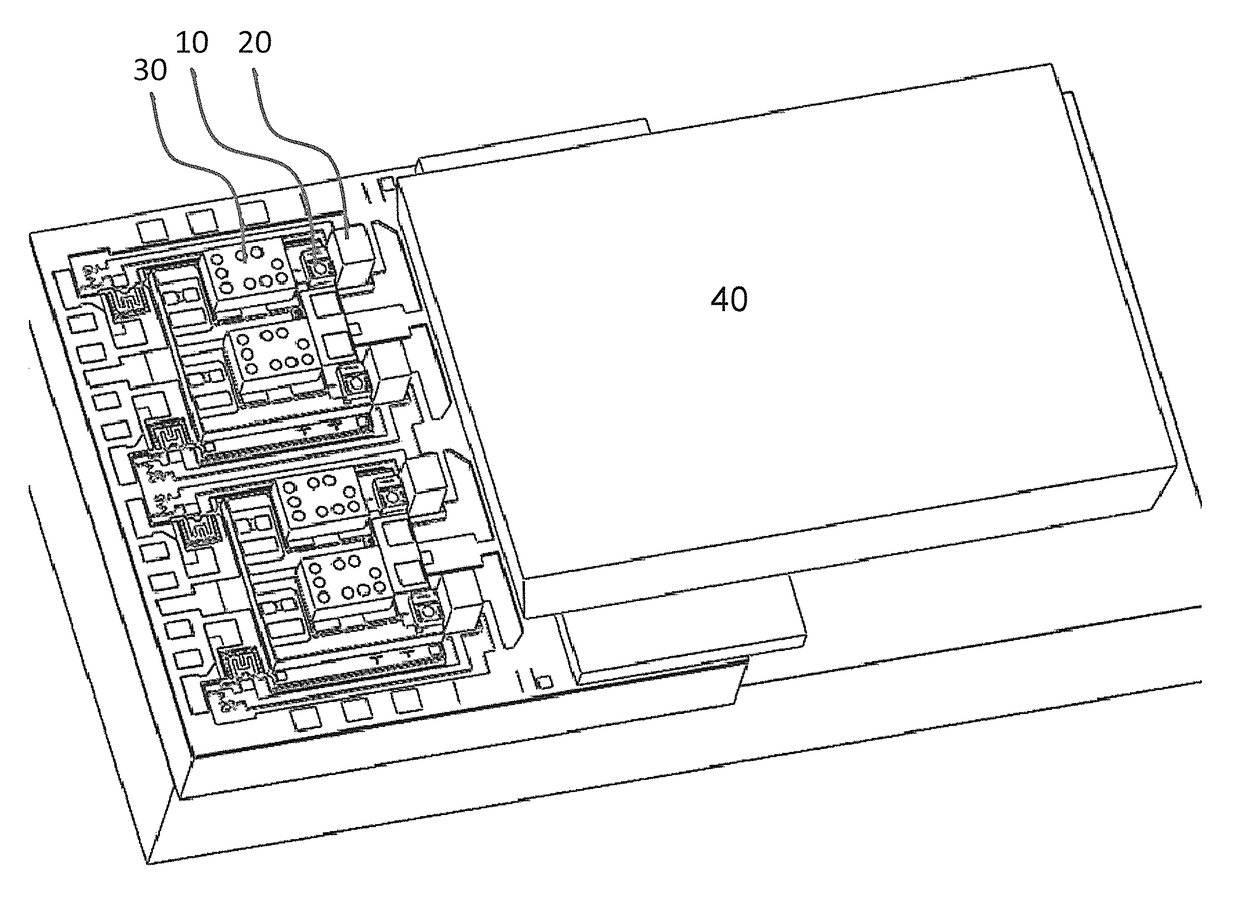
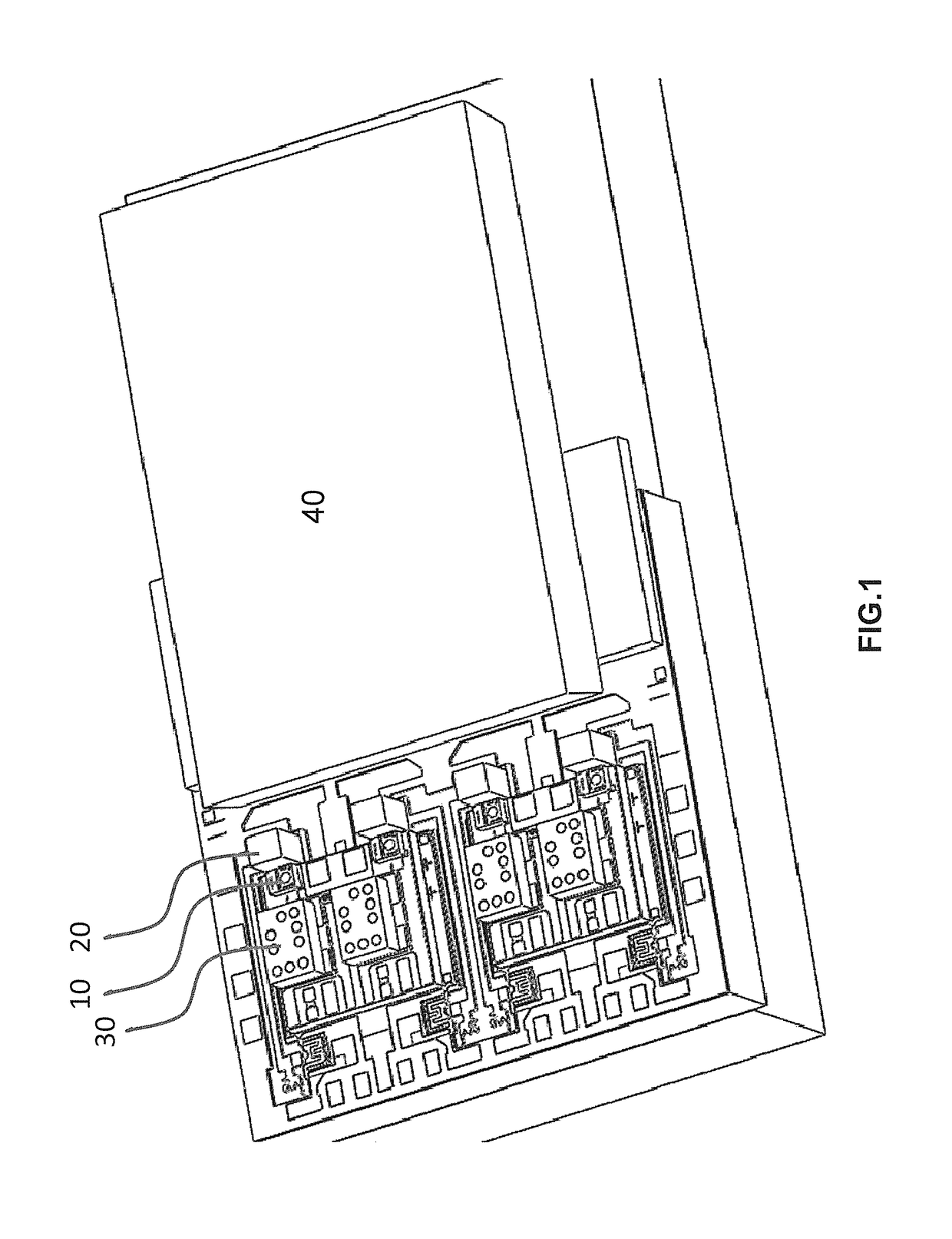
[0021]This is schematically shown in FIG. 1 for a 4×10 Gb / s transmitter. The transmitter includes a laser diode chip 10 with a laser that sends a beam of light forward into a microlens 20 that in turn focuses the beam into a planar lightwave circuit (PLC) 40. In some embodiments the laser output wavelength shift is about 0.1 nm per degree Centigrade. Behind the laser is a driver 30, which provides electrical signals to the laser diode chip. Note t...

the structure of the environmentally friendly knitted fabric provided by the present invention; figure 2 Flow chart of the yarn wrapping machine for environmentally friendly knitted fabrics and storage devices; image 3 Is the parameter map of the yarn covering machine
Login to View More

PUM

No PUM Login to View More

Abstract

A transmitter assembly incorporating multiple laser diodes that are wavelength multiplexed together using a planar lightwave circuit, and where the multiplexer's transmission spectrum depends on temperature at the same rate as the laser diodes. This allows a design for lower loss in the multiplexer and therefore is more power efficient.

Description

CROSS REFERENCE TO RELATED APPLICATIONS[0001]This application claims the benefit of the filing of U.S. Provisional Patent Application No. 61 / 824,869, filed on May 17, 2013, the disclosure of which is incorporated by reference herein.BACKGROUND OF THE INVENTION[0002]The present application relates to the field of fiber optic communication and, more particularly, to optical packaging techniques and designs used for multiple wavelength transmitters.[0003]In the past few decades, optics has gradually become the favored media for transmitting high bandwidths of information. Compared to electrical cabling, fiber optics can transmit modulated light for extreme distances with low loss and low distortion. As the bandwidth requirements in datacenters and between switches and routers have increased, optical links are becoming necessary in ever shorter domains. Thus gradually optics has migrated from long haul, to metro, and now to enterprise and datacenters. In previous decades the signal band...

Claims

the structure of the environmentally friendly knitted fabric provided by the present invention; figure 2 Flow chart of the yarn wrapping machine for environmentally friendly knitted fabrics and storage devices; image 3 Is the parameter map of the yarn covering machine
Login to View More

Application Information

Patent Timeline
no application Login to View More
IPC IPC(8): H04J14/02H04B10/50G02B6/12
CPCH04B10/506G02B6/12011G02B6/12009G02B6/12014G02B6/12019
Inventor LIU, ALICEPEZESHKI, BARDIAHEANUE, JOHNBULTHUIS, HENK
Owner BROADEX TECH UK LTD
Features
  • R&D
  • Intellectual Property
  • Life Sciences
  • Materials
  • Tech Scout
Why Patsnap Eureka
  • Unparalleled Data Quality
  • Higher Quality Content
  • 60% Fewer Hallucinations
Social media
Patsnap Eureka Blog
Learn More