
Method for preparing nano-porous gold film through treating graphene as template
A nanoporous gold and graphene technology, applied in the field of mesoporous materials, achieves the effects of non-toxic and environmentally friendly reagents, good controllability, and mild preparation conditions
- Summary
- Abstract
- Description
- Claims
- Application Information
AI Technical Summary
Problems solved by technology
Method used
Image

Examples
Embodiment 1
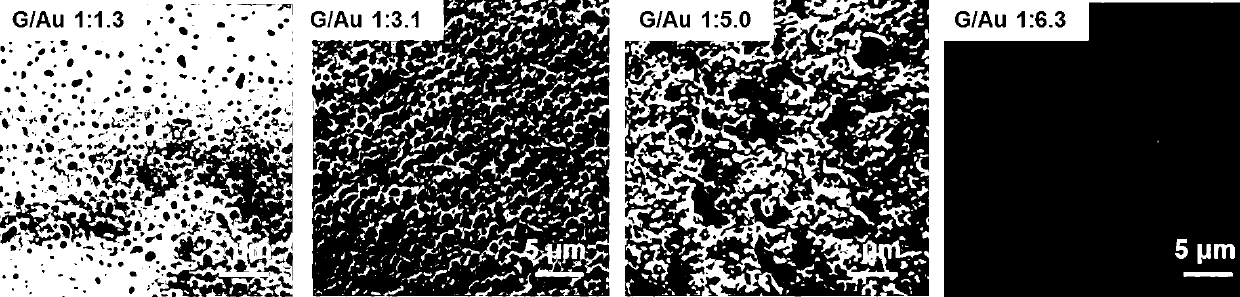
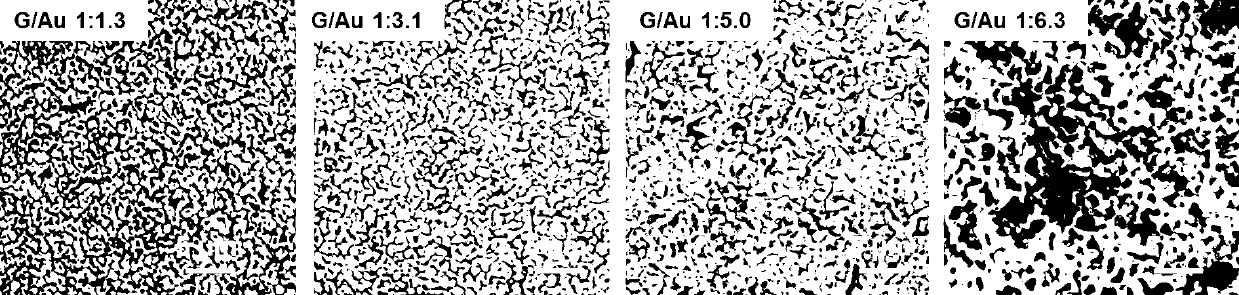
[0023] Sonicate chloroauric acid trihydrate (0.6, 1.6, 2.5 or 6.5 mmol / L), graphene oxide (0.1 mg / mL) and sodium citrate (10 mg / mL) in water for 2 min to disperse evenly; the mixture put in 100 o Stirring and heating reaction in C oil bath for 24 h to prepare gold nanoparticles / graphene composites (gold:graphene mass ratios were 1:1.3, 1:3.1, 1:5.0 and 1:6.3); After cooling, pour off the supernatant as much as possible, then centrifuge and wash the product three times at 5000 rpm until the supernatant is colorless, and the washing solvent is deionized water; redisperse the product in deionized water at a concentration of 0.1 mg / mL (with graphite olefin is the reference concentration); take 20 mL of the product dispersion, vacuum filter and wash with deionized water, the filter membrane is a mixed cellulose ester membrane with a pore size of 0.2 microns; dry the wet membrane in air for 1-2 days , the black composite film can be peeled off by itself; take about 10 mg of the com...
Embodiment 2
[0026] Sonicate chloroauric acid trihydrate (0.6, 1.6, 2.5 or 6.5 mmol / L), graphene oxide (0.1 mg / mL) and sodium citrate (10 mg / mL) in water for 2 min to disperse evenly; the mixture put in 100 o Stirring and heating reaction in C oil bath for 24 h to prepare gold nanoparticles / graphene composites (gold:graphene mass ratios were 1:1.3, 1:3.1, 1:5.0 and 1:6.3); After cooling, pour off the supernatant as much as possible, then centrifuge and wash the product three times at 5000 rpm until the supernatant is colorless, and the washing solvent is deionized water; redisperse the product in deionized water at a concentration of 0.1 mg / mL (with graphite olefin is the reference concentration); take 20 mL of the product dispersion, vacuum filter and wash with deionized water, the filter membrane is a mixed cellulose ester membrane with a pore size of 0.2 microns; dry the wet membrane in air for 1-2 days , the black composite film can be peeled off by itself; about 10 mg of the composit...
PUM
| Property | Measurement | Unit |
|---|---|---|
| pore size | aaaaa | aaaaa |
Abstract
Description
Claims
Application Information
 Login to View More