Check patentability & draft patents in minutes with Patsnap Eureka AI!

A method for reducing and degrading organic pollutants by Al-Ni alloy in alkaline wastewater

A technology of organic pollutants and aluminum-nickel alloys, applied in the direction of reduced water/sewage treatment, etc., can solve the problems of high cost, decreased catalytic activity, increased operation difficulty and danger, etc., and achieves low cost, wide range of sources, increased catalytic processing The effect of hydrogen reduction on the ability to degrade organic pollutants

Inactive Publication Date: 2016-01-20
JIANGSU TENGLONG BIOLOGICAL PHARMA
View PDF4 Cites 0 Cited by
  • Summary
  • Abstract
  • Description
  • Claims
  • Application Information

AI Technical Summary

Problems solved by technology

However, the cost of using noble metal catalysts is high, and the use of H 2 It will also increase the difficulty and danger of operation; and the bimetallic materials prepared by hydrometallurgy, the catalyst metal is loaded on the matrix metal by chemical deposition, although the material has high activity when it is first prepared, it will be used for many times due to the loss of the matrix metal. Corrosion will cause the catalytic metal to fall off, resulting in a rapid decline in catalytic activity

Method used

the structure of the environmentally friendly knitted fabric provided by the present invention; figure 2 Flow chart of the yarn wrapping machine for environmentally friendly knitted fabrics and storage devices; image 3 Is the parameter map of the yarn covering machine
View more

Image

Smart Image Click on the blue labels to locate them in the text.
Viewing Examples
Smart Image
  • A method for reducing and degrading organic pollutants by Al-Ni alloy in alkaline wastewater
  • A method for reducing and degrading organic pollutants by Al-Ni alloy in alkaline wastewater

Examples

Experimental program
Comparison scheme
Effect test

Embodiment 1

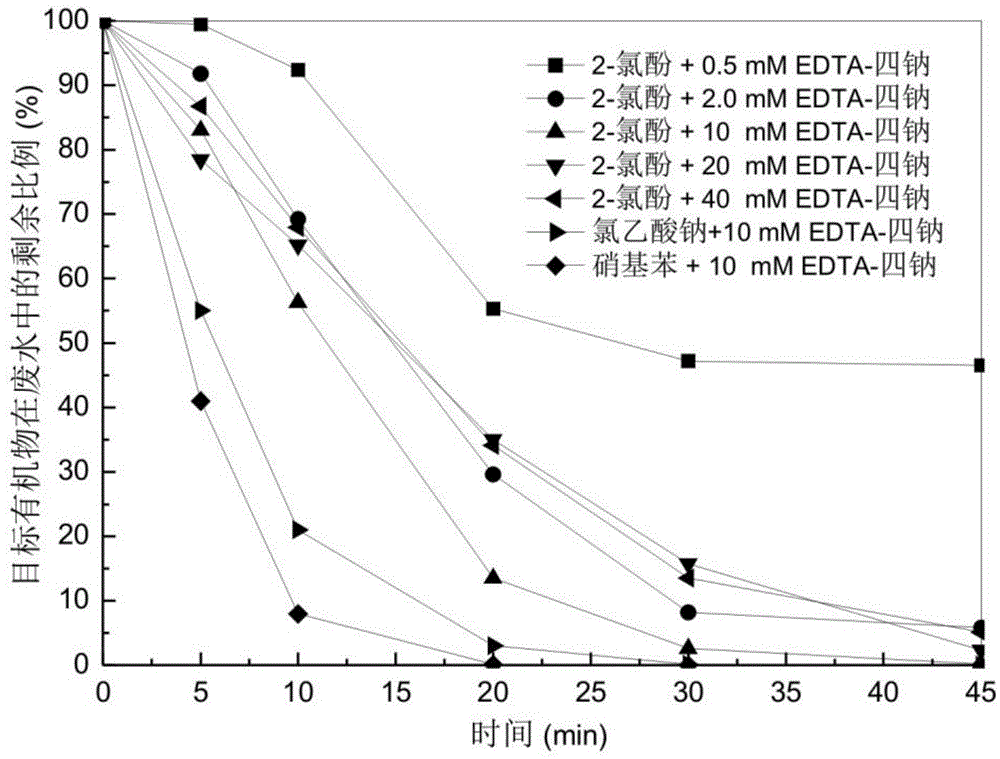
[0028] Embodiment 1: Aluminum-nickel alloy carries out hydrogenation reduction degradation of chlorinated organic wastewater under EDTA-tetrasodium complexation

[0029] First, put conventional commercial aluminum-nickel alloy (provided by Sinopharm Chemical Reagent Co., Ltd., nickel content is 40-50wt.%, the rest is aluminum) particles into the wastewater, and control the dosage of aluminum-nickel alloy at 1-20g / L ;

[0030] Secondly, add EDTA-tetrasodium, and the dosage is in the range of 1:0.05 to 1:4 (g:mM) according to the ratio of the “grammass of aluminum-nickel alloy to the “millimoles” of EDTA-tetrasodium. For the water phase In the dechlorination degradation reaction of chlorinated organic pollutants, the proportion of complexing agent can be increased with the increase of the amount of aluminum-nickel alloy; again, the dechlorination degradation reaction is carried out under normal temperature and pressure stirring conditions to strengthen mass transfer and preven...

Embodiment 2

[0032] Example 2: Nitrobenzene wastewater hydrogenation reduction degradation of aluminum-nickel alloy under EDTA-tetrasodium complexation

[0033] The reaction performance evaluation conditions of aluminum-nickel alloy particles under the action of EDTA-tetrasodium are basically the same as in Example 1, except that nitrobenzene wastewater is used, the volume is 100mL, and its initial concentration is 100mg / L, and 1g of aluminum-nickel alloy is put into Particles (particle size 100 mesh) and EDTA-tetrasodium with a final concentration of 10mM, the initial pH value of the solution was 11.0, stirred and reacted, water samples were taken during the gas chromatography analysis, the hydrogenation degradation reaction of nitrobenzene proceeded rapidly, and the reaction After 15 minutes, nitrobenzene is completely degraded, and the product is mainly aniline. The reaction effect is as follows: figure 1 shown.

Embodiment 3

[0034] Embodiment 3: Aluminum-nickel alloy carries out hydrogenation reduction degradation of high-concentration sodium chloroacetate wastewater under EDTA-tetrasodium complexation

[0035] The reaction performance evaluation conditions of aluminum-nickel alloy particles under the action of EDTA-tetrasodium are basically the same as in Example 1, except that the waste water prepared by sodium chloroacetate is initially about 500mg / L, and the volume is 500mL, which is weakly alkaline. Solution, adjust its pH value to 10.5 with NaOH, put 10g of aluminum-nickel alloy particles (particle size 100 mesh) and EDTA-tetrasodium particles with a final concentration of 20mM, stir and react, during which the water sample is lipidified by sulfuric acid and methanol Afterwards, it was extracted by methyl tert-butyl ether and analyzed by gas chromatography (GC-ECD). Chloroacetic acid and methyl chloroacetate were not detected after 30 minutes of reaction (the detection limit of GC-ECD was 500...

the structure of the environmentally friendly knitted fabric provided by the present invention; figure 2 Flow chart of the yarn wrapping machine for environmentally friendly knitted fabrics and storage devices; image 3 Is the parameter map of the yarn covering machine
Login to View More

PUM

No PUM Login to View More

Abstract

The invention discloses a method for using an aluminum-nickel alloy to reduce and degrade an organic pollutant in alkali wastewater. The method comprises the following steps: putting aluminum-nickel alloy particles in to-be-processed halogenated organic alkali wastewater, wherein for the aluminum-nickel alloy, the content of nickel based on mass is 40-50%, the other part is aluminum, and the putting amount of the aluminum-nickel alloy is controlled within the range of 1-20 g / L; putting a complexing agent which can be complex with aluminum in the to-be-processed halogenated organic alkali wastewater, and controlling the putting amount within the range of 0.5-40 mmol / L. The method is to utilize the stable complexation function that the complexing agent can make the aluminum-nickel alloy dissolve out Al<3+> from the alkali solution, so as to obstruct the aluminum matrix to corrode and damage the surface at ordinary state to stop fast spontaneous growth of the oxidation film of aluminum, enable the aluminum base to lose protection of the inert oxidation film, promote the metal aluminum monomer to directly expose in a water body to separate out hydrogen by electrons, and then combine the mutually soluble alloy nickel with hydrogen to catalyze the pollutant. Therefore, the method can obviously increase the capability of the aluminum-nickel alloy to catalyze and hydrogenate, reduce and degrade the organic pollutant.

Description

technical field [0001] The invention belongs to the hydrogenation reduction technology of water-phase organic matter and the environmental bimetallic catalytic degradation technology, specifically a method for reducing and degrading organic pollutants in alkaline waste water by using aluminum-nickel alloys. Background technique [0002] Chlorinated organic compounds and nitrobenzene are important chemical raw materials and organic reagents, widely used in chemical, pesticide, dye, military and other industries. With the mass production and use of these organic substances, the pollution caused by their proliferation has posed a serious threat to human health and environmental ecology. For example: chloroacetic acid, which is a by-product of drinking water disinfection and an important precursor of pesticide synthesis, common organochlorine pesticides (DDT, chlordane, lindane), chlorobenzene, and chlorophenol compounds all have significant toxicity and "three effects" ( Carci...

Claims

the structure of the environmentally friendly knitted fabric provided by the present invention; figure 2 Flow chart of the yarn wrapping machine for environmentally friendly knitted fabrics and storage devices; image 3 Is the parameter map of the yarn covering machine
Login to View More

Application Information

Patent Timeline
no application Login to View More
Patent Type & Authority Patents(China)
IPC IPC(8): C02F1/70
Inventor 肖建中陈刚杨波程晓兵石利利
Owner JIANGSU TENGLONG BIOLOGICAL PHARMA
Features
  • R&D
  • Intellectual Property
  • Life Sciences
  • Materials
  • Tech Scout
Why Patsnap Eureka
  • Unparalleled Data Quality
  • Higher Quality Content
  • 60% Fewer Hallucinations
Social media
Patsnap Eureka Blog
Learn More