
Washing-free long-time cell membrane fluorescence imaging reagent and preparation method thereof
A fluorescence imaging, long-term technology, applied in the field of biomedicine, can solve the problem of inability to clean the fluorescent dye, and achieve the effect of no cleaning, low luminous efficiency, and good biocompatibility
- Summary
- Abstract
- Description
- Claims
- Application Information
AI Technical Summary
Problems solved by technology
Method used
Image

Examples
Embodiment 1
[0029] The design, synthesis and cell membrane fluorescence staining method of chitosan-30% cholesterol-2% Nile red, a multi-site anchoring, no-wash long-term cell membrane fluorescence imaging reagent, are as follows:
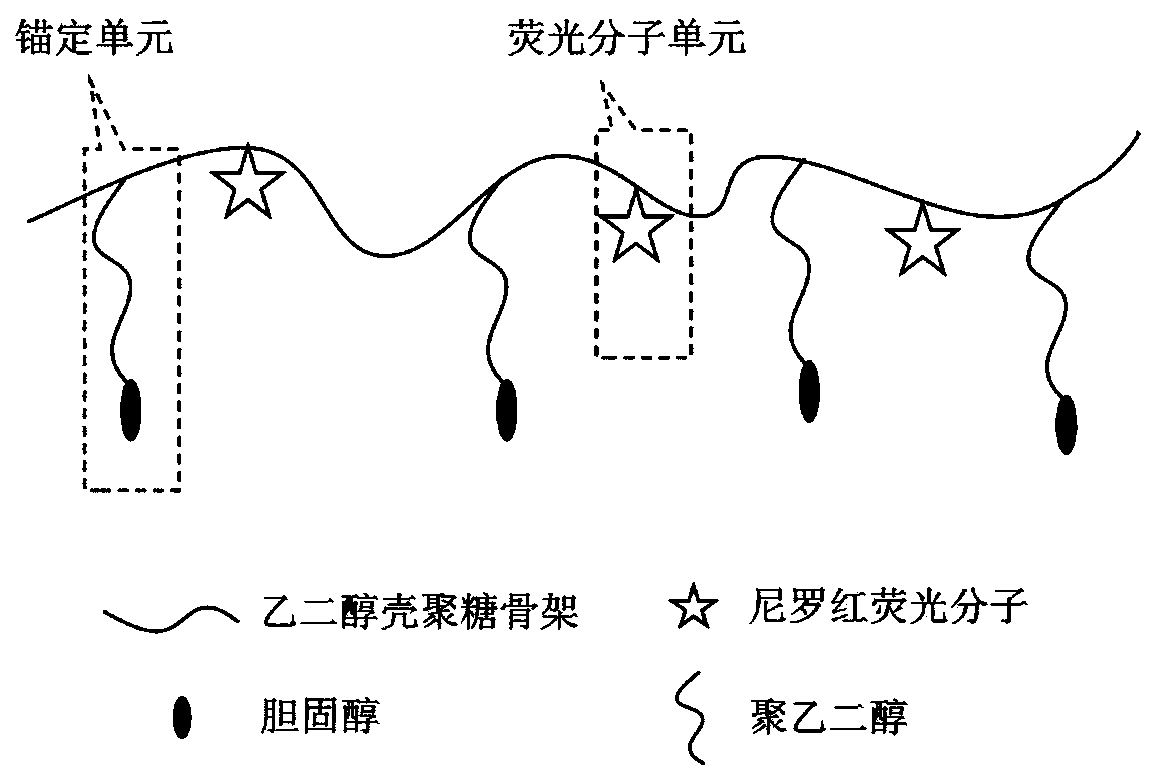
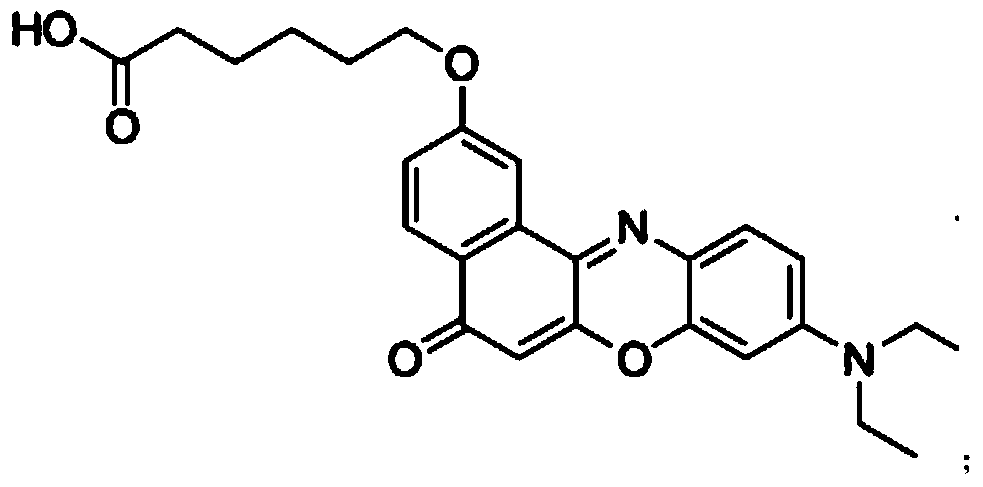
[0030] Reagent design: the reagent composition see figure 1 , The reagent uses glycol chitosan as the backbone, and the side chain contains 30% polyethylene glycol 2000-cholesterol (PEG2000-cholesterol) hydrophobic units and 2% Nile red dye fluorescent units. The ethylene glycol chitosan macromolecule has good biocompatibility and water solubility, and the molecular weight is above 10,000. The hydrophobic side chain of cholesterol is linked to the amino group of ethylene glycol chitosan in the form of NHS-PEG2000-cholesterol to increase water solubility. The Nile Red dye is carboxylated Nile Red, which is directly linked to ethylene glycol chitosan through reaction with amino groups. After the reagent is dissolved in water, it maintains a free stretching sta...
Embodiment 2
[0034] The implementation method of this embodiment is consistent with the method in embodiment 1, except that the Nile red fluorescent molecule is replaced by tetraphenylethylene (TPE) fluorescent molecule, and the molecular weight of the selected ethylene glycol chitosan is about 100,000. The fluorescent molecule is a kind of aggregation-induced emission (AIE), which can emit light through restriction of intra-molecular rotation (RIR). The fluorescent molecule has a large degree of freedom in aqueous solution, and the energy is easily dispersed, so the luminous efficiency is low; after being inserted into the hydrophobic cell membrane, because it is bound in the tight space of the hydrophobic phospholipid, the rotation of the molecule is limited, and the energy dispersion is hindered, resulting in Green fluorescence with high fluorescence quantum yield. Therefore, the luminescent condition of the fluorescent molecule is similar to that of Nile Red, and it can be used to make...
Embodiment 3
[0036] The implementation method of the present embodiment is similar to the method in Example 1, except that the high molecular weight of glycol chitosan selected is about 10000, and the percentage of synthetic anchor unit accounting for the number of repeating units of glycol chitosan is changed to 5%. , the percentage of fluorescent molecular units in the repeating units of ethylene glycol chitosan was changed to 1%, and the prepared imaging reagent consisted of chitosan-5% cholesterol-1% Nile red.
PUM
 Login to View More
 Abstract
Description
Claims
Application Information
 Login to View More