

A kind of method of synthesizing aminophenylboronic acid pinacol ester
A technology for synthesizing aminobenzeneboronic acid and aminobromobenzene is applied in the field of boron chemical synthesis and can solve problems such as difficulty in determining the purity
- Summary
- Abstract
- Description
- Claims
- Application Information
AI Technical Summary
Problems solved by technology
Method used
Image

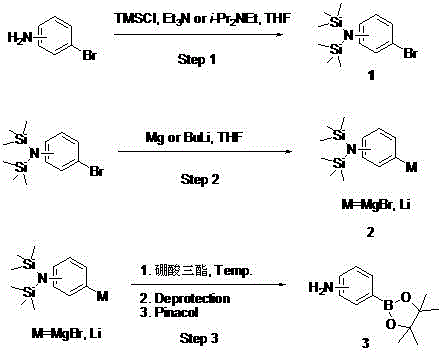


Examples
Embodiment 1
[0027] Example 1: Synthesis of 2-bis(trimethylsilyl)aminobromobenzene (1, ortho):
[0028] Under argon protection, in a 3L three-neck flask equipped with magnetic stirring, 2-aminobromobenzene (172 g, 1.0 mol) and triethylamine (303.6 g, 3.0 mol) were added to 850 ml of anhydrous THF solvent, and the After stirring, the reaction solution was cooled to about 0°C, and then 3.0 equivalents of trimethylchlorosilane (325.9 g, 3 moles) was slowly added dropwise, and the temperature of the system rose to 30°C during the dropwise addition. Stir for 10 minutes after dropping, and then react at 40-60°C for 1-3 hours. TLC detects that the reaction is complete. The developing solvent is: n-hexane / ethyl acetate=10:1. At this time, it is the intermediate protected by the previous trimethylsilyl group.
[0029] Cool down to -10-0°C, and maintain the temperature by adding 1.5 equivalents of commercially available 3M methylmagnesium chloride tetrahydrofuran solution (500 ml, 1.5 moles), follow...
Embodiment 2
[0030] Example 2: Synthesis of 3-bis(trimethylsilyl)aminobromobenzene (1, meta):
[0031] Under nitrogen protection, in a 3L three-necked flask equipped with magnetic stirring, 3-aminobromobenzene (172 g, 1.0 mol) and diisopropylethylamine (387.7 g, 3.0 mol) were added to 850 ml of anhydrous THF solvent , start stirring, and cool the reaction solution to about 0°C, then slowly add 3.0 equivalents of trimethylchlorosilane (325.9 g, 3 moles) dropwise, and the temperature of the system rises to 30°C during the dropwise addition. Stir for 10 minutes after dropping, and then react at 40-60°C for 1-3 hours. TLC detects that the reaction is complete. The developing solvent is: n-hexane / ethyl acetate=10:1. At this time, it is the intermediate protected by the previous trimethylsilyl group.
[0032] Cool down to -10-0°C, and maintain the temperature by adding 1.5 equivalents of a commercially available 3.2M methylmagnesium bromide 2-methyltetrahydrofuran solution (469 ml, 1.5 moles), f...
Embodiment 3
[0033] Example 3: Synthesis of 4-bis(trimethylsilyl)aminobromobenzene (1, p-position):
[0034] Under nitrogen protection, in a 3L three-necked flask equipped with magnetic stirring, 4-aminobromobenzene (172 grams, 1.0 moles) and triethylamine (303.6 grams, 3.0 moles) were added to 850 milliliters of anhydrous THF solvent, and the stirring was started , the reaction solution was cooled to about 0°C, and then 3.0 equivalents of trimethylchlorosilane (325.9 g, 3 moles) was slowly added dropwise, and the temperature of the system rose to 30°C during the dropwise addition. Stir for 10 minutes after dropping, and then react at 40-60°C for 1-3 hours. TLC detects that the reaction is complete. The developing solvent is: n-hexane / ethyl acetate=10:1. At this time, it is the intermediate protected by the previous trimethylsilyl group.
[0035] Cool down to -10-0°C, and maintain the temperature by adding 1.5 equivalents of a commercially available 2M isopropylmagnesium chloride tetrahydr...
PUM
| Property | Measurement | Unit |
|---|---|---|
| melting point | aaaaa | aaaaa |
| melting point | aaaaa | aaaaa |
Abstract
Description
Claims
Application Information
 Login to View More