
4-sulfophthalic acid rare-earth metal complex, preparation method therefor and application thereof
A technology of sulfophthalic acid and rare earth metals, which is applied in the field of metal-organic coordination polymers and photoluminescent materials, can solve the problems of shallow research on luminescent properties, achieve good reproducibility, high yield, The effect of high thermal stability
- Summary
- Abstract
- Description
- Claims
- Application Information
AI Technical Summary
Problems solved by technology
Method used
Image

Examples
Embodiment 1
[0027] 4-sulfophthalic acid rare earth metal complex A Synthesis:
[0028] Dissolve 4-sulfophthalic acid (0.65 mmol, 160.2 mg) and dysprosium chloride hexahydrate (0.3 mmol, 113.1 mg) in a mixed solvent of double distilled water (8.0 mL) and methanol (2.0 mL) . The pH of the reaction system was adjusted to 6 with triethylamine, and after stirring for several minutes, the reaction mixture was sealed into a 23.0 ml hydrothermal kettle. The sealed reaction kettle was transferred to a temperature-controlled oven, and kept at 170 °C for four days, then heated at 3.0 °C h –1 rate program to cool down to room temperature. After opening the reaction kettle, colorless needle-like crystals were obtained directly, washed with methanol, and dried in air to obtain the complex A .
Embodiment 2
[0030] 4-sulfophthalic acid rare earth metal complex B Synthesis:
[0031] Dissolve 4-sulfophthalic acid (0.65 mmol, 160.2 mg) and terbium chloride hexahydrate (0.3 mmol, 112.0 mg) in a mixed solvent of double distilled water (6.0 mL) and ethanol (4.0 mL) . The pH of the reaction system was adjusted to 6 with triethylamine, and after stirring for several minutes, the reaction mixture was sealed into a 23.0 ml hydrothermal kettle. The sealed reaction kettle was transferred to a temperature-controlled oven, and kept at 170 °C for four days, then heated at 3.0 °C h –1 rate program to cool down to room temperature. After opening the reaction kettle, colorless needle-like crystals were obtained directly, washed with methanol, and dried in air to obtain the complex B .
Embodiment 3
[0033] 4-sulfophthalic acid rare earth metal complex C Synthesis:
[0034] 4-Sulphophthalic acid (0.65 mmol, 160.2 mg) and erbium oxide (0.3 mmol, 114.8 mg) were dissolved in a mixed solvent of double distilled water (8.0 mL) and ethanol (2.0 mL). The pH of the reaction system was adjusted to 5 with triethylamine, and after stirring for several minutes, the reaction mixture was sealed into a 23.0 ml hydrothermal kettle. The sealed reaction kettle was transferred to a temperature-controlled oven, and kept at 200 °C for four days, then heated at 3.0 °C h –1 rate program to cool down to room temperature. After opening the reaction kettle, light pink needle-like crystals were obtained directly, washed with methanol, and dried in air to obtain the complex C .
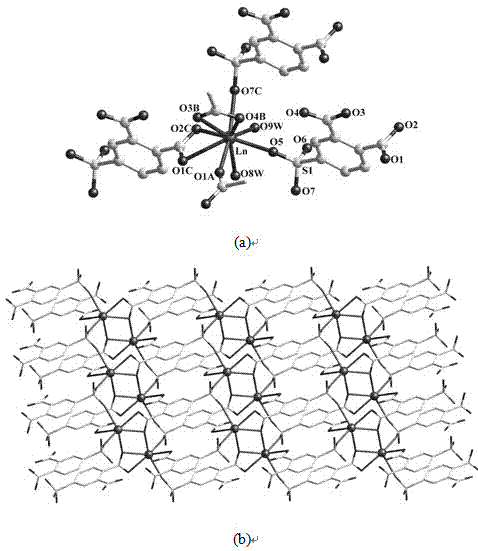
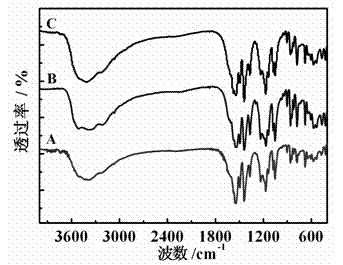
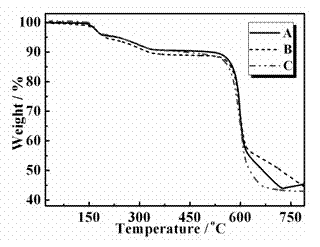
[0035] 4-sulfophthalic acid rare earth metal complex prepared by the present invention (embodiment 1-3, A - C ) is characterized by the following structure:
[0036] (1) Determination of the crystal structure of the c...
PUM
 Login to View More
 Abstract
Description
Claims
Application Information
 Login to View More