
O18, O19, O23, and O12 specific nucleotides and applications
A technology of Vibrio cholerae and nucleotides, which is applied in the determination/inspection of microorganisms, resistance to vector-borne diseases, biochemical equipment and methods, etc., can solve the problems of high missed detection rate, insufficient quantity, low sensitivity, etc., and achieve The effect of high accuracy, strong practicability and low detection cost
- Summary
- Abstract
- Description
- Claims
- Application Information
AI Technical Summary
Problems solved by technology
Method used
Image

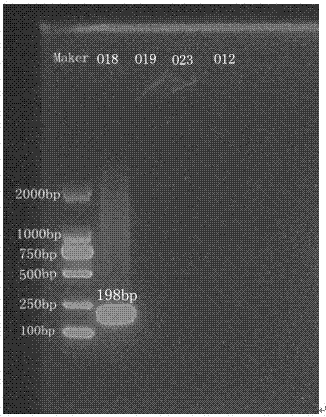
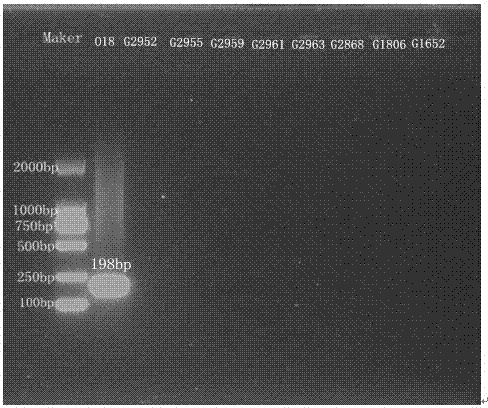
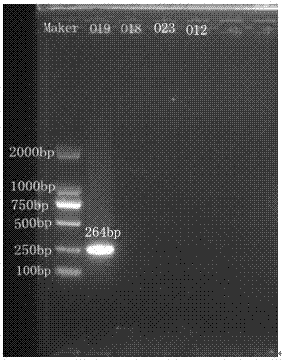
Examples
Embodiment 1
[0037] Example 1 : Genome Extraction
[0038] Cultivate Vibrio cholerae in a nutrient broth medium at 37°C, collect the bacteria, and extract the genome. The specific steps are as follows:
[0039] The cells were resuspended with 500ul 50mM Tris-HCl (pH8.0) and 10ul 0.4M EDTA, incubated at 37°C for 20 minutes, and then 10ul 10mg / ml lysozyme was added to continue the incubation for 20 minutes. Then add 3ul 20mg / ml proteinase K, 15ul10% SDS, incubate at 50°C for 2 hours, then add 3ul 10mg / ml RNase, and incubate at 65°C for 30 minutes. Add an equal volume of phenol to extract the mixture, take the supernatant, and then extract twice with an equal volume of phenol: chloroform: isoamyl alcohol (25:24:1), take the supernatant, and then extract with an equal volume of ether. Extract to remove residual phenol. Precipitate DNA with 2 times the volume of ethanol in the supernatant, roll out the DNA with glass wool and wash the DNA with 70% ethanol, and finally resuspend the DNA in 3...
Embodiment 2
[0040] Example 2: sequence deciphering
[0041] The genomes of the standard strains of each serotype of Vibrio cholerae were extracted, and the genomes of each serotype of Vibrio cholerae were sequenced by Solexa pair-end sequencing technology to obtain the sequence of the serotype, and the sequences were compared using Blast and PSI-Blast. The TMHMM 2.0 program was used to predict the transmembrane structure, and the ClustalW program was used to perform sequence alignment and screen conservative and specific gene fragments, and finally obtained the O antigen gene cluster sequences and deciphered results of each serotype of Vibrio cholerae.
Embodiment 3
[0042] Example 3 : Primer design
[0043] The O antigen gene cluster sequences of each serotype of Vibrio cholerae were self-tested by our laboratory. Through comparative analysis, we selected gene-specific segments with relatively low values of identity and similarity in Blast comparison results to design primers. Of which O18 serotype wzz The identity and similarity values of the gene comparison results were 91% and 95%; the O19 serotype wxya The identity and similarity values of the gene comparison results were 84% and 93%; the O23 serotype wzz The identity and similarity values of the gene comparison results were 90% and 94%; the O12 serotype wxya The identity and similarity values of the gene comparison results were 100% and 100%; therefore, the above-mentioned corresponding genes were selected as the specific target genes of the serotypes for each serotype, and specific primers were designed for the gene-specific segments of each serotype.
[0044] Pri...
PUM
 Login to View More
 Abstract
Description
Claims
Application Information
 Login to View More