
Wet smelting method of nickel oxide ore
A smelting method and nickel oxide technology, applied in the direction of improving process efficiency, etc., can solve problems such as increased smelting costs, fluctuations in organic component content, increased losses, etc., and achieve the effect of suppressing the amount of sulfuric acid
- Summary
- Abstract
- Description
- Claims
- Application Information
AI Technical Summary
Problems solved by technology
Method used
Image

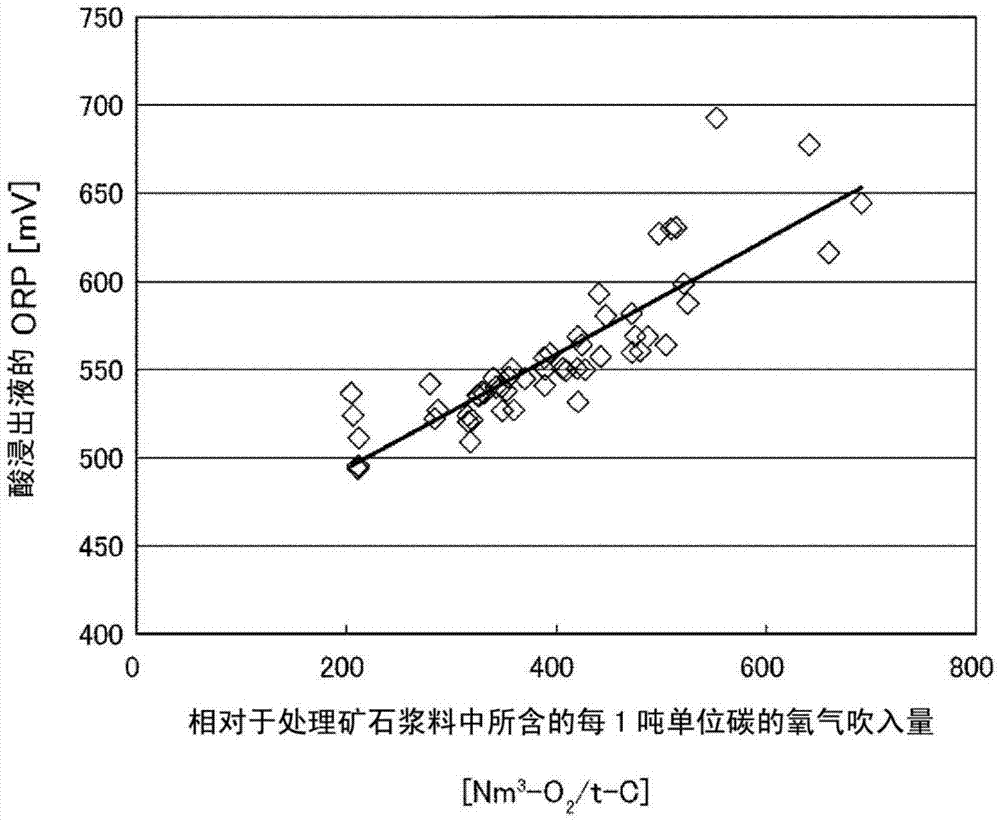
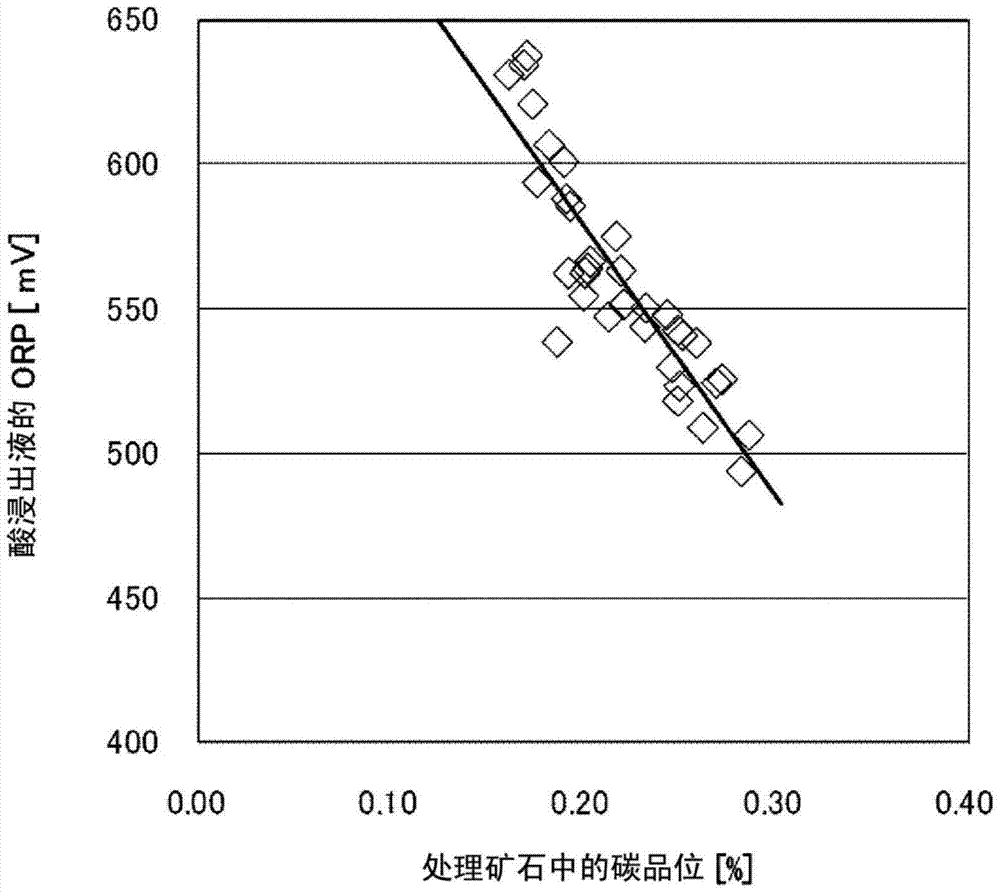
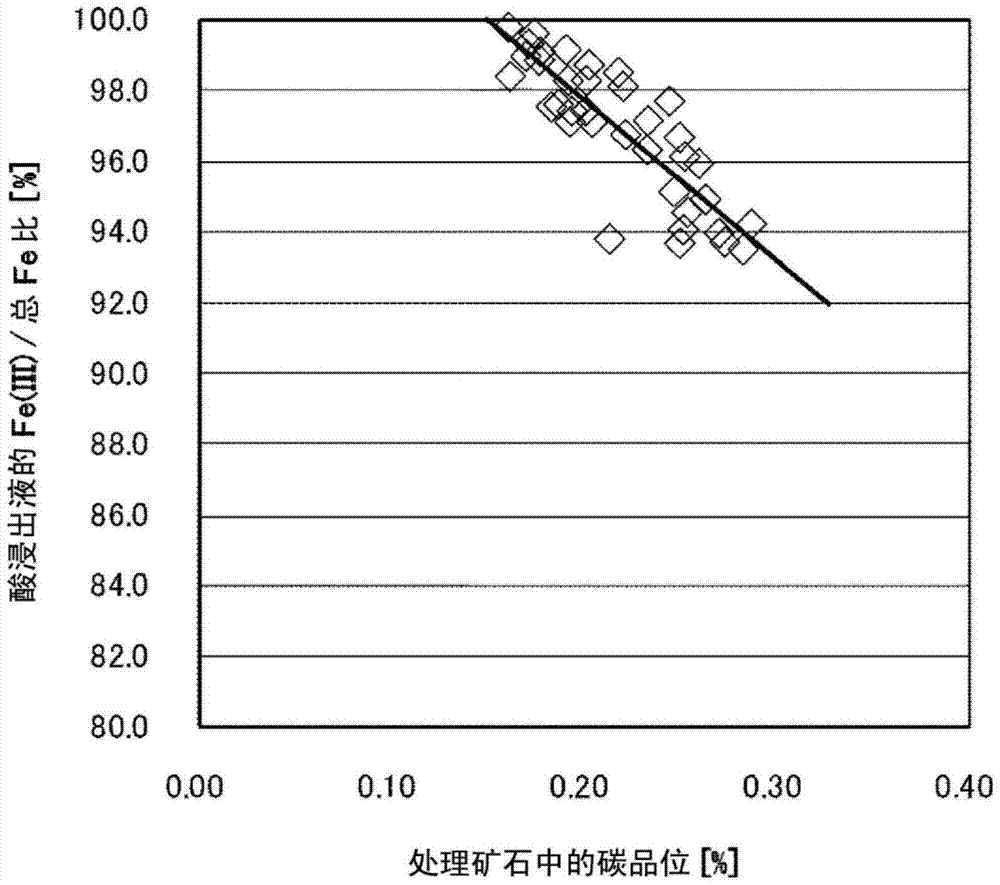
Examples
Embodiment 1
[0095] Example 1 is operated in the following manner: the carbon (C) grade in the solid content is 0.22% by weight, and for high-pressure air and high-pressure oxygen of about 5MPaG, the oxygen purity is adjusted to 46.6%, so as to correspond to 1 ton of carbon The amount is 426 [Nm 3 -O 2 / t-C] the oxygen blowing amount is blown in, and the oxygen partial pressure in the container is adjusted to 277kPaG. In addition, it operated while blowing high-pressure steam of about 5 MPaG, and maintaining the temperature of 245 degreeC, stirring.
[0096] As a result, the ORP (based on Ag / AgCl) of the obtained leaching slurry was properly maintained at 559mV, and the amount of sulfuric acid per 1 ton of dry ore was 226 [kg-H 2 SO 4 / t-dry-solids].
Embodiment 2
[0098] In Example 2, the operation was carried out in the following manner: the carbon (C) grade in the solid content was 0.23% by weight, and the oxygen purity was adjusted to 47.8% for high-pressure air and high-pressure oxygen of about 5MPaG, so as to correspond to each 1 ton of carbon is 317[Nm 3 -O 2 / t-C] the oxygen blowing amount is blown in, and the oxygen partial pressure in the container is adjusted to 277kPaG. In addition, it operated while blowing high-pressure steam of about 5 MPaG, and maintaining the temperature of 245 degreeC, stirring.
[0099] As a result, the ORP (based on Ag / AgCl) of the obtained leaching slurry was properly maintained at 518mV, and the amount of sulfuric acid per 1 ton of dry ore was 219 [kg-H 2 SO 4 / t-dry-solids].
Embodiment 3
[0101] In Example 3, the operation was carried out in the following manner: the carbon (C) grade in the solid content was 0.24% by weight, and the oxygen purity was adjusted to 54.7% for high-pressure air and high-pressure oxygen of about 5MPaG, so as to correspond to each 1 ton of carbon is 412[Nm 3 -O 2 / t-C] the oxygen blowing amount is blown in, and the oxygen partial pressure in the container is adjusted to 325kPaG. In addition, it operated while blowing high-pressure steam of about 5 MPaG, and maintaining the temperature of 245 degreeC, stirring.
[0102] As a result, the ORP (based on the Ag / AgCl electrode) of the obtained leaching slurry was properly maintained at 528mV, and the amount of sulfuric acid per 1 ton of dry ore was 232 [kg-H 2 SO 4 / t-dry-solids].
PUM
 Login to View More
 Abstract
Description
Claims
Application Information
 Login to View More