Check patentability & draft patents in minutes with Patsnap Eureka AI!

An engineering strain of Saccharomyces cerevisiae that efficiently utilizes whey to produce ethanol and its construction method

A technology for Saccharomyces cerevisiae and a construction method, which is applied in the field of bioengineering, can solve problems such as deregulation of galactose metabolism, and achieve the effect of wide application prospects

Active Publication Date: 2018-12-07
HEBEI NORMAL UNIVERSITY OF SCIENCE AND TECHNOLOGY
View PDF1 Cites 0 Cited by
  • Summary
  • Abstract
  • Description
  • Claims
  • Application Information

AI Technical Summary

Problems solved by technology

[0009] At present, there is no report at home and abroad that overexpresses LAC4 and LAC12 genes while releasing the regulation of galactose metabolism

Method used

the structure of the environmentally friendly knitted fabric provided by the present invention; figure 2 Flow chart of the yarn wrapping machine for environmentally friendly knitted fabrics and storage devices; image 3 Is the parameter map of the yarn covering machine
View more

Image

Smart Image Click on the blue labels to locate them in the text.
Viewing Examples
Smart Image
  • An engineering strain of Saccharomyces cerevisiae that efficiently utilizes whey to produce ethanol and its construction method
  • An engineering strain of Saccharomyces cerevisiae that efficiently utilizes whey to produce ethanol and its construction method
  • An engineering strain of Saccharomyces cerevisiae that efficiently utilizes whey to produce ethanol and its construction method

Examples

Experimental program
Comparison scheme
Effect test

Embodiment 1

[0033] Example 1: Construction of Saccharomyces cerevisiae Genetically Engineered Bacteria to Remove Galactose Metabolism Regulation

[0034] (1) Construction of genetic engineering strains

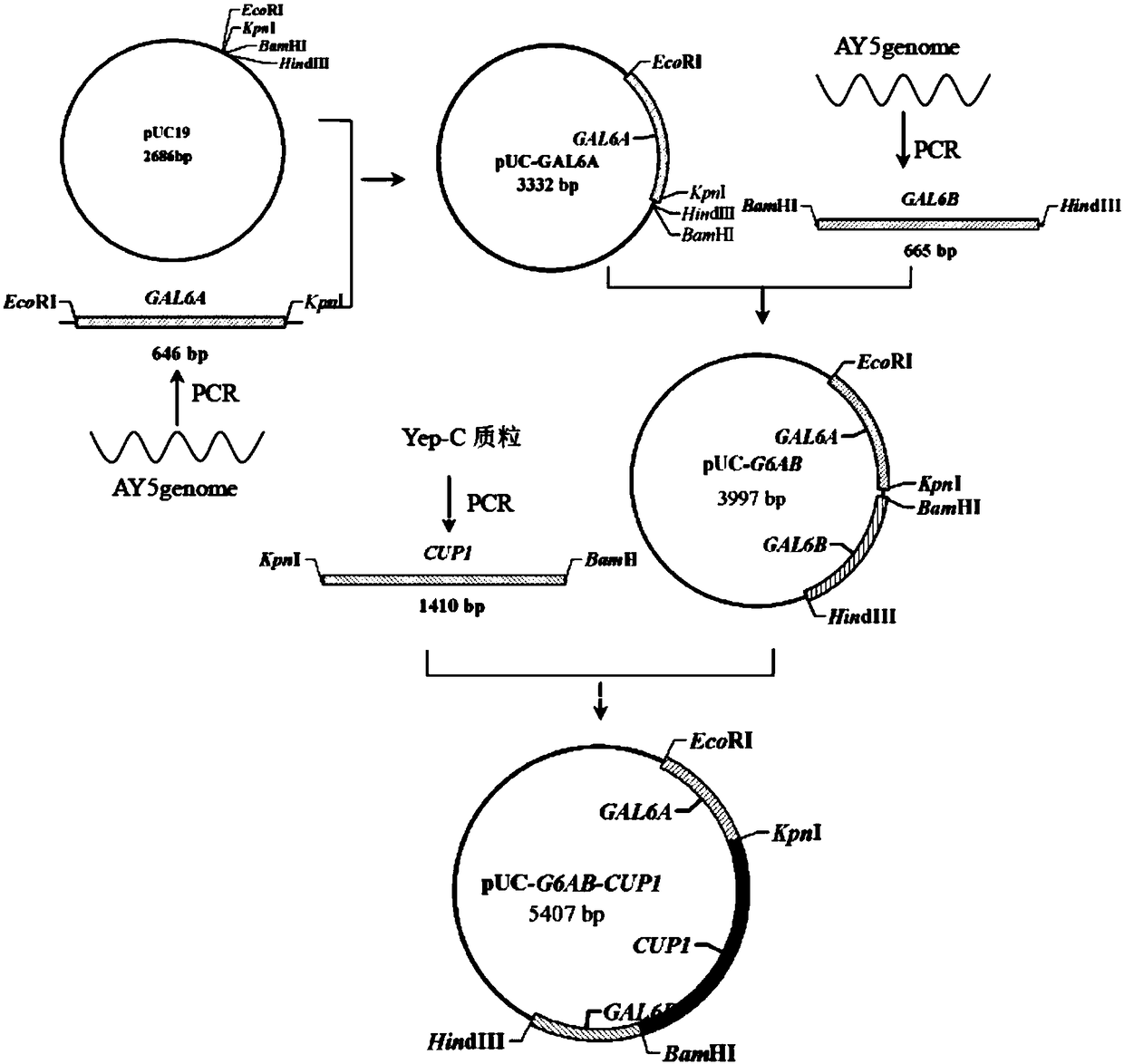
[0035] 1) Using the genome of Saccharomyces cerevisiae CGMCC No 2.1364 as a template, and using G6A-U and G6A-D as primers, use PCR to amplify a fragment GAL6A with a length of 646 bp upstream of the full sequence of the GAL6 gene, and use it in the same way G6B-U and GB6-D were used as primers to amplify the 665bp fragment GAL6B downstream of the full sequence of the GAL6 gene (see Table 1 for primer sequences and restriction sites), and then connect GAL6A, GAL6B and the pUC19 plasmid to obtain a plasmid pUC-G6AB;

[0036] 2) Using the Yep-C plasmid as a template and using Cup-U, Cup-D1, and Cup-D2 as primers, a 1410bp copper resistance gene CUP1 was amplified and connected to the plasmid pUC-G6AB to obtain the plasmid pUC-G6AB-CUP1 (see the build process figure 1 );

[0037] 3) Usin...

Embodiment 2

[0050] Example 2: Research on Fermentation Performance of Engineering Bacteria Using Whey to Produce Fuel Ethanol

[0051] Inoculate AY5MG and its parent AY-510B24M into 20mL glucose culture medium, and culture overnight at 30°C for 12 hours; after centrifugation and washing, transfer all the bacterial liquid to 200mL whey medium, and culture and ferment at 30°C. Whey medium (g / L): whey powder 120 (lactose content is 53.1g / L), (NH 4 ) 2 SO 4 5. MgSO 4 ·7H 2 O 1, make up to 1L with water. During the fermentation period, the samples were shaken every 24 hours, and the weight loss was recorded; after the fermentation, the culture was stopped and weighed;

[0052] Table 2 Fermentation performance of Saccharomyces cerevisiae receptor strain and engineered strain in whey

[0053]

[0054] Note: The data shown are the average of the results of three parallel experiments.

Embodiment 3

[0055] Example 3: Study on glucose repression of whey decomposition products of whey-utilizing Saccharomyces cerevisiae engineering bacteria and starting strains

[0056] The engineering bacteria and the recipient bacteria were respectively inserted into 5mL YEPD culture medium, and cultured overnight at 30°C for 12h; all the bacterial liquids were transferred to 20mL galactose culture medium, and cultured at 30°C for 24h. Prepare simulated whey breakdown product medium: glucose 3g, galactose 3g, (NH 4 ) 2 SO 4 0.5g, MgSO 4 ·7H 2 O 0.1g, yeast powder 0.2g, peptone 0.1g, KH 2 PO 4 0.3g, distilled water 100mL. Inoculate according to 10% inoculum amount, and culture statically at 30°C. Shake samples at regular intervals during fermentation, measure different sugar concentrations, and see the results Figure 5 . Lactose in whey is first decomposed into glucose and galactose in the engineered strain of Saccharomyces cerevisiae, and then enters their respective metabolic pa...

the structure of the environmentally friendly knitted fabric provided by the present invention; figure 2 Flow chart of the yarn wrapping machine for environmentally friendly knitted fabrics and storage devices; image 3 Is the parameter map of the yarn covering machine
Login to View More

PUM

No PUM Login to View More

Abstract

An engineering strain of Saccharomyces cerevisiae that efficiently utilizes whey to produce fuel ethanol. The Saccharomyces cerevisiae provided by the present invention uses the strong promoter PGK1 to express the lactose decomposing enzyme gene LAC4 and the lactose permease gene LAC12 respectively, and at the same time knocks out the MIG1, NTH1 and GAL6 genes to eliminate the Saccharomyces cerevisiae while alleviating the glucose repression phenomenon. According to the regulation of galactose metabolism, a strain of Saccharomyces cerevisiae (Saccharomyces cerevisiae) AY5MG with high tolerance and efficient use of lactose in whey to produce ethanol was obtained, and the preservation number is CGMCC No.11223. The bacterium can grow and ferment ethanol in a medium with a whey concentration of 120g / L (lactose content is 53.1g / L) without affecting other fermentation performances. The fermentation period is 54h, and the lactose in the whey The utilization rate is 98.7%, and the yield of lactose by absolute ethanol is 49.7% (equivalent to 92.3% of the theoretical yield); at the same time, the repression of glucose to galactose is alleviated, so that glucose and galactose are utilized simultaneously; (v / v) ethanol, or when the fermentation temperature is 39°C, it can be fermented normally.

Description

technical field [0001] The invention belongs to the technical field of bioengineering, and relates to the breeding of industrial microorganisms, in particular to a strain of Saccharomyces cerevisiae engineering bacteria that not only alleviates the regulation of galactose metabolism but also improves stress resistance and efficiently utilizes whey and its construction method. Background technique [0002] Whey refers to the extremely thin liquid left after the flocs are separated when making cheese or casein. It is a by-product of industrial production of cheese and casein. Every 1 ton of cheese produced produces 9t of whey, which contains 55% of milk nutrition, but because whey has high BOD and COD, it causes a great burden on the environment. At present, the global whey production is about 1.6 billion tons, and only 50% of it is processed for food, feed, etc. The remaining about 800 million tons are not effectively used and are excreted into nature, which not only causes e...

Claims

the structure of the environmentally friendly knitted fabric provided by the present invention; figure 2 Flow chart of the yarn wrapping machine for environmentally friendly knitted fabrics and storage devices; image 3 Is the parameter map of the yarn covering machine
Login to View More

Application Information

Patent Timeline
no application Login to View More
Patent Type & Authority Patents(China)
IPC IPC(8): C12N1/19C12N15/90C12N15/04C12R1/865
CPCY02E50/10
Inventor 邹静李军康维民崔蕊静朱凤妹张建才刘素稳
Owner HEBEI NORMAL UNIVERSITY OF SCIENCE AND TECHNOLOGY
Features
  • R&D
  • Intellectual Property
  • Life Sciences
  • Materials
  • Tech Scout
Why Patsnap Eureka
  • Unparalleled Data Quality
  • Higher Quality Content
  • 60% Fewer Hallucinations
Social media
Patsnap Eureka Blog
Learn More