
Method for grafting anhydride onto cellulosic material in ionic liquid to prepare carboxyl cellulose
A carboxycellulose and ionic liquid technology, applied in the field of biochemical industry, can solve the problems of difficult manipulation and complex preparation process of carboxycellulose, and achieve the effects of easy control, fast and efficient dissolution rate, and shortened reaction time
- Summary
- Abstract
- Description
- Claims
- Application Information
AI Technical Summary
Problems solved by technology
Method used
Image

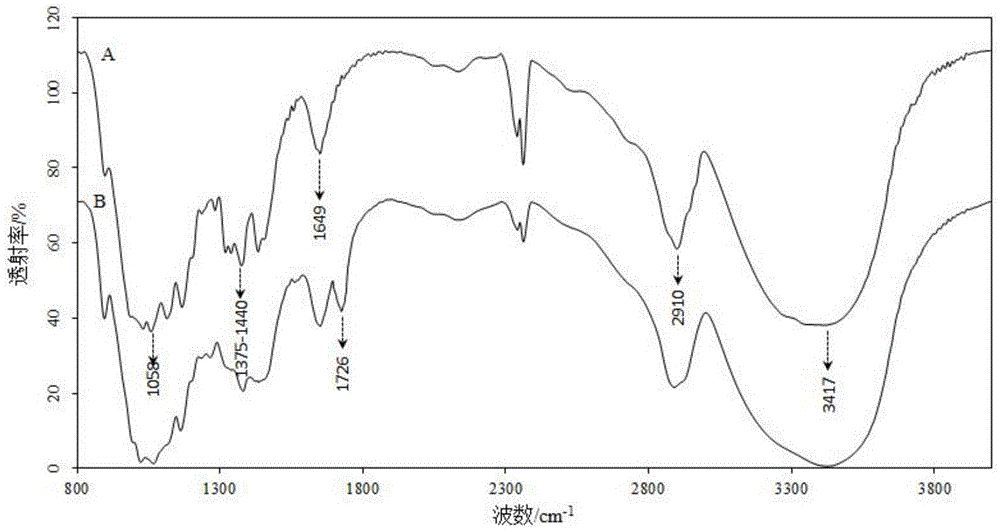
Examples
Embodiment 1
[0027] (1) Take an appropriate amount of microcrystalline cellulose in a beaker, and dry at 80°C for 4-6 hours;
[0028] (2) Weigh 2.25g of ionic liquid [EMIM][DEP] and 0.15g of dried microcrystalline cellulose, successively add them to 20ml iodine measuring bottle A, and carry out oil bath in a collector type constant temperature heating magnetic stirrer. Heat and magnetically stir, react at a constant temperature of 90°C for 1.5 hours to prepare a cellulose solution, at this time the microcrystalline cellulose is completely activated and dissolved in [EMIM][DEP];
[0029] (3) Weigh 1.5g of [EMIM][DEP] and 0.15g of succinic anhydride, add them to 20ml iodine bottle B successively, heat in an oil bath and magnetically stir in a collector type constant temperature heating magnetic stirrer, 40°C React at constant temperature for 1 hour to obtain a succinic anhydride solution;
[0030] (4) Add the above-mentioned cellulose solution and succinic anhydride solution successively in...
Embodiment 2
[0033] (1) Take an appropriate amount of microcrystalline cellulose in a beaker, and dry at 80°C for 4-6 hours;
[0034] (2) Weigh 2.25g of ionic liquid [EMIM][DEP] and 0.15g of dried microcrystalline cellulose, successively add them to 20ml iodine measuring bottle A, and carry out oil bath in a collector type constant temperature heating magnetic stirrer. Heat and magnetically stir, react at a constant temperature of 90°C for 2 hours to prepare a cellulose solution, at this time the microcrystalline cellulose is completely activated and dissolved in [EMIM][DEP];
[0035] (3) Weigh 1.5g of ionic liquid [EMIM][DEP] and 0.15g of succinic anhydride respectively, successively add to 20ml iodine measuring bottle B, carry out oil bath heating and magnetic stirring in the collector type constant temperature heating magnetic stirrer, React at a constant temperature of 40°C for 0.5h to obtain a succinic anhydride solution;
[0036] (4) Add the above-mentioned cellulose solution and su...
Embodiment 3
[0039] (1) Take an appropriate amount of microcrystalline cellulose in a beaker, and dry at 80°C for 4-6 hours;
[0040] (2) Weigh 2.25g of ionic liquid [EMIM][DEP] and 0.15g of dried microcrystalline cellulose, successively add them to 20ml iodine measuring bottle A, and carry out oil bath in a collector type constant temperature heating magnetic stirrer. Heating and stirring with magnetic force, and reacting at a constant temperature of 90°C for 2 hours to obtain a cellulose solution;
[0041] (3) Weigh 1.5g of ionic liquid [EMIM][DEP] and 0.15g of maleic anhydride, successively add to 20ml iodine measuring bottle B, heat in an oil bath and magnetically stir in a collector type constant temperature heating magnetic stirrer , constant temperature reaction at 40°C for 0.5h to obtain a maleic anhydride solution;
[0042] (4) Add the above-mentioned cellulose solution and maleic anhydride solution to a 20ml iodine flask C successively, heat in an oil bath and magnetically stir ...
PUM
 Login to View More
 Abstract
Description
Claims
Application Information
 Login to View More