
Temperature-resistant salt-resistant low-tension foaming agent composition as well as preparation method and application thereof
A temperature-resistant, salt-resistant, low-tension technology, applied in drilling compositions, chemical instruments and methods, etc., can solve the problems of poor foam performance of low-tension surfactants, difficulty in forming stable plugs, and inability to clean up, etc. Achieve the effect of good foam stability, increased salt resistance, and strong salt resistance
- Summary
- Abstract
- Description
- Claims
- Application Information
AI Technical Summary
Problems solved by technology
Method used
Image

Examples
Embodiment 1
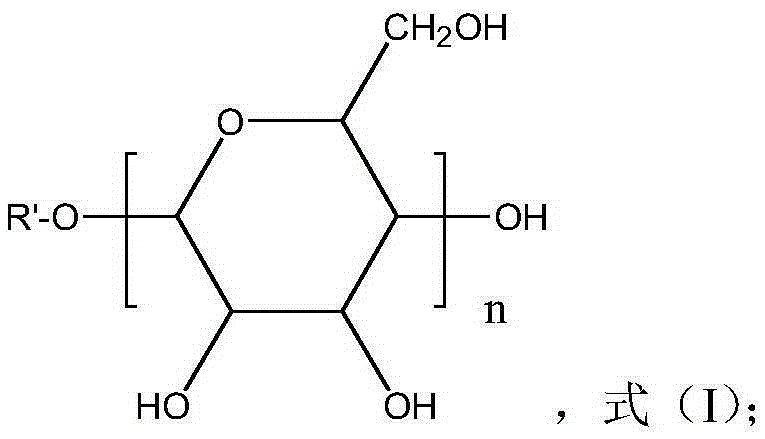
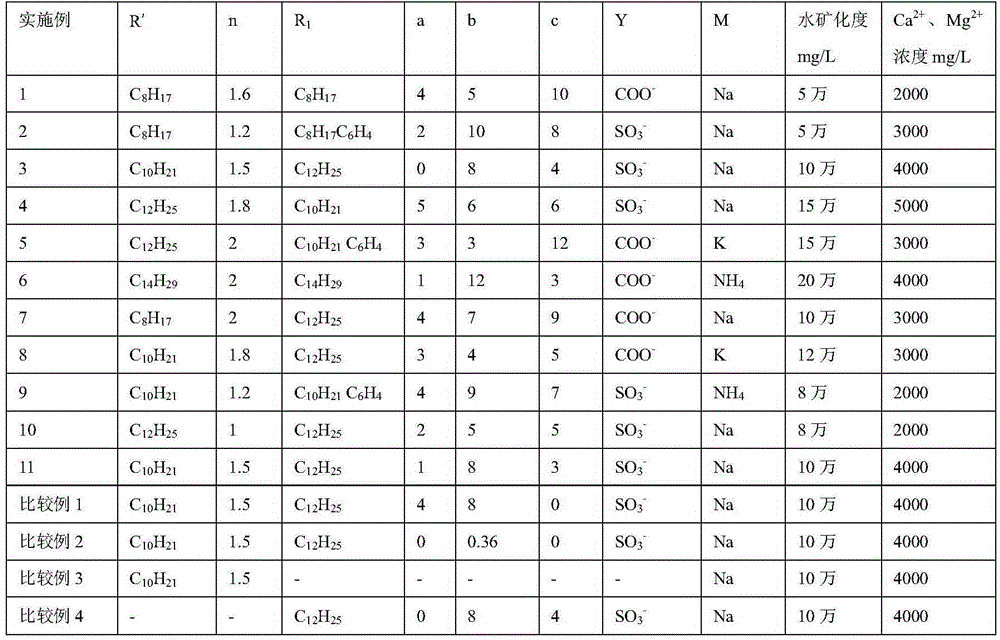
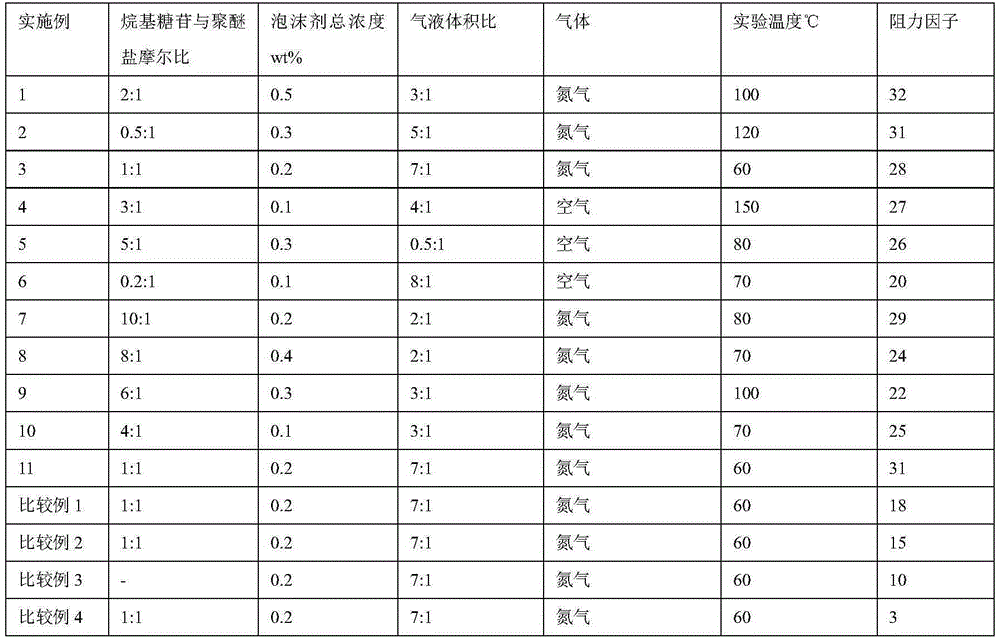
[0031] Dissolve the alkyl glucoside and polyether anionic surfactant in the water whose salinity is 50000mg / L and wherein the content of calcium and magnesium ions is 2000mg / L according to the molar ratio of 2:1, and the alkyl glycoside and polyether anionic surfactant Based on the total mass, the mass fraction is 0.5%, and mixed uniformly to form an aqueous foam agent solution, that is, to obtain the temperature-resistant, salt-resistant, low-tension foam agent composition.
[0032] The obtained temperature-resistant, salt-resistant, low-tension foam composition is mixed with nitrogen in a volume ratio of 3:1 to obtain a temperature-resistant, salt-resistant, low-tension foam flooding composition.
[0033] The above composition was taken under the condition of 100°C, and the test of foam plugging capacity was carried out in a sand-filled pipe with a length of 30 cm, a diameter of 3.8 cm, and a permeability of 300 mD. First inject water at a rate of 1mL / min, and record the pre...
Embodiment 2
[0035] Dissolve the alkyl glucoside and polyether anionic surfactant in the water whose salinity is 50000mg / L and wherein the calcium and magnesium ion content is 3000mg / L according to the molar ratio of 0.5:1, and the alkyl glycoside and polyether anionic surfactant Based on the total mass, the mass fraction is 0.3%, and mixed uniformly to form an aqueous foam agent solution, that is, to obtain the temperature-resistant, salt-resistant, low-tension foam agent composition.
[0036] The obtained temperature-resistant, salt-resistant, low-tension foam composition is mixed with nitrogen gas at a volume ratio of 5:1 to obtain a temperature-resistant, salt-resistant, low-tension foam flooding composition.
[0037]The above composition was taken under the condition of 120°C, and the test of foam plugging capacity was carried out in a sand-filled pipe with a length of 30 cm, a diameter of 3.8 cm, and a permeability of 300 mD. First inject water at a rate of 1mL / min, and record the pr...
Embodiment 3
[0039] Dissolve the alkyl glucoside and polyether anionic surfactant in the water with a salinity of 100000mg / L and a calcium and magnesium ion content of 4000mg / L according to the molar ratio of 1:1, and use the alkyl glycoside and polyether anionic surfactant Based on the total mass, the mass fraction is 0.2%, and they are uniformly mixed to form an aqueous solution of the foaming agent, that is, the temperature-resistant, salt-resistant, low-tension foaming agent composition is obtained.
[0040] The obtained temperature-resistant, salt-resistant, low-tension foam composition is mixed with nitrogen gas at a volume ratio of 7:1 to obtain a temperature-resistant, salt-resistant, low-tension foam flooding composition.
[0041] The above composition was taken under the condition of 60°C, and the test of foam plugging ability was carried out in a sand-filled pipe with a length of 30 cm, a diameter of 3.8 cm, and a permeability of 300 mD. First inject water at a rate of 1mL / min, ...
PUM
 Login to View More
 Abstract
Description
Claims
Application Information
 Login to View More