
High-temperature-resistant yellowing-resistant high-hardness vinyl acetate-acrylic emulsion and preparation method thereof
An acetone-acrylic emulsion and anti-yellowing technology, applied in the direction of monocarboxylate copolymer adhesive, adhesive type, etc., can solve the problem of reducing the forming hardness of sprayed cotton non-woven fabrics, increasing the residual amount of emulsion monomers, Low reaction conversion rate, etc., to avoid high temperature decomposition, reduce oxidation yellowing, and increase dry film hardness
- Summary
- Abstract
- Description
- Claims
- Application Information
AI Technical Summary
Problems solved by technology
Method used
Image

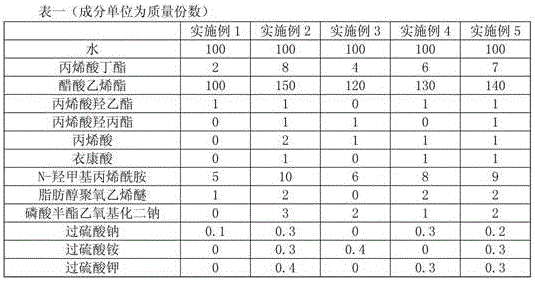
Examples
preparation example Construction
[0032] The preparation method of the high-temperature-resistant, yellowing-resistant high-hardness acetate-acrylic emulsion of the present invention comprises the following steps:
[0033] a) Weigh the raw materials according to the above ratio for later use;
[0034] b) Add 30-40 parts of water, emulsifier, butyl acrylate, vinyl acetate, functional monomer and N-methylol acrylamide into the emulsification tank under normal temperature and pressure, and fully stir until uniform;
[0035] c) Add the remaining amount of water into the reactor, raise the temperature of the reactor to 65-70°C, add 5-15% of the mixture obtained in step b, and react for 30-40 minutes;
[0036] d) Add the remaining mixture obtained in step b and persulfate to the mixture obtained in step c, keep the reaction temperature at 75-80°C and keep stirring, and the reaction time is 3-5 hours;
[0037] e) After the dropwise addition in step d, the temperature is raised to 80-85°C and kept for 1-2 hours;
[...
Embodiment 1
[0045] The high-temperature-resistant, yellowing-resistant high-hardness acrylic emulsion of the present invention comprises water, butyl acrylate, vinyl acetate, hydroxyethyl acrylate, N-methylol acrylamide, fatty alcohol polyoxyethylene ether, and sodium persulfate. The above components are calculated in parts by mass: 100 parts of water, 2 parts of butyl acrylate, 100 parts of vinyl acetate, 1 part of hydroxyethyl acrylate, 5 parts of N-methylol acrylamide, 1 part of fatty alcohol polyoxyethylene ether part, 0.1 part of sodium persulfate. Among them, N-methylolacrylamide is 40% effective active ingredient liquid.
[0046] The preparation method of the high-temperature-resistant, yellowing-resistant high-hardness acetate-acrylic emulsion of the present invention comprises the following steps:
[0047] a) Weigh the raw materials according to the above ratio for later use;
[0048] b) Add 30 parts of water, emulsifier, butyl acrylate, vinyl acetate, functional monomer and N-...
Embodiment 2
[0058] The high-temperature-resistant, yellowing-resistant high-hardness acetate-acrylic emulsion of the present invention comprises water, butyl acrylate, vinyl acetate, hydroxyethyl acrylate, hydroxypropyl acrylate, acrylic acid, itaconic acid, N-methylol acrylamide, Fatty Alcohol Ethoxylates, Disodium Phosphate Half Ethoxylate, Sodium Persulfate, Ammonium Persulfate, Potassium Persulfate. The above components are calculated in parts by mass: 100 parts of water, 8 parts of butyl acrylate, 150 parts of vinyl acetate, 1 part of hydroxyethyl acrylate, 1 part of hydroxypropyl acrylate, 2 parts of acrylic acid, 1 part of itaconic acid, 10 parts of N-methylol acrylamide, 2 parts of fatty alcohol polyoxyethylene ether, 3 parts of disodium ethoxylate phosphate half ester, 0.3 part of sodium persulfate, 0.3 part of ammonium persulfate, and 0.4 part of potassium persulfate. Among them, N-methylolacrylamide is 50% effective active ingredient liquid.
[0059] The preparation method of ...
PUM
 Login to View More
 Abstract
Description
Claims
Application Information
 Login to View More