Unlock instant, AI-driven research and patent intelligence for your innovation.

Multi-contact core-shell cavity structure sodium ion battery negative electrode material and preparation method thereof

A technology for sodium ion batteries and negative electrode materials, which is applied in battery electrodes, structural parts, secondary batteries, etc., can solve the problems of rapid capacity decay of tin dioxide, low conductivity and transmission efficiency, etc., and achieves rich pores and internal space, and reagent costs Low, the effect of shortening the diffusion distance

Active Publication Date: 2020-07-31
SOUTHEAST UNIV
View PDF1 Cites 0 Cited by
  • Summary
  • Abstract
  • Description
  • Claims
  • Application Information

AI Technical Summary

Problems solved by technology

[0004] Purpose of the invention: Aiming at the problems of the tin dioxide capacity fading fast and low conductivity transmission efficiency existing in the negative electrode materials of sodium ion batteries in the prior art, the present invention provides a negative electrode material for sodium ion batteries with a multi-contact core-shell cavity structure. The preparation method of the negative electrode material of the sodium ion battery is provided

Method used

the structure of the environmentally friendly knitted fabric provided by the present invention; figure 2 Flow chart of the yarn wrapping machine for environmentally friendly knitted fabrics and storage devices; image 3 Is the parameter map of the yarn covering machine
View more

Image

Smart Image Click on the blue labels to locate them in the text.
Viewing Examples
Smart Image
  • Multi-contact core-shell cavity structure sodium ion battery negative electrode material and preparation method thereof
  • Multi-contact core-shell cavity structure sodium ion battery negative electrode material and preparation method thereof
  • Multi-contact core-shell cavity structure sodium ion battery negative electrode material and preparation method thereof

Examples

Experimental program
Comparison scheme
Effect test

Embodiment 1

[0028] Add 8.87g of glucose and 3.93g of potassium stannate into a container filled with 70mL of deionized water in turn, then ultrasonicate the above mixed solution for 1 hour; put the obtained colorless solution into a 100mL hydrothermal reaction kettle, Seal it, and place the reaction kettle in a drying oven at 180° C. for 4 hours. After the reaction, the product was centrifuged, the supernatant was discarded, and the precipitate was thoroughly cleaned. The obtained product was dried in a vacuum oven at 80°C for 12 hours, and then the dried sample was placed in a tube at 550°C. In a type furnace, the heat treatment was carried out in air atmosphere for 4 hours, and the tin dioxide nanospheres were obtained after cooling.

[0029] Add 100mg of tin dioxide nanospheres to a container containing a mixed solution of 80mL of water and 20mL of ethanol, ultrasonically treat for 1 hour, then add 1mL of concentrated ammonia water and 0.5mL of ethyl orthosilicate to the above solution...

Embodiment 2

[0041] Add 7.86g of glucose and 3.93g of potassium stannate to a container containing 80mL of deionized water in turn, then ultrasonicate the above mixed solution for 1.5 hours; put the obtained colorless solution into a hydrothermal reaction kettle, seal it, The reaction kettle was heated in a drying oven at 170°C for 6 hours; after the reaction, the product was centrifuged, the supernatant was discarded, and the precipitate was thoroughly cleaned, and the obtained product was placed in a vacuum drying oven at 70°C Dry for 10 hours, then place the dried sample in a tube furnace at 500°C, heat-treat for 3 hours in an air atmosphere, and obtain tin dioxide nanospheres after cooling.

[0042] Add 100mg of tin dioxide nanospheres into a container containing a mixed solution of 60mL of water and 20mL of ethanol, ultrasonically treat it for 2 hours, then add 1mL of concentrated ammonia water and 0.4mL of ethyl orthosilicate to the above solution successively, continuously Stir for ...

Embodiment 3

[0048] Add 11.79g of glucose and 3.93g of potassium stannate into a container containing 80mL of deionized water in turn, then ultrasonicate the above mixed solution for 0.5 hours; put the obtained colorless solution into a hydrothermal reaction kettle, seal it, The reaction kettle was heated in a drying oven at 160°C for 8 hours; after the reaction, the product was centrifuged, the supernatant was discarded, and the precipitate was thoroughly cleaned, and the obtained product was placed in a vacuum drying oven at 60°C Dry in the middle for 8 hours, then place the dried sample in a tube furnace at 600°C, heat-treat for 2 hours in air atmosphere, and obtain tin dioxide nanospheres after cooling.

[0049] Add 100mg of tin dioxide nanospheres into a container containing a mixed solution of 40mL of water and 20mL of ethanol, and ultrasonically treat it for 1.5 hours; Stir for 8 hours, centrifuge the product after the reaction is complete, pour off the supernatant, and wash the pre...

the structure of the environmentally friendly knitted fabric provided by the present invention; figure 2 Flow chart of the yarn wrapping machine for environmentally friendly knitted fabrics and storage devices; image 3 Is the parameter map of the yarn covering machine
Login to View More

PUM

PropertyMeasurementUnit
diameteraaaaaaaaaa
retention rateaaaaaaaaaa
Login to View More

Abstract

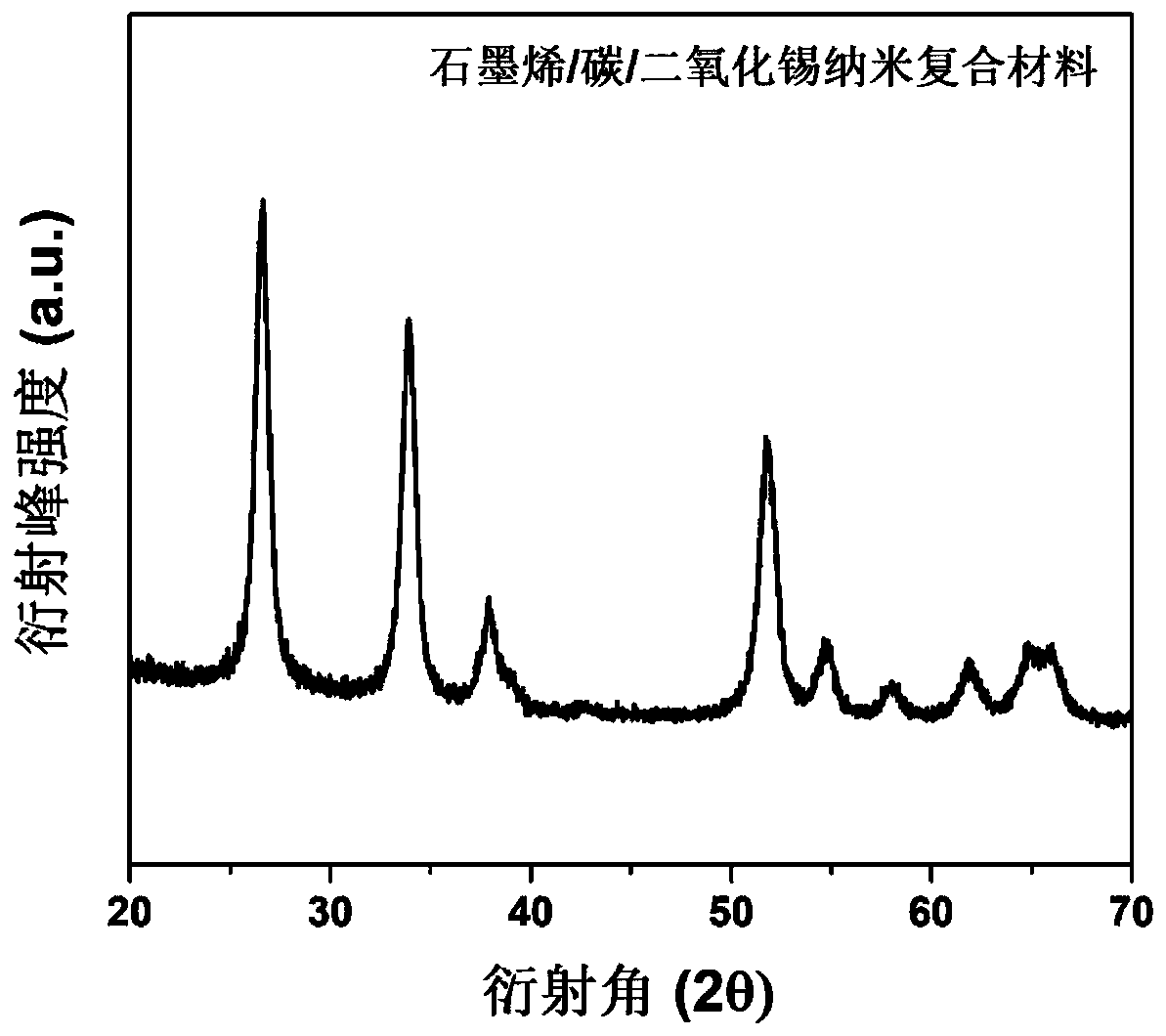
The invention discloses a multi-contact core-shell cavity-structure sodium ion battery negative electrode material and a preparation method thereof. The multi-contact core-shell cavity-structure sodium ion battery negative electrode material is a graphene / carbon / tin dioxide core-shell cavity-structure nanometer composite material, wherein a core layer is a tin dioxide porous nanosphere, the shellis a graphene nanosheet, and the core layer and the shell are in multi-contact connection by a carbon nanometer belt. The preparation method of the multi-contact core-shell cavity-structure sodium ionbattery negative electrode material comprises the steps of preparing the tin dioxide nanosphere, sequentially coating a layer of silicon dioxide and a layer of polydopamine on a surface of the tin dioxide nanosphere; mixing the obtained product with polyvinyl alcohol and a graphene oxide aqueous solution, continuously stirring for 8-12 hours under 50-70 DEG C, dropwise adding the mixture into a die, demolding after freezing and formation to obtain a sample, and performing freezing-drying and thermal processing on the sample; and placing the obtained product in a sodium hydroxide aqueous solution for stirring 8-12 hours at 50-70 DEG C, thereby obtaining the multi-contact core-shell cavity-structure sodium ion battery negative electrode material. When the material is used as a sodium ion battery negative electrode, superhigh specific capacity, excellent rate performance and cycle stability are shown due to excellent structural characteristic.

Description

technical field [0001] The invention relates to a negative electrode material for a sodium ion battery and a preparation method thereof, in particular to a negative electrode material for a sodium ion battery with a multi-contact core-shell cavity structure and a preparation method thereof, and belongs to the technical field of nanocomposite material preparation. Background technique [0002] At present, lithium-ion batteries have become the main power source of portable devices such as mobile phones and notebook computers, and with the rapid development of large-scale energy storage devices such as electric vehicles, the demand for lithium-ion batteries will increase. However, due to the relative scarcity of lithium resources, the cost of lithium-ion batteries remains high, which seriously restricts its practical application. In recent years, it has become a trend to replace lithium-ion batteries with sodium-ion batteries. This is because sodium resources are very abundant,...

Claims

the structure of the environmentally friendly knitted fabric provided by the present invention; figure 2 Flow chart of the yarn wrapping machine for environmentally friendly knitted fabrics and storage devices; image 3 Is the parameter map of the yarn covering machine
Login to View More

Application Information

Patent Timeline
no application Login to View More
Patent Type & Authority Patents(China)
IPC IPC(8): H01M4/36H01M4/48H01M4/62H01M10/054B82Y30/00B82Y40/00
CPCB82Y30/00B82Y40/00H01M4/362H01M4/483H01M4/62H01M4/625H01M4/628H01M10/054Y02E60/10
Inventor 陈坚徐晖秦立光
Owner SOUTHEAST UNIV