

A kind of preparation method of iridium-catalyzed moxifloxacin side chain intermediate
A technology of moxifloxacin side chain and intermediate, applied in the field of pharmacy, can solve the problems of environmental pollution, increase production cost, reduce the total yield of synthesis, etc., and achieve the effect of wide application prospect.
- Summary
- Abstract
- Description
- Claims
- Application Information
AI Technical Summary
Problems solved by technology
Method used
Image



Examples
Embodiment 1
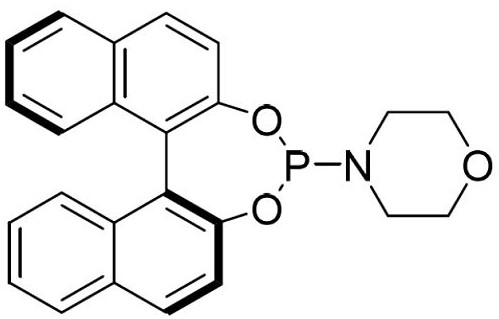
[0035] Asymmetric hydrogenation of (1S,6R)-8-benzyl-7,9-dioxo-2,8-diazabicyclo[4,3,0]nonane: In a 10mL reaction tube, add Phosphine ligand L1 (0.005mmol) and [Ir(COD)Cl] 2 (0.005mmol), the system passed through the vacuum line, replaced with nitrogen for 3 times, added 2 mL of freshly steamed degassed toluene, the solution was stirred at room temperature for 1 hour, and the solvent was removed under reduced pressure to obtain a brown solid. After 2 hours of vacuum pumping, 2 mL of tert-butanol solvent, add this solution into a vial containing 6-benzyl-pyrrolo[3,4-b]pyridine-5,7-dione (0.5mmol), put it into an autoclave and replace it with hydrogen six times Afterwards, the initial hydrogen pressure was 20 bar, and the reaction was stirred at 90° C. for 24 hours. Cool, release gas carefully, open the autoclave, take out the vial, drain the solvent, detect the conversion rate by NMR, detect the enantiomeric excess value by liquid chromatography, and obtain the product by column...
Embodiment 2
[0038] Asymmetric hydrogenation of (1S,6R)-8-benzyl-7,9-dioxo-2,8-diazabicyclo[4,3,0]nonane: In a 10mL reaction tube, add Phosphine ligand L1 (0.005mmol) and [Ir(COD)Cl] 2 (0.005mmol), the system passed through the vacuum line, replaced 3 times with nitrogen, added 2 mL of freshly steamed degassed tert-butanol, and the solution was stirred at room temperature for 1 hour, and the solvent was removed under reduced pressure to obtain a brown solid. After vacuum pumping for 2 hours, Add 2mL of tert-butanol solvent, add this solution into a vial containing 6-benzyl-pyrrolo[3,4-b]pyridine-5,7-dione (0.5mmol), and put it into an autoclave for six times After hydrogen replacement, the initial hydrogen pressure was 20 bar, and the reaction was stirred at 90° C. for 24 hours. Cool, release gas carefully, open the autoclave, take out the vial, drain the solvent, detect the conversion rate by NMR, detect the enantiomeric excess value by liquid chromatography, and obtain the product by co...
Embodiment 3
[0040] Asymmetric hydrogenation of (1S,6R)-8-benzyl-7,9-dioxo-2,8-diazabicyclo[4,3,0]nonane: In a 10mL reaction tube, add Phosphine ligand L2 (0.005mmol) and [Ir(COD)Cl] 2 (0.005mmol), the system passed through the vacuum line, replaced 3 times with nitrogen, added 2 mL of freshly steamed degassed tert-butanol, and the solution was stirred at room temperature for 1 hour, and the solvent was removed under reduced pressure to obtain a brown solid. After vacuum pumping for 2 hours, Add 2mL of tert-butanol solvent, add this solution into a vial containing 6-benzyl-pyrrolo[3,4-b]pyridine-5,7-dione (0.5mmol), and put it into an autoclave for six times After hydrogen replacement, the initial hydrogen pressure was 20 bar, and the reaction was stirred at 90° C. for 24 hours. Cool, release gas carefully, open the autoclave, take out the vial, drain the solvent, detect the conversion rate by NMR, detect the enantiomeric excess value by liquid chromatography, and obtain the product by co...
PUM
 Login to View More
 Abstract
Description
Claims
Application Information
 Login to View More