Al technical title is built by PatSnap Al team. It summarizes the technical point description of the patent document.
A micro-lubrication, water-insoluble technology, used in lubricating compositions, petroleum industry, etc., which can solve the problems of large particle size, difficult to follow lubricating oil, and inapplicability
Active Publication Date: 2020-04-17
苏州福瑞斯德新材料科技有限公司
View PDF12 Cites 2 Cited by
Summary
Abstract
Description
Claims
Application Information
AI Technical Summary
This helps you quickly interpret patents by identifying the three key elements:
Problems solved by technology
Method used
Benefits of technology
Problems solved by technology
However, ordinary solidmolybdenum disulfide has a larger particle size than nano molybdenum disulfide, and it is difficult to follow the lubricating oil to form droplets, which is not suitable for lubricating oil in minimum quantity lubrication. MoS 2 water-insoluble microlubricating fluid with a wide range of value
Method used
the structure of the environmentally friendly knitted fabric provided by the present invention; figure 2 Flow chart of the yarn wrapping machine for environmentally friendly knitted fabrics and storage devices; image 3 Is the parameter map of the yarn covering machine
View more
Image
Smart Image Click on the blue labels to locate them in the text.
Viewing Examples
Smart Image
Click on the blue label to locate the original text in one second.
Reading with bidirectional positioning of images and text.
Smart Image
Examples
Experimental program
Comparison scheme
Effect test
Embodiment 1
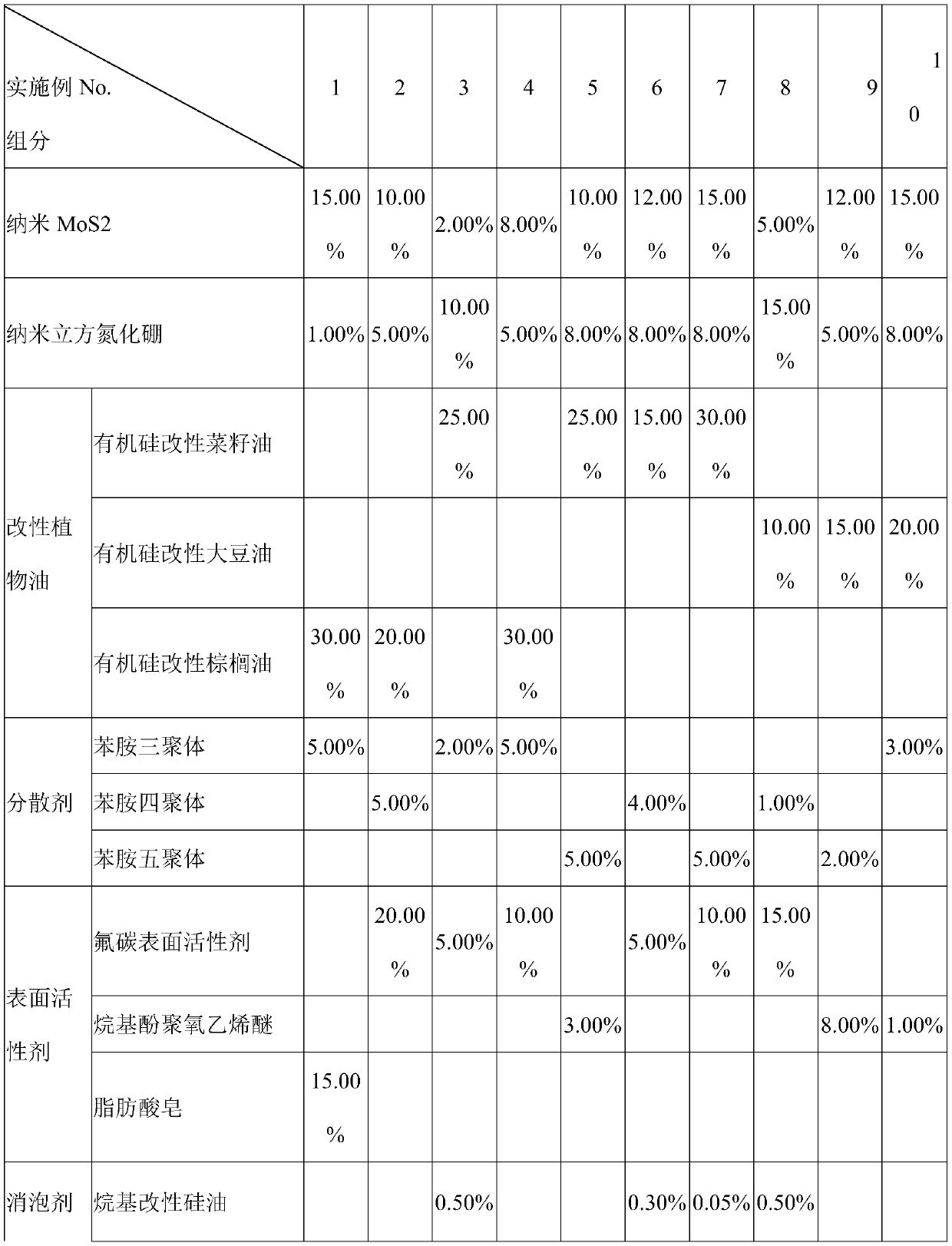
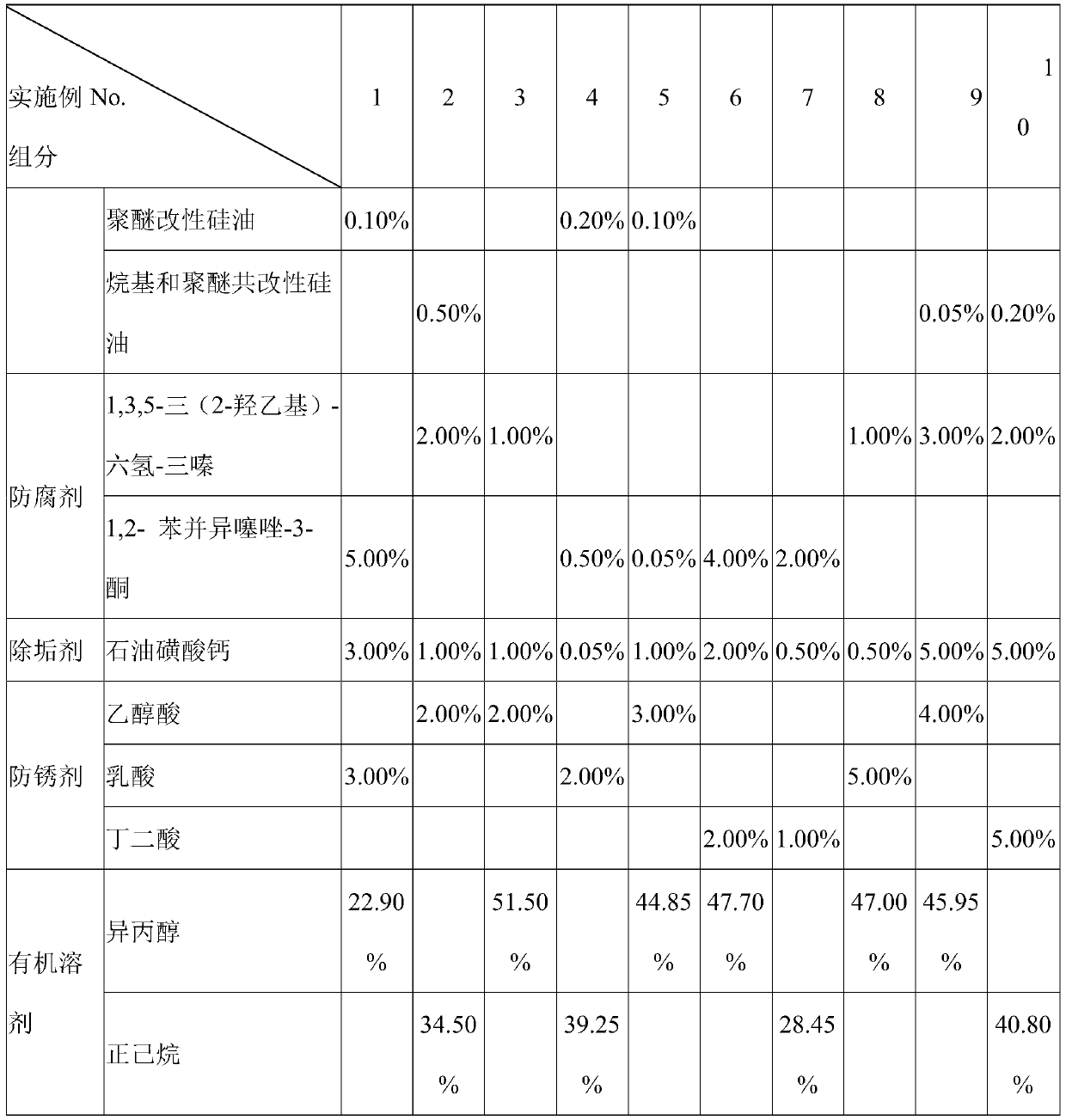
[0063] The invention provides a MoS-containing 2 The non-water-soluble micro-lubricating fluid comprises each component according to the weight percentage of Example 1 in the above Table 1.
[0064] 1. Preparation of nano-MoS 2
[0065] Wherein, the method includes the following steps:
[0066] (1) Mix the prepared ammoniummolybdate solution and ammoniumsulfide solution in a three-necked flask with a molar ratio of 1:5, and use 95% ethanol as a dispersant and a surfactant;
[0067] (2) Put it in a constant temperature water bath at 90°C, drop hydrochloric acid into the mixed solution under continuous stirring conditions, make it evenly mixed and fully react;
[0068] (3) After the reaction is finished, filter the precipitate to obtain a brown paste precipitate, and then repeatedly wash the precipitate;
[0069] (4) Make a suspension with absolute ethanol, put it in a drying oven at 60°C and dry it for 6 hours to obtain molybdenum trisulfide;
[0085] Each of Examples 2-10 contains MoS 2 The non-water-miscible microlubricating fluid, comprising each component of the weight percent of embodiment 2-10 in above-mentioned table 1, and the nanometer MoS that uses 2 The preparation method and the preparation method of the water-soluble micro-lubricating fluid are consistent with those in Example 1.
[0086] Containing MoS for Examples 1-10 2 The method, procedure, and evaluation of the physical properties of the non-water-soluble microlubricating fluid are carried out in accordance with the standard GB / T6144-2010, and the results are shown in Table 2.
[0087] Table 2 MoS of Examples 1-10 2 Evaluation results of the physical properties of the water-insoluble microlubricating fluid
[0088]
[0089] According to the above experimental data, the appearance, defoaming property, surface tension and rust resistance of the water-insoluble trace lubricating fluids in Examples 3, 5-6 and 8-10 all conform to the national stan...
the structure of the environmentally friendly knitted fabric provided by the present invention; figure 2 Flow chart of the yarn wrapping machine for environmentally friendly knitted fabrics and storage devices; image 3 Is the parameter map of the yarn covering machine
Login to View More
PUM
Login to View More
Abstract
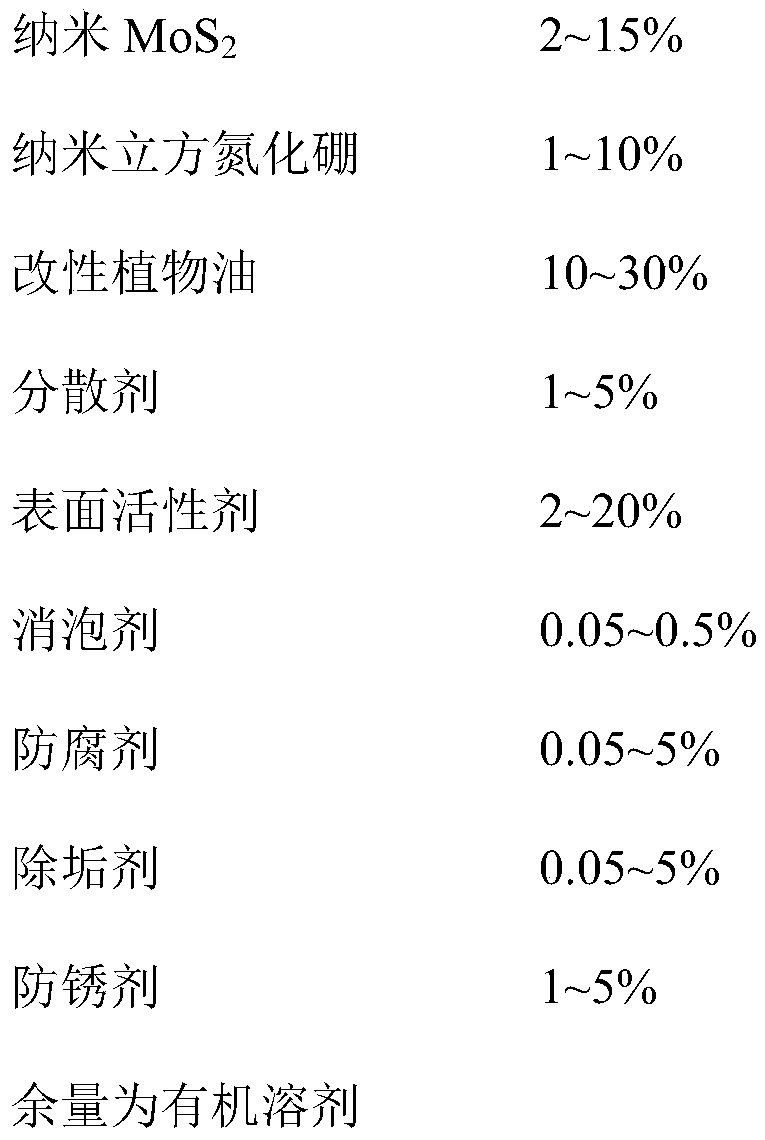
The invention discloses a non-water-soluble minimal quantity lubricating liquid containing MoS2. The lubricating liquid comprises 2-15 wt% of nanometer molybdenum disulfide, 1-10 wt% of nanometer cubic boronnitride, 10-30 wt% of modified vegetable oil, 1-5 wt% of a dispersing agent, 2-20 wt% of a surfactant, 0.05-0.5 wt% of a defoaming agent, 0.05-5 wt% of a preservative, 0.05-5 wt% of a descaling agent, 1-5 wt% of an antirust agent, and the balance of an organic solvent. The molybdenum content in the lubricating liquid is high, and the hexagonal boron nitride and the nano-MoS2 particles canform a synergistic effect to achieve the good lubricating effect; and the degradable modified vegetable oil is used for replacing mineral oil, so the service life is long, and environmental protectionis achieved.
Description
technical field [0001] The invention belongs to the technical field of lubricating oil and lubricating oil additives, and relates to a MoS-containing 2 Non-water-soluble micro-lubricating fluid; especially suitable for drilling, reaming, tapping, deep hole drilling, aluminum alloy face milling and other processing of cast iron, steel and aluminum alloy. Background technique [0002] The concept of minimum quantity lubrication was first proposed in 1996 by two scholars, W.D.Hewson and G.K.Gerow of Michigan Technical University. The application of minimal quantity lubrication technology began in the late 1990s in some foreign industrial powers. At the beginning, it was limited to the field of castingprocessing, and then gradually expanded to non-ferrous metals such as steel and aluminum parts. [0003] Minimal quantity lubrication is an emerging green manufacturing technology. It is to mix a small amount of lubricant into high-pressure gas, and enter the high-temperature cut...
Claims
the structure of the environmentally friendly knitted fabric provided by the present invention; figure 2 Flow chart of the yarn wrapping machine for environmentally friendly knitted fabrics and storage devices; image 3 Is the parameter map of the yarn covering machine
Login to View More
Application Information
Patent Timeline
Application Date:The date an application was filed.
Publication Date:The date a patent or application was officially published.
First Publication Date:The earliest publication date of a patent with the same application number.
Issue Date:Publication date of the patent grant document.
PCT Entry Date:The Entry date of PCT National Phase.
Estimated Expiry Date:The statutory expiry date of a patent right according to the Patent Law, and it is the longest term of protection that the patent right can achieve without the termination of the patent right due to other reasons(Term extension factor has been taken into account ).
Invalid Date:Actual expiry date is based on effective date or publication date of legal transaction data of invalid patent.



 Login to View More
  Login to View More