Unlock instant, AI-driven research and patent intelligence for your innovation.
Adipose extracellular matrix scaffold and production method and application thereof
Active Publication Date: 2020-07-07
SHENZHEN LANDO BIOMATERIALS
View PDF10 Cites 5 Cited by
Summary
Abstract
Description
Claims
Application Information
AI Technical Summary
This helps you quickly interpret patents by identifying the three key elements:
Problems solved by technology
Method used
Benefits of technology
Problems solved by technology
However, the mechanical strength of fat extracellular matrix is poor, and the degradation rate in vivo is too fast, which is not conducive to the application of fat extracellular matrix in the field of biomedical materials.
Method used
the structure of the environmentally friendly knitted fabric provided by the present invention; figure 2 Flow chart of the yarn wrapping machine for environmentally friendly knitted fabrics and storage devices; image 3 Is the parameter map of the yarn covering machine
View more
Image
Smart Image Click on the blue labels to locate them in the text.
Viewing Examples
Smart Image
Click on the blue label to locate the original text in one second.
Reading with bidirectional positioning of images and text.
Smart Image
Examples
Experimental program
Comparison scheme
Effect test
preparation example Construction
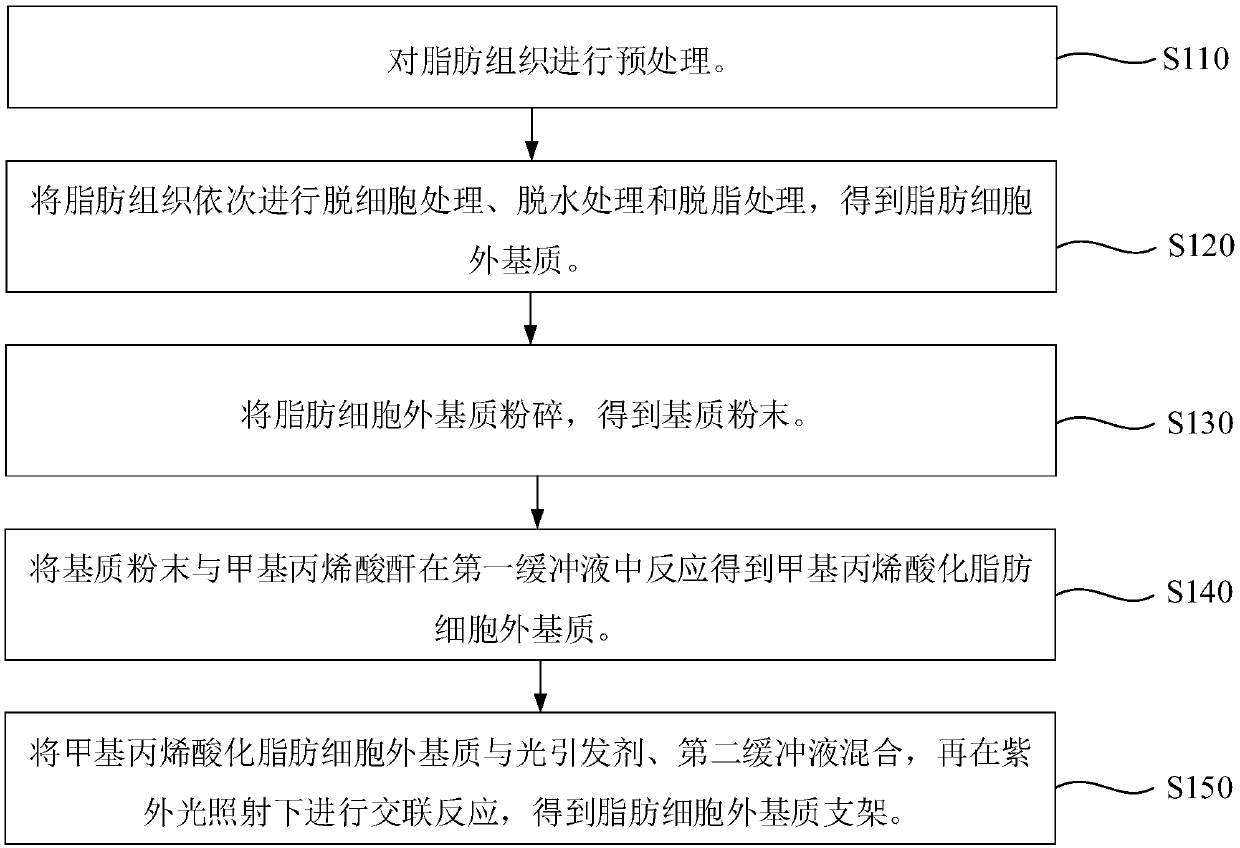
[0035] Such asfigure 1 As shown, the preparation method of the adipocyte extracellular matrix scaffold in one embodiment comprises the following steps:
[0036] Step S110: Perform pretreatment on the adipose tissue.
[0037] Wherein, the step of pretreating the adipose tissue includes: washing the adipose tissue with physiological saline to remove the blood in the adipose tissue; then mixing the washed adipose tissue with water for homogenization and collecting the precipitate.
[0038] Specifically, the adipose tissue may be animal fat or isolated human fat, wherein the isolated human fat may be extracted human fat, for example.
[0039] Specifically, the step of washing the adipose tissue with physiological saline includes: chopping the adipose tissue, mixing it with physiological saline, and centrifuging at 1000 rpm to 2000 rpm for 3 minutes to 10 minutes to remove blood in fat.
[0040] Specifically, the step of mixing the washed adipose tissue with water for homogenizat...
Embodiment 1
[0076] The preparation process of the adipocyte extracellular matrix scaffold of the present embodiment is as follows:
[0077] (1) Pretreatment of adipose tissue: cut fresh porcine adipose tissue into small pieces with a size of about 1cm×1cm×1cm, then mix with normal saline, and centrifuge at 1200 rpm for 8 minutes to remove fat in the blood. Mix the washed adipose tissue with pure water at a mass ratio of 0.5:1, then homogenize in a high-speed homogenizer at room temperature at a speed of 12,000 rpm for 6 minutes, and place the homogenized tissue suspension to obtain a suspension The suspension was centrifuged at 4° C. for 3 minutes at a speed of 3000 rpm, and the white precipitate was collected to obtain pretreated adipose tissue.
[0078] (2) Decellularization treatment: mix the pretreated adipose tissue obtained in step (1) with an aqueous solution of sodiumhydroxide with a mass percentage concentration of 1.0% in a mass ratio of 1:20, and then at 25° C. Incubate in a...
Embodiment 2
[0084] The preparation process of the adipocyte extracellular matrix scaffold of the present embodiment is as follows:
[0085] (1) Pretreatment of adipose tissue: the body fat collected by liposuction was mixed with normal saline, and centrifuged at 2000 rpm for 10 minutes to remove the blood in the fat. Mix the washed adipose tissue with pure water at a mass ratio of 3:1, then homogenize in a high-speed homogenizer at room temperature at a speed of 10,000 rpm for 3 minutes, and let the homogenized tissue suspension stand still to obtain a suspension Liquid, the suspension was centrifuged at 10° C. for 10 minutes at a speed of 5000 rpm, and the white precipitate was collected to obtain pretreated adipose tissue.
[0086] (2) Decellularization treatment: mix the pretreated adipose tissue obtained in step (1) with an aqueous solution of sodiumhydroxide with a mass percentage concentration of 2% in a mass ratio of 1:10, and then at 20° C. Incubate in a shaking shaker for 4 hou...
the structure of the environmentally friendly knitted fabric provided by the present invention; figure 2 Flow chart of the yarn wrapping machine for environmentally friendly knitted fabrics and storage devices; image 3 Is the parameter map of the yarn covering machine
technical field [0001] The invention relates to the field of biomedical materials, in particular to a fat cell extracellular matrix scaffold and its preparation method and application. Background technique [0002] In recent years, soft tissue injuries caused by congenital malformations, chronic diseases, infections, tumor resections, or traumas have been increasing every year, leading to an increase in medical costs and patient morbidity. However, for soft tissue injuries, the ideal surgical treatment is to completely resect the defective tissue first, and then replace the defective tissue and reconstruct the structure and function of the defective tissue by whole organ transplantation or autologous transplantation. However, the lack of availability to transplant soft tissue, the relative complexity of tissue matching, and the high risk of morbidity at the donor site make whole organ transplantation or autologous transplantation for soft tissue defects relatively difficult ...
Claims
the structure of the environmentally friendly knitted fabric provided by the present invention; figure 2 Flow chart of the yarn wrapping machine for environmentally friendly knitted fabrics and storage devices; image 3 Is the parameter map of the yarn covering machine
Login to View More
Application Information
Patent Timeline
Application Date:The date an application was filed.
Publication Date:The date a patent or application was officially published.
First Publication Date:The earliest publication date of a patent with the same application number.
Issue Date:Publication date of the patent grant document.
PCT Entry Date:The Entry date of PCT National Phase.
Estimated Expiry Date:The statutory expiry date of a patent right according to the Patent Law, and it is the longest term of protection that the patent right can achieve without the termination of the patent right due to other reasons(Term extension factor has been taken into account ).
Invalid Date:Actual expiry date is based on effective date or publication date of legal transaction data of invalid patent.



 Login to View More