
Flange with neck and its preparing method
A high-neck flange and flange technology, which is used in the field of neck flanges and their preparation, can solve the problems of unguaranteed air tightness, low reliability requirements, and unguaranteed quality, and achieves high productivity. , The effect of high material utilization rate and less process
Inactive Publication Date: 2005-05-18
INST OF METAL RESEARCH - CHINESE ACAD OF SCI
View PDF0 Cites 0 Cited by
- Summary
- Abstract
- Description
- Claims
- Application Information
AI Technical Summary
Problems solved by technology
The first method is the method of plate processing, that is, the rolled plate is blanked and machined into a flange; at the same time, the plate is machined and machined, the coiled plate is welded into a cylindrical shape, and the flange neck is formed after shaping; The blue plate and the flange neck are welded together, and the finished product is machined as a whole; the disadvantage of this method is that the material utilization rate is low, the process is many, the process is complicated, and the cycle is long. In addition, the product has two welds, and the airtightness is not good enough. Guaranteed, poor reliability
The second method is the forging method, that is, the process route of casting, ring rolling and turning machine to add the flange neck. This method has no weld seam, the air tightness can be reliably guaranteed, and the mechanical properties of the product are good. The quality is stable and reliable, but this method requires a large investment in equipment, and only those factories with strong equipment and technical capabilities can adopt it. It is only suitable for the production of standard flanges with large market demand, and the material utilization rate is only 50%.
The third method is the casting method, that is, the neck flange is directly manufactured by casting method. Although the manufacturing cost of this method is low, the quality cannot be guaranteed, and the material required for some flanges is forged alloy. Suitable for casting, this method is powerless, so the flange cast by this method is mainly used in occasions with low pipeline pressure and low reliability requirements, such as gray cast iron and ductile iron flanges, etc., which are widely used in water supply and drainage projects
Method used
the structure of the environmentally friendly knitted fabric provided by the present invention; figure 2 Flow chart of the yarn wrapping machine for environmentally friendly knitted fabrics and storage devices; image 3 Is the parameter map of the yarn covering machine
View moreImage
Smart Image Click on the blue labels to locate them in the text.
Smart ImageViewing Examples

Examples
Experimental program
Comparison scheme
Effect test
Embodiment
[0021] LF 2R High neck flange, smelting alloy according to GB3193-82 standard, pouring at 700±15°C, mold temperature 250±50°C, mold closing time, pressure gradually rising time is not more than 5 seconds, when reaching 25MPa, hold pressure for 1 minute and 30 seconds Up to 2 minutes, open the touch, and eject the workpiece. In order to make the workpiece easy to come out, the lubricant can be sprayed in the inner cavity of the mold. The material of the flange is a deformed alloy, which is not suitable for casting. The performance of the flange prepared by the method of this embodiment reaches σ D ≥187Mpa, δ≥24%, good welding performance.
the structure of the environmentally friendly knitted fabric provided by the present invention; figure 2 Flow chart of the yarn wrapping machine for environmentally friendly knitted fabrics and storage devices; image 3 Is the parameter map of the yarn covering machine
Login to View More PUM
 Login to View More
 Abstract
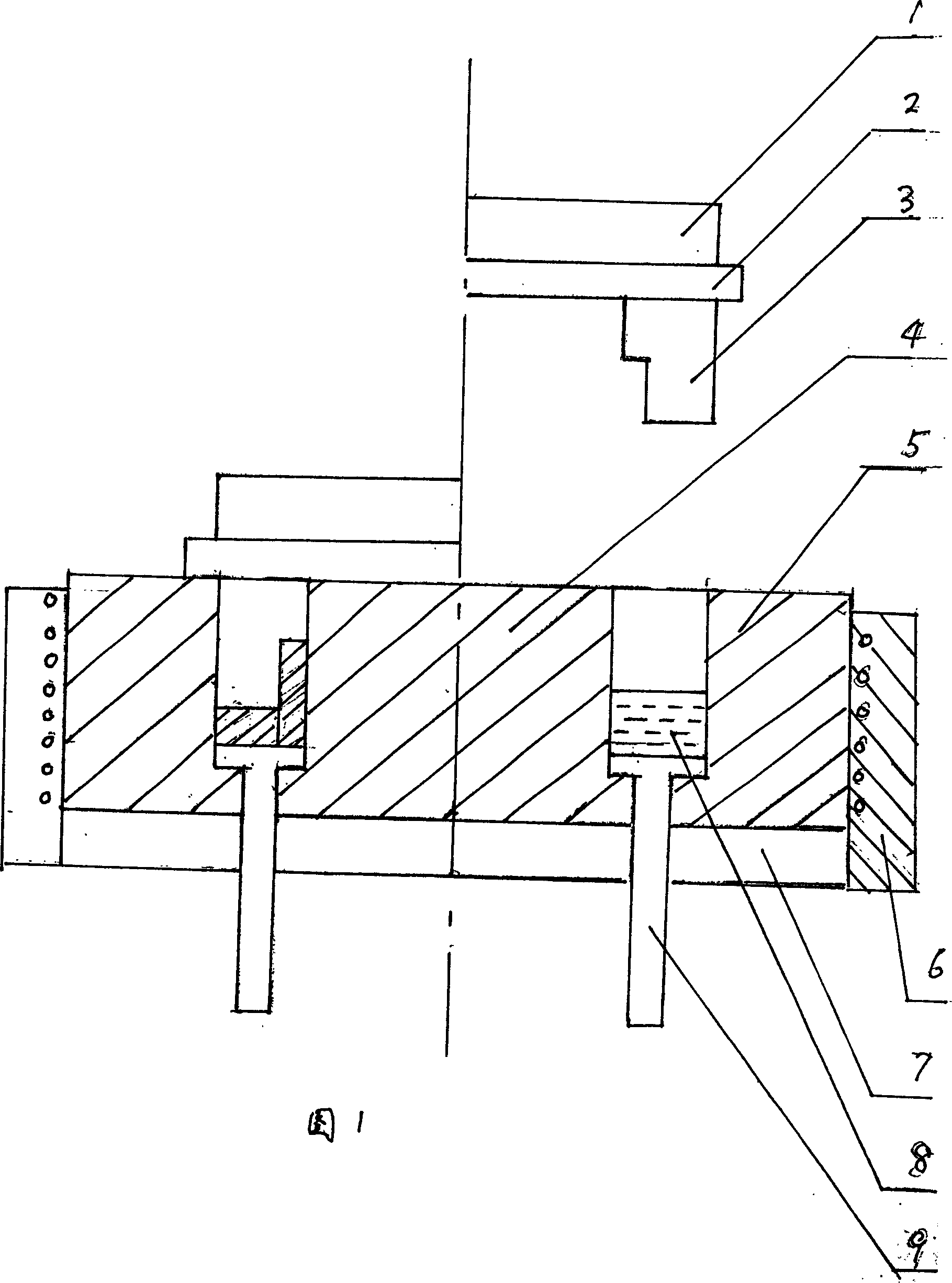
The present invention relates to a LF 2R High-neck flange, obtained by extrusion casting, has no weld seam, and its microstructure presents a continuous streamlined structural feature, and its streamlined shape is consistent with the direction of the flange shape; a preparation method of a LF2R high-neck flange of the present invention , the metal liquid crystallizes and solidifies under the pressure in the mold casting cavity composed of the upper pressure head, the female mold (5), the mold core (4) and the ejector pin (9); the extrusion casting process is: pouring at 700±15°C , The mold temperature is 250±50°C. When the mold is closed, the pressure gradually rises for no more than 5 seconds. When it reaches 25MPa, the pressure is kept for 1 minute 30 seconds to 2 minutes. The necked flange casting of the present invention has few internal defects, compact structure and high mechanical properties. The squeeze casting process has strong applicability, wide range of material selection, simple process, good stability, high casting quality, and easy casting. Implement automation.
Description
Technical field: [0001] The invention relates to a pipe connector flange, and in particular provides a necked flange obtained by a squeeze casting method and a preparation method thereof. Background technique: [0002] Flange is an indispensable part in pipeline connection, with a wide range of applications and a large market demand. Among them, the neck flange is a relatively complicated variety of flanges. At present, domestic enterprises specializing in the production of flanges mainly use the following three methods for production. The first method is the method of plate processing, that is, the rolled plate is blanked and machined into a flange; at the same time, the plate is machined and machined, the coiled plate is welded into a cylindrical shape, and the flange neck is formed after shaping; The blue plate and the flange neck are welded together, and the finished product is machined as a whole; the disadvantage of this method is that the material utilization rate is...
Claims
the structure of the environmentally friendly knitted fabric provided by the present invention; figure 2 Flow chart of the yarn wrapping machine for environmentally friendly knitted fabrics and storage devices; image 3 Is the parameter map of the yarn covering machine
Login to View More Application Information
Patent Timeline
 Login to View More
 Patent Type & AuthorityPatents(China)
IPC IPC(8): B22D18/02F16L23/00
Inventor闫德胜胡宛平杨奇雄
OwnerINST OF METAL RESEARCH - CHINESE ACAD OF SCI