Unlock instant, AI-driven research and patent intelligence for your innovation.

High voltage redox shuttles, method for making high voltage redox shuttles

a high-voltage redox and shuttle technology, applied in the direction of electrochemical generators, secondary cell servicing/maintenance, group 5/15 element organic compounds, etc., can solve the problems of long battery life, damage to battery components (e.g., the positive electrode or the cathode), and other problems, to achieve the effect of preventing overcharg

Active Publication Date: 2018-06-26
UCHICAGO ARGONNE LLC
View PDF14 Cites 0 Cited by
  • Summary
  • Abstract
  • Description
  • Claims
  • Application Information

AI Technical Summary

Benefits of technology

The present invention provides a redox shuttle for lithium batteries that has a high solubility in the battery's electrolyte. This increased solubility helps to prevent damage to the battery's components and allows for the shuttle to be used without the need for additional mechanisms to manage charge transfer. The invention also includes a method for producing the redox shuttle and a system for preventing overcharge in lithium batteries, which involves using the shuttle in combination with other components of the battery.

Problems solved by technology

Lithium ion batteries provide superior reversibility during charge / discharge cycles; longer battery lives result.
However, care must be taken to prevent overcharging, as battery components (e.g., the positive electrode or cathode), can be otherwise damaged.
If a short occurs in the wiring between the cells and the BMS, a thermal runaway could result from overcharging or from external excessive loading, as has been postulated in recent airliner electrical system malfunctions.
To date, there are no viable high voltage shuttles.
However, state of the art processes for producing redox-shuttles for lithium ion batteries require expensive starting materials, which are in many cases hazardous.
As a consequence of these drawbacks, the costs for producing more than small amounts of the shuttles is prohibitive.
Therefore, industrial scale up has been hampered.

Method used

the structure of the environmentally friendly knitted fabric provided by the present invention; figure 2 Flow chart of the yarn wrapping machine for environmentally friendly knitted fabrics and storage devices; image 3 Is the parameter map of the yarn covering machine
View more

Image

Smart Image Click on the blue labels to locate them in the text.
Viewing Examples
Smart Image
  • High voltage redox shuttles, method for making high voltage redox shuttles
  • High voltage redox shuttles, method for making high voltage redox shuttles
  • High voltage redox shuttles, method for making high voltage redox shuttles

Examples

Experimental program
Comparison scheme
Effect test

example 1

[0050]The following example is an exemplary embodiment of the invented method and resulting product.

Step I

Synthesis Detail

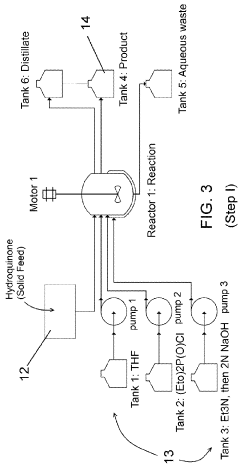
[0051]A glass reactor (20 L, jacketed, e.g., Chemglass) equipped with drain valve, internal temperature probe, reflux condenser, gas inlet / outlet adapters and powder port was flushed with argon. The jacket of the reactor was connected to a Huber heating / chilling circulator. An argon flow was continued to inert the reactor. The reactor was charged with hydroquinone (265 g), THF (4 L) and diethyl chloro-phosphate (995 g). The process temperature was set to 18° C. Triethylamine (1 L) was added via peristaltic pump at 10 mL / min. A light blue suspension formed within 20 minutes. The reaction was stirred overnight and cooled to about −2° C. MTBE (2 L) was added. The reaction was quenched by the addition of 2 L of 2M NaOH. The layers were separated and the organic layer washed with additional 2M NaOH (2×2 L). The organic layer was then rotovaped to a purple oil. The oil...

example 2

[0064]A 250 mL 3 neck flask was charged with tetraethyl (2,5-dimethoxy-1,4-phenylene)bis(phosphonate) (25.46 g, lot TD50129). A thermocouple and reflux condenser were attached. The flask was purged with inert gase (e.g., nitrogen) and the outlet gasses send to a NaOH(aq) trap. The solids were dissolved in thionyl chloride (75 mL) and the solution was heated to 65° C. with stirring. N,N-Dimethylformamide (19 mL, 4 equiv) was added via syringe pump over 1 hour. The solution was kept at temperature for 14 hours. The mixture was then cooled to room temperature.

[0065]The solids that precipitated from the reaction mixture were filtered under nitrogen and washed with toluene (2×20 mL) and MTBE (20 mL) and dried under a nitrogen stream for a time sufficient to yield substantially moisture free precipitate. (e.g., a drying protocol involves drying for about one hour to give an off-white powder. This material was split into two reactions.

[0066]The crude intermediate was slurried in 2-methylte...

example 3

[0068]A 250 mL 3 neck flask was charged with tetraethyl (2,5-dimethoxy-1,4-phenylene)bis(phosphonate) (10.0030 g, lot TD50127). A thermocouple and reflux condenser were attached. The flask was purged with an inert gas and the outlet gasses send to a NaOH(aq) trap. The solids were dissolved in thionyl chloride (25 mL) and the solution was heated to 65° C. with stirring. N,N-Dimethylformamide (7.5 mL, 4 equiv) was added via syringe pump over 1 hour. The solution was kept at temperature for 14 hours. HPLC showed some starting material. Additional DMF and SOCl2 were added. The mixture was then cooled to room temperature.

[0069]The solids that precipitated from the reaction mixture were filtered under nitrogen and washed with MTBE (2×20 mL) and dried under a nitrogen stream for 1 hour to give an off-white powder (10.3 g, theoretical 9.1 g).

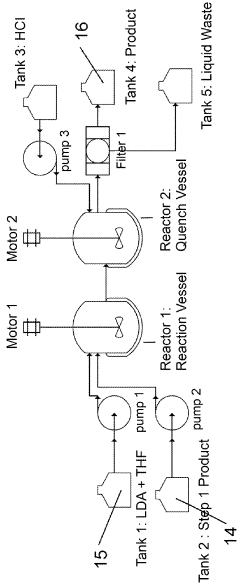
[0070]The crude intermediate was slurried in 2-methyltetrahydrofuran (50 mL). The mixture was cooled to between about 0 and about −10° C. Phenylmagnesi...

the structure of the environmentally friendly knitted fabric provided by the present invention; figure 2 Flow chart of the yarn wrapping machine for environmentally friendly knitted fabrics and storage devices; image 3 Is the parameter map of the yarn covering machine
Login to View More

PUM

PropertyMeasurementUnit
temperatureaaaaaaaaaa
Login to View More

Abstract

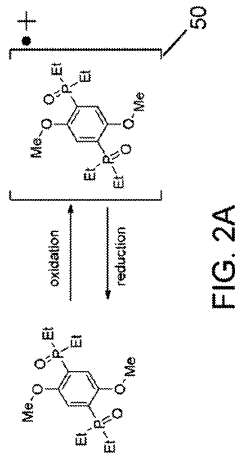
The invention provides a method for producing a molecule capable of undergoing reduction-oxidation when subjected to a voltage potential, the method comprising phosphorylating hydroquinone to create a first intermediate; rearranging the first intermediate to an aryl-bis-(phosphonate) thereby creating a second intermediate comprising phosphorous alkoxy groups; alkylating (e.g., methylating) the second intermediate; converting the alkoxy groups to halides; and substituting the halides to alkyl or aryl groups. Also provided is a system for preventing overcharge in a Lithium-ion battery, the method comprising a mixture of a redox shuttle with electrolyte in the battery such that the shuttle comprises between about 10 and about 20 weight percent of the mixture.

Description

[0001]The U.S. Government has rights in this invention pursuant to Contract No. DE-AC02-06CH11357 between the U.S. Department of Energy and the University of Chicago representing Argonne National Laboratory.BACKGROUND OF THE INVENTION[0002]1. Field of the Invention[0003]This invention relates to high voltage lithium ion battery components and more particularly this invention relates to high voltage reduction-oxidation shuttles and methods for their production.[0004]2. Background of the Invention[0005]Lithium ion batteries provide the best option to date for portable electric power. Their safety compared to early lithium batteries is multi-fold, and include the minimization of lithium metal within the battery. Whereas solid lithium comprised the anode (negative electrode) of the first lithium batteries, the anodes of lithium ion batteries comprise graphite or other intercalating media adapted to receive lithium cations.[0006]Unlike lithium metal, which is still used in primary batter...

Claims

the structure of the environmentally friendly knitted fabric provided by the present invention; figure 2 Flow chart of the yarn wrapping machine for environmentally friendly knitted fabrics and storage devices; image 3 Is the parameter map of the yarn covering machine
Login to View More

Application Information

Patent Timeline
no application Login to View More
Patent Type & Authority Patents(United States)
IPC IPC(8): H01M10/0567C07F9/12C07F9/40H01M10/0525C07F9/42H01M10/42
CPCH01M10/0567C07F9/12C07F9/4021H01M10/0525H01M10/4235C07F9/42H01M2300/0025Y02E60/10
Inventor KRUMDICK, GREGORY K.DZWINIEL, TREVOR L.PUPEK, KRZYSZTOF
Owner UCHICAGO ARGONNE LLC