
Light-emitting sheet, interlayer for laminated glass, and laminated glass
a technology of interlayers and laminated glass, which is applied in the direction of windows, transportation and packaging, synthetic resin layered products, etc., can solve the problems of insufficient illumination of luminescent material between two transparent plates, and not the entire face of laminated glass is free from the double meter image phenomenon
- Summary
- Abstract
- Description
- Claims
- Application Information
AI Technical Summary
Benefits of technology
Problems solved by technology
Method used
Image

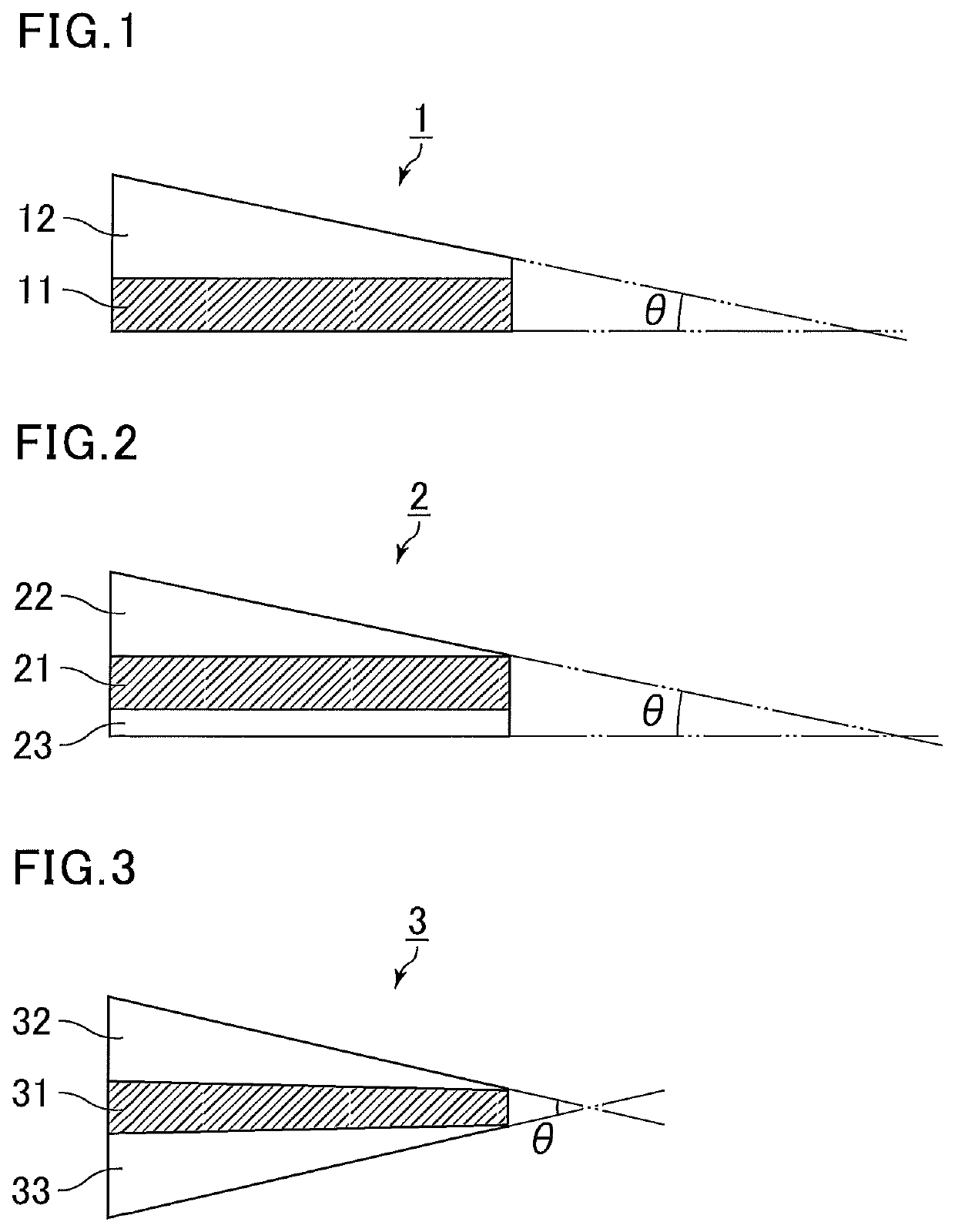
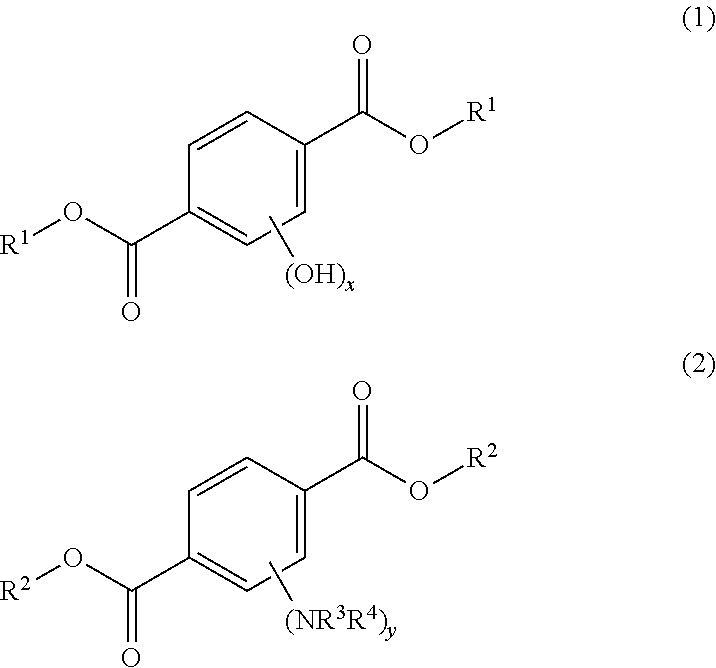
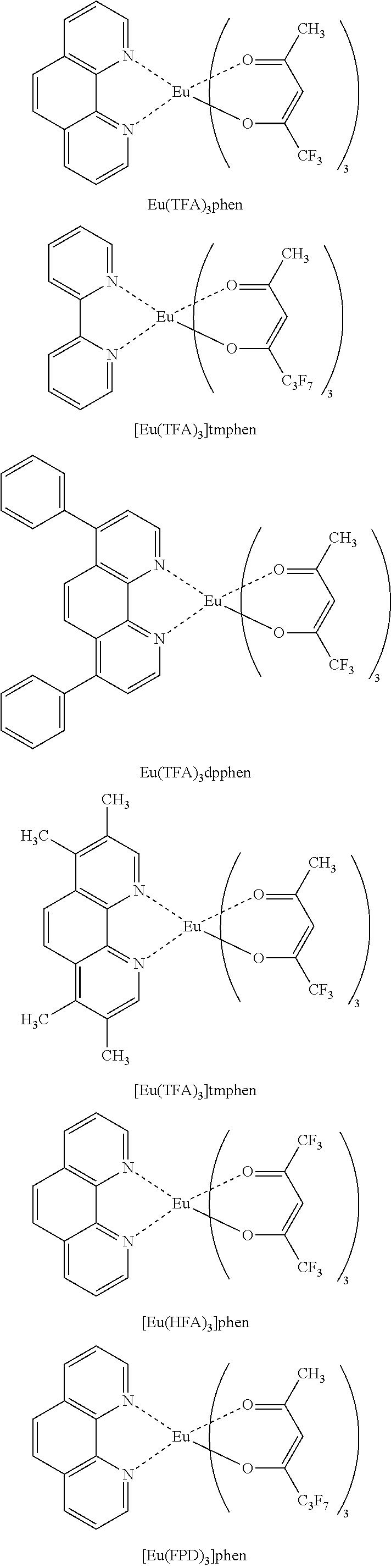
Examples
example 1
(1) Preparation of Eu(HFA)3Phen
[0131]Europium acetate (Eu(CH3COO)3) in an amount of 4.11 g (12.5 mmol) was dissolved in 50 mL of distilled water. To the solution was added 7.00 g (33.6 mmol) of hexafluoroacetylacetone (HFA), and the mixture was stirred at room temperature for 3 hours. The precipitated solid was filtered, washed with water, and recrystallized using methanol and distilled water to give Eu(HFA)3(H2O)2. Then, 7.20 g of the resulting complex (Eu(HFA)3(H2O)2) and 2.5 g of 1,10-phenanthroline(phen) were dissolved in 100 mL of methanol, followed by heating under reflux for 12 hours. After 12 hours, methanol was distilled off under reduced pressure, thereby obtaining a white product. The white product powder was washed with toluene so that unreacted materials were removed by suction filtration. Subsequently, toluene was distilled off under reduced pressure, thereby preparing a powder. Through recrystallization using a solvent mixture of toluene and hexane, Eu(HFA)3phen was o...
example 2
(1) Preparation of Tb(HFA)3Phen
[0136]Terbium acetate (Tb(CH3COO)3) in an amount of 4.20 g (12.5 mmol) was dissolved in 50 mL of distilled water. To the solution was added 7.00 g (33.6 mmol) of hexafluoroacetylacetone (HFA, CF3COCH2COCF3), and the mixture was stirred at room temperature for 3 hours. The precipitated solid was filtered, washed with water, and recrystallized using methanol and distilled water to give Tb(HFA)3(H2O)2. Then, 7.26 g of the obtained complex Tb(HFA)3(H2O)2 and 2.5 g of 1,10-phenanthroline(phen) were added to 100 mL of methanol, followed by heating under reflux for 12 hours. After 12 hours, methanol was distilled off under reduced pressure, thereby obtaining a white product. The white product powder was washed with toluene so that unreacted materials were removed by suction filtration. Subsequently, toluene was distilled off under reduced pressure, thereby preparing a powder. Through recrystallization using a solvent mixture of toluene and hexane, Tb(HFA)3phe...
example 3
[0140]An interlayer film for a laminated glass and a laminated glass were produced in the same manner as in Example 1, except that 0.069 parts by weight of hexafluoroacetylacetone magnesium was added instead of 0.036 parts by weight of acetylacetone magnesium.
PUM
| Property | Measurement | Unit |
|---|---|---|
| mol % | aaaaa | aaaaa |
| mol % | aaaaa | aaaaa |
| particle size | aaaaa | aaaaa |
Abstract
Description
Claims
Application Information
 Login to View More