Check patentability & draft patents in minutes with Patsnap Eureka AI!

Process and intermediates for the preparation of bilastine

a bilastine and intermediate technology, applied in the direction of carboxylic acid esters/lactones, organic chemistry, chemical production, etc., can solve the problems of lack of industrial interest in cross coupling, high cost, high instability, etc., and achieve simple and low cost process, short reaction time, and high productivity

Active Publication Date: 2022-06-28
FAES FARMA SA
View PDF9 Cites 0 Cited by
  • Summary
  • Abstract
  • Description
  • Claims
  • Application Information

AI Technical Summary

Benefits of technology

This process results in high-yield, cost-efficient production of Bilastine intermediates with shorter reaction times, making it suitable for industrial scale production and eliminating the need for additional reaction steps to incorporate the leaving group, thereby simplifying the synthesis of Bilastine.

Problems solved by technology

However, this cross coupling approach lacks industrial interest due to the instability, availability and cost of the ketene acetal and the phosphine used in the key step of the synthesis.
Then again, this approach uses organometallic reagents and an amide base, which is highly unstable and expensive.
This alternative cross coupling approach uses in the first step high cost and low available vinyl synthons (and highly toxic in the case of the tin compound).
Besides, the anti-Markovnikov hydroxylation step is performed using the well-known and undesirable borane (highly toxic and flammable gas), which also undermines its industrial applicability.
In general, the methods disclosed in the prior art for the preparation of compounds of formula (III) according to the present invention, require the use of organometallic reagents, toxic reagents, harsh reaction conditions or have a low productivity and, therefore, are not suitable for industrial production.

Method used

the structure of the environmentally friendly knitted fabric provided by the present invention; figure 2 Flow chart of the yarn wrapping machine for environmentally friendly knitted fabrics and storage devices; image 3 Is the parameter map of the yarn covering machine
View more

Image

Smart Image Click on the blue labels to locate them in the text.
Viewing Examples
Smart Image
  • Process and intermediates for the preparation of bilastine
  • Process and intermediates for the preparation of bilastine
  • Process and intermediates for the preparation of bilastine

Examples

Experimental program
Comparison scheme
Effect test

example 1

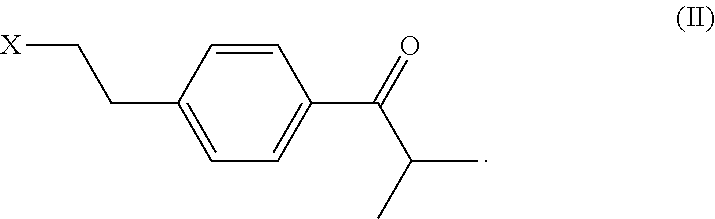
on of 1-(4-(2-chloroethyl)phenyl)-2-methylpropan-1-one

[0169]

[0170]In a reaction vessel iPrCOCl (8.2 g) was cooled to 9° C. and mixed with AlCl3 (5.2 g). 2-Chloroethylbenzene (4.3 g) was added dropwise and the mixture was stirred for 60 minutes, poured over HCl 1M (50 mL) at 0° C. TBME (10 mL) was added and the mixture was stirred. The organic layer was washed with NaOH 1M (25 mL), separated, dehydrated with anhydrous sodium sulfate and then condensed and the solvent was removed under vacuum. 7.4 g of 1-(4-(2-chloroethyl)phenyl)-2-methylpropan-1-one were obtained in a 100% yield and a 90% purity.

example 2

on of 2-[4-(2-Chloro-ethyl)-phenyl]-2-methyl-propionic Acid Methyl Ester

[0171]

[0172]In a round-bottom flask with a reflux condenser, ICl (9.6 mL) was added to a solution of 1-[4-(2-chloro-ethyl)-phenyl]-2-methyl-propan-1-one (13.42 g) in TMOF (55 mL). The mixture reacted fairly vigorously in an exothermic reaction. After few minutes, when the bubbling and the reflux had stopped, the mixture was cooled down and the workup was performed as follows: it was quenched with a saturated solution of sodium bicarbonate (120 mL) and extracted with dichloromethane (80 mL×3). The organic layer was washed with a solution of Na2S2O3 (10%, 150 mL), dried with anhydrous sodium sulfate and concentrated. 15.03 g of 2-[4-(2-chloro-ethyl)-phenyl]-2-methyl-propionic acid methyl ester were obtained in a 98% yield and 85% purity.

example 3

on of 2-[4-(2-Chloro-ethyl)-phenyl]-2-methyl-propionic Acid Methyl Ester

[0173]

[0174]I2 (794 mg) was added to a round-bottom flask with 1-[4-(2-chloro-ethyl)-phenyl]-2-methyl-propan-1-one (200 mg) in TMOF (913 μL). The mixture was stirred for five minutes before sulphuric acid (22 μL) was added. At this point, the vessel was heated at 80° C. After 1 hour, workup was accomplished by the addition of a solution of NaHCO3 (5 mL) and then extraction with dichloromethane (5 mL×3). The organic layer was washed with a solution of Na2S2O3 (20 mL), dried with anhydrous sodium sulfate and concentrated under vacuum. 0.226 g of 2-[4-(2-Chloro-ethyl)-phenyl]-2-methyl-propionic acid methyl ester were obtained in a 99% yield and 86% purity.

the structure of the environmentally friendly knitted fabric provided by the present invention; figure 2 Flow chart of the yarn wrapping machine for environmentally friendly knitted fabrics and storage devices; image 3 Is the parameter map of the yarn covering machine
Login to View More

PUM

PropertyMeasurementUnit
temperatureaaaaaaaaaa
Login to View More

Abstract

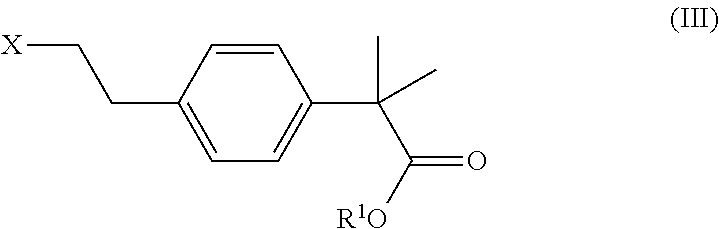
The invention relates to a process for preparing a compound of (III)whereinX is a leaving group; andR1 is C1-C6 alkyl;which comprises oxidative rearrangement of a compound of formula (II) or a solvate thereofCompounds of formula (III) are key intermediates in the synthesis of Bilastine.

Description

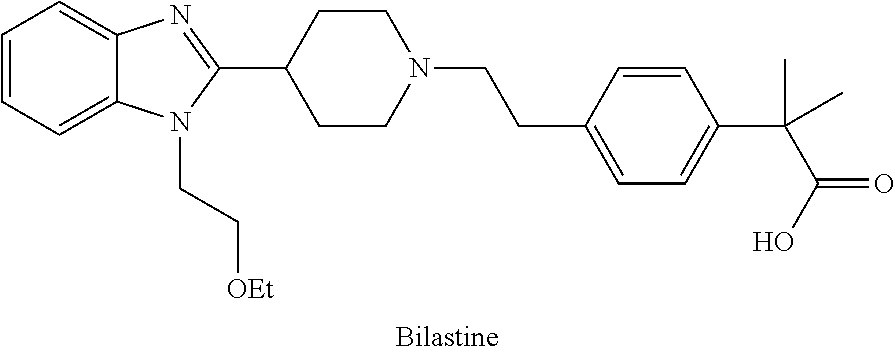
CROSS-REFERENCE TO RELATED APPLICATIONS[0001]This application is filed under the provisions of 35 U.S.C. § 371 and claims the priority of International Patent Application No. PCT / EP2019 / 069772 filed on 23 Jul. 2019 entitled “PROCESS AND INTERMEDIATES FOR THE PREPARATION OF BILASTINE” in the name of Gonzalo HERNANDEZ HERRERO, et al., which claims priority to European Patent Application No. 18382556.1, filed on 24 Jul. 2018, both of which are hereby incorporated by reference herein in their entirety.FIELD OF THE INVENTION[0002]The invention relates to a process for the preparation of key intermediates in the synthesis of Bilastine and to new intermediates in said process.BACKGROUND OF THE INVENTION[0003]Bilastine is a second-generation antihistamine medication which is used in the treatment of allergic rhinoconjunctivitis and urticaria.[0004][0005]Several synthesis of Bilastine has been disclosed in the last years using a compound of formula (III) as key intermediate as it provides a ...

Claims

the structure of the environmentally friendly knitted fabric provided by the present invention; figure 2 Flow chart of the yarn wrapping machine for environmentally friendly knitted fabrics and storage devices; image 3 Is the parameter map of the yarn covering machine
Login to View More

Application Information

Patent Timeline
no application Login to View More
Patent Type & Authority Patents(United States)
IPC IPC(8): C07C67/42C07C45/46C07D235/04C07D401/04C07C51/09C07C67/00
CPCC07C67/42C07C45/46C07C51/09C07C67/00C07D235/04C07D401/04Y02P20/55C07C49/80C07C69/62C07C57/58C07C69/63
Inventor HERNÁNDEZ HERRERO, GONZALOGARCÍA DOMÍNGUEZ, NEFTALÍMORÁN POLADURA, PABLOGONZÁLEZ GARCÍA, TANIAGANZA GONZÁLEZ, ÁLVAROTATO CERDEIRAS, PALOMA
Owner FAES FARMA SA
Features
  • R&D
  • Intellectual Property
  • Life Sciences
  • Materials
  • Tech Scout
Why Patsnap Eureka
  • Unparalleled Data Quality
  • Higher Quality Content
  • 60% Fewer Hallucinations
Social media
Patsnap Eureka Blog
Learn More