
Scale deposit inhibitor, process for its production, polymerizer whose inside wall is covered with the inhibitor, and process for production of vinylic polymers by the use of the polymerizer
a deposit inhibitor and scale technology, applied in the field of scale deposit inhibitors, process for their production, polymerizers whose, can solve the problems of scale adhesion preventing agents that are unsatisfactory in terms of adhesion preventing effect, deterioration of product quality, and reducing heat exchange efficiency, so as to prevent the adhesion of scal
- Summary
- Abstract
- Description
- Claims
- Application Information
AI Technical Summary
Benefits of technology
Problems solved by technology
Method used
Image

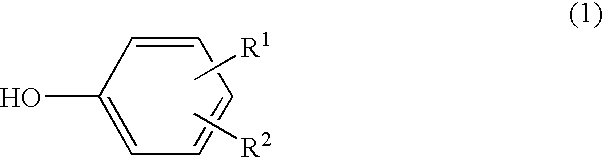
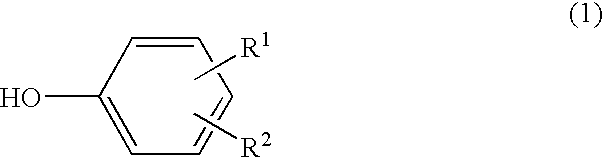
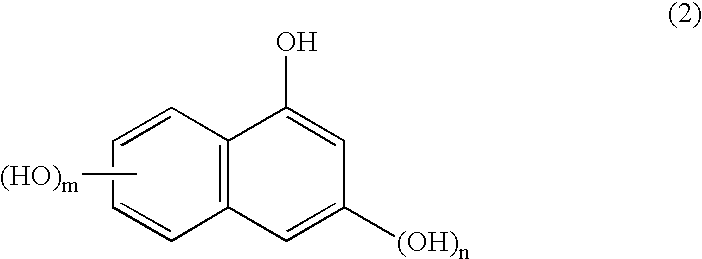
Examples
example 1
[0066] 25 g of 1-naphthol, 10 g of pyrogallol, 7 g of sodium hydroxide and 300 g of distilled water were fed to a 500 ml closed glass vessel equipped with a cooling capacitor. After the inside of the vessel was substituted by nitrogen, the resulting mixture was heated at 70.degree. C. in a hot bath under agitation. Thereafter, 20 g of a 37 wt % aqueous solution of formaldehyde was added slowly under agitation. A condensation reaction was carried out under agitation for 5 hours by maintaining that temperature. A yellowish transparent aqueous solution was obtained.
[0067] An alkaline aqueous solution of the above condensation product was adjusted to a concentration of 0.5 wt % and applied to the inner wall (stainless steel) of a reactor for polymerizing vinyl chloride having an inner capacity of about 50 liters by a steam ejector spray.
[0068] Thereafter, the reactor was washed with water to obtain a polymerization reactor having a film formed on the inner wall. The thickness of the for...
examples 2 to 16
[0071] Polymerization reactors having a film formed on the inner wall were obtained in the same manner as in Example 1 except that the types and amounts of the 1-naphthol, phenol and aldehyde were changed as shown in Table 1 and the condensation conditions were changed as shown in Table 2. The weights of the formed films are shown in Table 2. A scale adhesion prevention test was made on the obtained polymerization reactors, and coloration and colored foreign substance tests were made on molded products of the obtained vinyl chloride-based polymers. The results of the above tests are shown in Table 3.
[0072] Since a condensate obtained by using an acid catalyst is solid, it was dissolved in an alkali aqueous solution before use.
1 TABLE 1 1-naphthol phenol aldehyde distilled molar molar molar catalyst water type g ratio type g ratio.sup.1) type g ratio.sup.2) type g g Ex. 1 A1 25 1 B1 10 0.46 C1 20 0.98 Na 7 300 Ex. 2 A1 25 1 B2 10 0.52 C1 13 0.61 Na 7 300 Ex. 3 A1 25 1 B3 5 0.26 C1 18...
example 17
[0075] 25 g of 1-naphthol, 10 g of catechol, 7 g of sodium hydroxide and 300 g of distilled water were fed to a 500 ml closed pressure vessel equipped with a cooling capacitor. The inside of the vessel was substituted by nitrogen gas and then heated at 70.degree. C. in a hot bath under agitation. Thereafter, 13 g of a 37 wt % aqueous solution of formaldehyde was added slowly under agitation while that temperature was maintained.
[0076] The temperature of the reaction solution was then elevated to 100.degree. C. at a rate of 0.7.degree. C. / min under agitation and a condensation reaction was carried out at that temperature under agitation for 5 hours. As a result, a yellowish transparent aqueous solution of a scale adhesion preventing agent was obtained.
[0077] The alkaline aqueous solution containing the above condensation product was adjusted to a concentration of 0.5 wt % and applied to the inner wall (stainless steel) of a reactor for polymerizing vinyl chloride having an inner capa...
PUM
| Property | Measurement | Unit |
|---|---|---|
| Angle | aaaaa | aaaaa |
| Angle | aaaaa | aaaaa |
| Angle | aaaaa | aaaaa |
Abstract
Description
Claims
Application Information
 Login to View More