
Compounds and methods for the inhibition of the expression of VCAM-1
a technology of compound and method, applied in the direction of drug composition, immunological disorders, metabolism disorders, etc., can solve the problems of ischemia or infarction, narrowing of the vessel passage, hardening of the vascular system, etc., and achieve the effect of improving the water solubility of the compound
- Summary
- Abstract
- Description
- Claims
- Application Information
AI Technical Summary
Benefits of technology
Problems solved by technology
Method used
Image

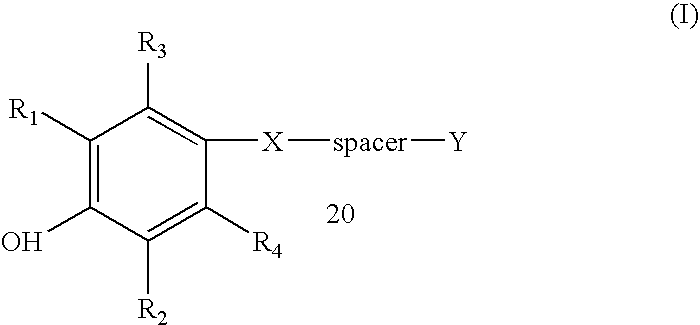
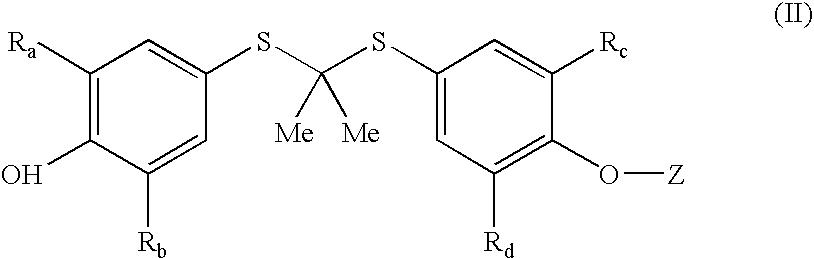
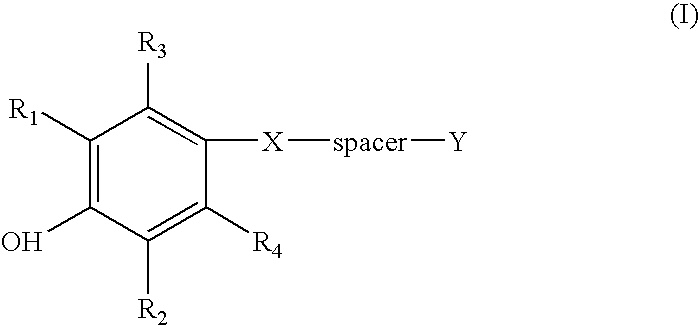
Examples
example 1
2,6di-tert-butyl-4-thio(4′(methyl)phenylacetic acid))phenol
Reaction Description:
[0213] 2,6di-t-butyl-4-thiophenol (238 mg, 1 mmol) was dissolved in ethanol (0.7 mL) and cooled to 0° C. 5 N NaOH (0.6 mL, 3 mmol) was added followed by addition of 4-(bromomethyl)phenyl acetic acid (229 mg, 1 mmol). The reaction was warmed to room temperature and after 0.5 h the reaction was complete. The reaction was quenched with 1 N HCl (3.5 mL) and diluted with ether (25 mL). The ether layer was separated and washed with water (1×5 mL) and brine (1×5 mL), dried over MgSO4, filtered and concentrated. Chromatography over silica gel and eluting with 50:50 ether / hexane provided 170 mg of (2,6-di-tert-butyl-4-thio(4′(methyl)phenylacetic acid))phenol). 1H NMR (CDCl3, 400 MHZ): δ 7.24 (s, 2 H), 7.17 (d, J=8.4 Hz, 2 H), 7.11 (d, J=8.4 Hz, 2 H), 5.20 (s, 1 H), 3.91 (s, 2 H), 3.59 (s, 2 H), 1.33 (s, 18 H).
example 2
2,6-di-tert-butyl-4thio(4′-nitrobenzyl)phenol
Reaction Description:
[0214] A solution of 0.28 mmol (68 mg) of 2,6-di-tert-butyl-4-thiophenol in 0.5 mL of EtOH (denatured) was stirred and treated with 0.3 mmol (0.06 mL) of NaOH (5 N in de-ionized water) at 0° C. After stirring for 5 mmol, 0.29 mmol (62 mg) of 4-nitrobenzyl bromide was added to give an orange solution. The progress of the reaction was monitored by TLC (1:1 hexanes- hexanes-CH2Cl2; visualized by UV and PMA / char). The bromide was consumed over a 2 h period. The mixture was then quenched with sat. NaCl-EtOAc. The aqueous layer was back-extracted with 2×2 mL of EtOAc; the combined organic layers were dried over anhydrous MgSO4. The drying agent was removed by filtration; solvent was removed by rotary evaporation to give a crude oil. The oil was purified by preparative thin-layer chromatography (pTLC) using 2×500w plates and 1:1 hexanes-CH2Cl2 as eluant. The desired product (2,6-di-tert-butyl-4-thio(4′-nitrobenzyl)phenol)...
example 3
2,6-di-tert-butyl-4-thio(4′-nitrophenethyl)phenol
Reaction Description:
[0215] 0.48 mmol (115 mg) of 2,6-di-tert-butyl-4-thiophenol was taken up and stirred in 2 mL of dry THF. The mixture was treated with 0.67 mmol (27 mg) of sodium hydride (60% suspension in mineral oil) to give a clear, dark yellow solution. 4-Nitrophenethyl iodide (0.49 mmol; 135 mg) was added to give a dark brown mixture which was stirred overnight The progress of the reaction was monitored by TLC (3×10:1 hexanes-CH2Cl2; visualized by UV and PMA / char), and the reaction was quenched (with sat. NaCl-EtOAc) when only races of the starting iodide remained. The aqueous layer was back-extracted with 2×5 mL of EtOAc; the combined organic layers were dried over anhydrous MgSO4. Filtration to remove the drying agent followed by solvent removal by rotary evaporation gave a dark brown oil. Purification of the crude material using radial chromatography (10:1 hexanes CH2Cl2; 4 mm plate) gave 93 mg (50% yield) of 2,6-di-ter...
PUM
 Login to View More
 Abstract
Description
Claims
Application Information
 Login to View More