Check patentability & draft patents in minutes with Patsnap Eureka AI!

Synthesis of poly(arylene)s copolymers containing pendant sulfonic acid groups bonded to naphthalene as proton exchange membrane materials

a technology of arylene and sulfonic acid groups, applied in the field of poly (arylene) s copolymer synthesis, can solve the problems of high fuel permeability, low operation temperature, high cost, etc., and achieve the effect of reducing the solubility of polymer and reactan

Inactive Publication Date: 2006-01-05
NAT RES CONCIL OF CANADA
View PDF40 Cites 10 Cited by
  • Summary
  • Abstract
  • Description
  • Claims
  • Application Information

AI Technical Summary

Benefits of technology

[0020] In a preferred embodiment of the process, the reaction is effected under inert gas atmosphere in the presence of an aprotic polar solvent, such as NMP, and a dehydrating agent typically used in this kind of a reaction, known as “nucleophilic aromatic substitution polycondensation”. Toluene and other similar types of compounds could be used such as xylene. The main thing is that the boiling point is >100 C, it is not miscible to a great extent with water, and it is miscible with the polar aprotic solvent, and would not reduce the polymer and reactant solubility too much.

Problems solved by technology

However, their disadvantages of high cost, low operation temperatures and high fuel permeability are stimulating an intensive search for alternative materials.

Method used

the structure of the environmentally friendly knitted fabric provided by the present invention; figure 2 Flow chart of the yarn wrapping machine for environmentally friendly knitted fabrics and storage devices; image 3 Is the parameter map of the yarn covering machine
View more

Image

Smart Image Click on the blue labels to locate them in the text.
Viewing Examples
Smart Image
  • Synthesis of poly(arylene)s copolymers containing pendant sulfonic acid groups bonded to naphthalene as proton exchange membrane materials
  • Synthesis of poly(arylene)s copolymers containing pendant sulfonic acid groups bonded to naphthalene as proton exchange membrane materials
  • Synthesis of poly(arylene)s copolymers containing pendant sulfonic acid groups bonded to naphthalene as proton exchange membrane materials

Examples

Experimental program
Comparison scheme
Effect test

Embodiment Construction

2. Experimental Part

2.1. Materials.

[0029] DHNS was purchased from Rintech, Inc. and recrystallized from a mixture of ethanol / water (50 / 50) before use. NMP was purchased from Aldrich Co. Inc. and vacuum distilled before use. All other chemicals were reagent grade and were purchased from Aldrich Co. Inc. and used as received.

2.2. Copolymerization.

[0030] As an example of a typical reaction, 5 mmol BFBB, 31 mmol DHNS, 2 mmol 4,4′-biphenol, and 7.5 mmol K2CO3, were added into a three-neck flask equipped with a magnetic stirrer, a Dean-Stark trap, and an argon gas inlet, then 10 mL NMP and 10 mL toluene were charged into the reaction flask under an argon atmosphere. The reaction mixture was heated to 130 to 140° C. After dehydration and removal of toluene, the reaction temperature was increased to about 160 to 170° C. When the solution viscosity had increased obviously, the mixture was cooled to 100° C. and coagulated into a large excess of ethanol with vigorous stirring. SPAEEK-B6...

the structure of the environmentally friendly knitted fabric provided by the present invention; figure 2 Flow chart of the yarn wrapping machine for environmentally friendly knitted fabrics and storage devices; image 3 Is the parameter map of the yarn covering machine
Login to View More

PUM

PropertyMeasurementUnit
temperatureaaaaaaaaaa
conductivityaaaaaaaaaa
Login to View More

Abstract

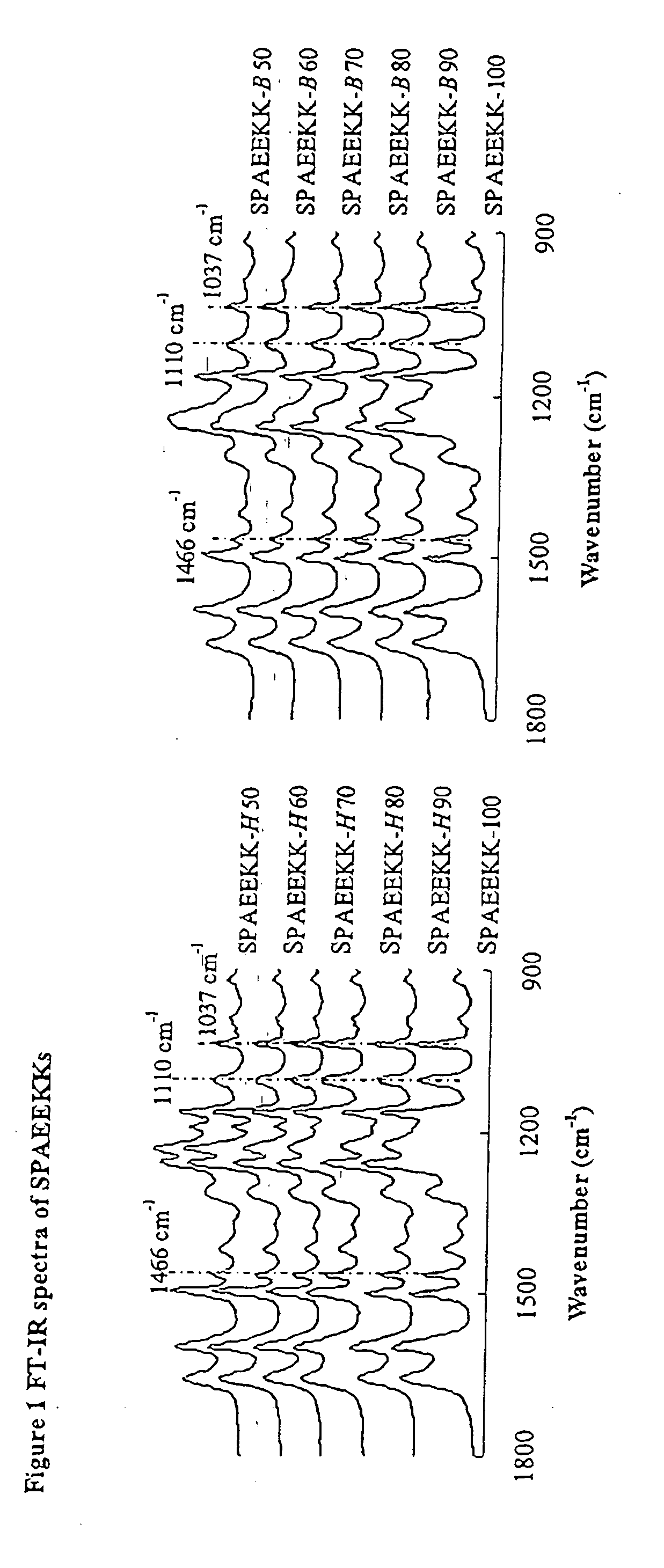
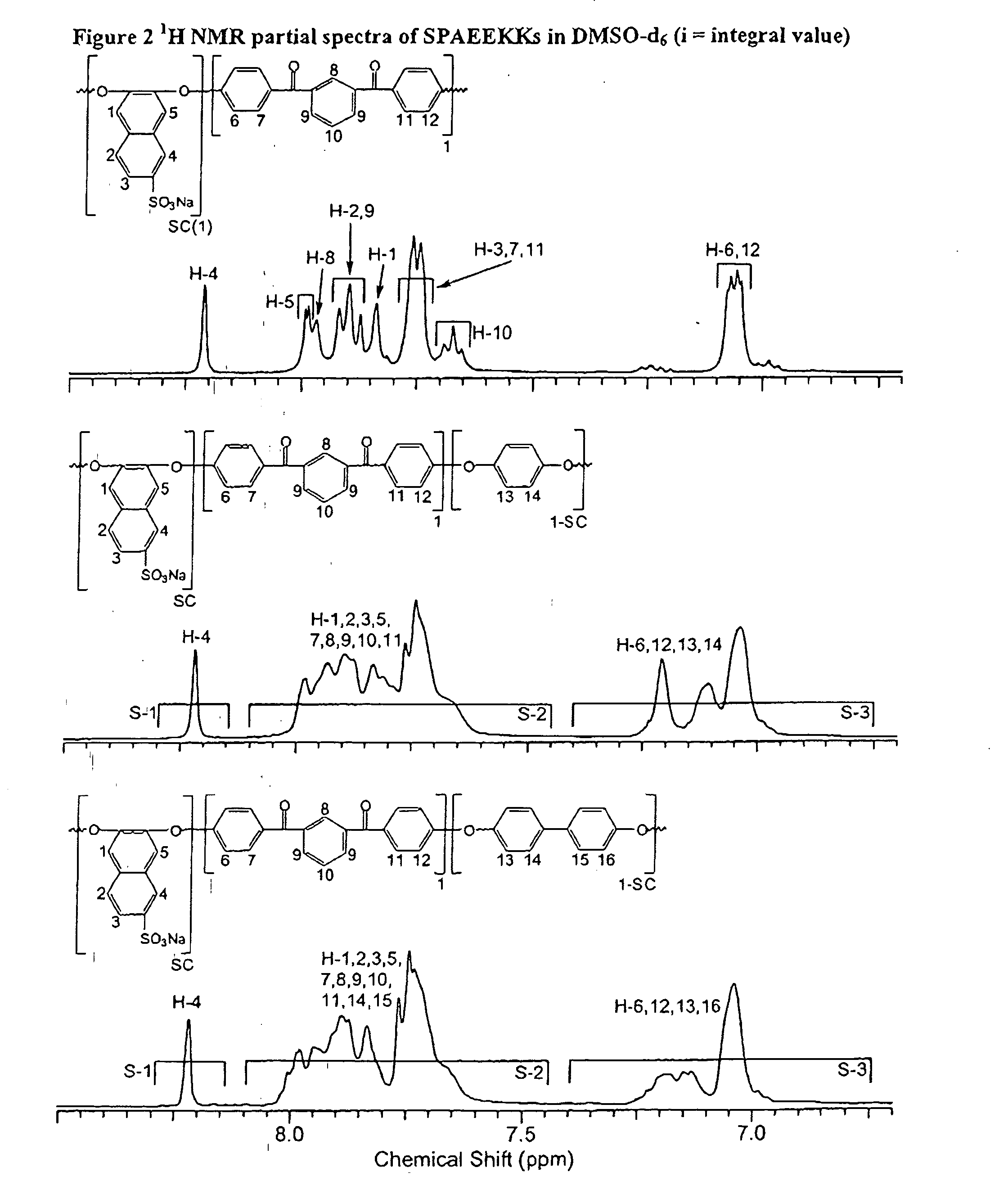
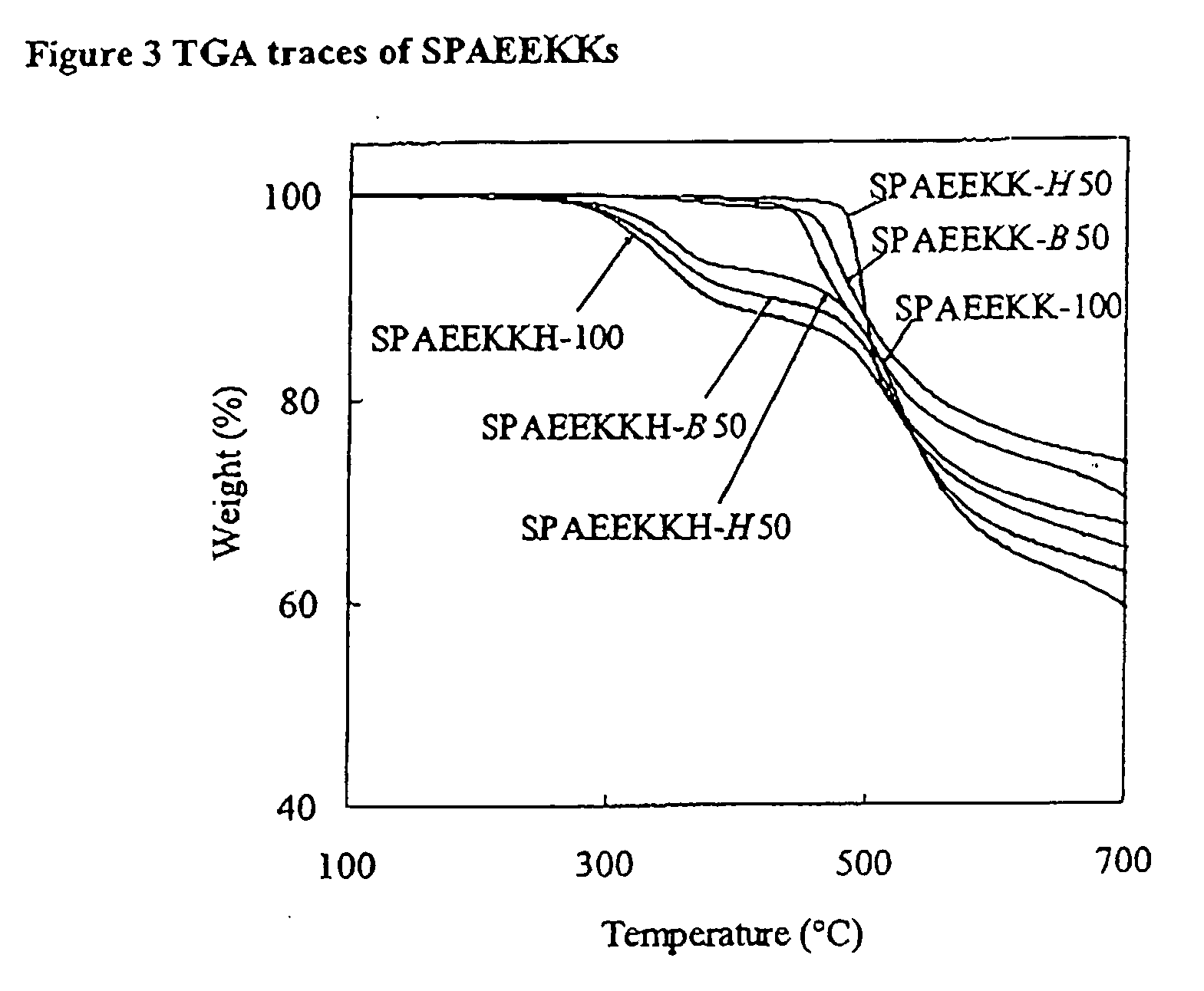
A new series of wholly aromatic poly(arylene ether ether ketone ketone)s containing pendant sulfonic acid groups (SPAEEKK) were conveniently prepared by potassium carbonate mediated nucleophilic polycondensation reactions of inexpensive commercially available monomers: 1,3-bis(4-fluorobenzoyl)benzene (BFBB), sodium 6,7-dihydroxy-2-naphthalenesulfonate (DHNS), and 4,4′-biphenol or hydroquinone in N-methyl-2-pyrrolidone (NMP) at 170° C. FT-IR and NMR were used to characterize the structures and the sulfonate or sulfonic acid contents (SC) of the polymers. Flexible membrane films were obtained by casting N,N-dimethylacetamide (DMAc) solutions of copolymers. Membrane films in acid form were then obtained by treating the sodium form membrane films in 2 N sulfuric acid at room temperature. Glass transition temperatures (Tgs) and decomposition temperatures (Tds) of SPAEEKKs in both sodium and acid forms were determined. Water uptake and swelling ratio values increased with SCs and temperatures. The proton conductivities of acid form membrane films increased with SC value and temperature and reached 5.6×10⁻²S / cm at 100° C. for SPAEEKK-100.

Description

CROSS-REFERENCE APPLICATIONS [0001] This application claims the benefit of U.S. Provisional Application Ser. No. 60 / 583,791 filed Jun. 30, 2004, which is herein incorporated by reference.BACKGROUND OF THE INVENTION [0002] Proton exchange membrane fuel cells (PEMFC)s are promising clean power sources for vehicular transportation, residential and institutional, and also for computers and mobile communication equipment1. As one of the key components of the membrane electrode assembly (MEA), proton exchange membranes (PEM)s carry catalyst, provide ionic pathways for protons and prevent crossover of gases or fuel. Perfluorosulfonic acid PEMs, such as Dupont's Nafion® membrane, are typically used as the polymer electrolytes in PEMFCs because of their excellent chemical and mechanical stabilities as well as high proton conductivity. However, their disadvantages of high cost, low operation temperatures and high fuel permeability are stimulating an intensive search for alternative materials....

Claims

the structure of the environmentally friendly knitted fabric provided by the present invention; figure 2 Flow chart of the yarn wrapping machine for environmentally friendly knitted fabrics and storage devices; image 3 Is the parameter map of the yarn covering machine
Login to View More

Application Information

Patent Timeline
no application Login to View More
Patent Type & Authority Applications(United States)
IPC IPC(8): C08G61/02C08F228/02C08G8/02
CPCC08G65/4012C08G65/48C08G65/4056
Inventor GAO, YANGUIVER, MICHAEL D.ROBERTSON, GILLES P.
Owner NAT RES CONCIL OF CANADA
Features
  • R&D
  • Intellectual Property
  • Life Sciences
  • Materials
  • Tech Scout
Why Patsnap Eureka
  • Unparalleled Data Quality
  • Higher Quality Content
  • 60% Fewer Hallucinations
Social media
Patsnap Eureka Blog
Learn More