Protein complex using an immunoglobulin fragment and method for the preparation thereof

a protein complex and immunoglobulin technology, applied in the field of protein conjugates, can solve the problems of reducing the number of titers of physiologically active proteins, reducing yield, and pain for patients, and achieves the effects of enhancing the serum half-life of polypeptides, minimizing activity reduction, and improving stability and the duration of physiological action

a protein complex and immunoglobulin technology, applied in the field of protein conjugates, can solve the problems of reducing the number of titers of physiologically active proteins, reducing yield, and pain for patients, and achieves the effects of enhancing the serum half-life of polypeptides, minimizing activity reduction, and improving stability and the duration of physiological action

US20060269553A1Active Publication Date: 2006-11-30HANMI SCI CO LTD

Image

Smart Image Click on the blue labels to locate them in the text.
Viewing Examples
Smart Image
  • Protein complex using an immunoglobulin fragment and method for the preparation thereof
  • Protein complex using an immunoglobulin fragment and method for the preparation thereof
  • Protein complex using an immunoglobulin fragment and method for the preparation thereof

Examples

Experimental program
Comparison scheme
Effect test

example 1

Preparation I of IFNα-PEG-immunoglobulin Fc Fragment Conjugate

Preparation of Immunoglobulin Fc Fragment Using Immunoglobulin

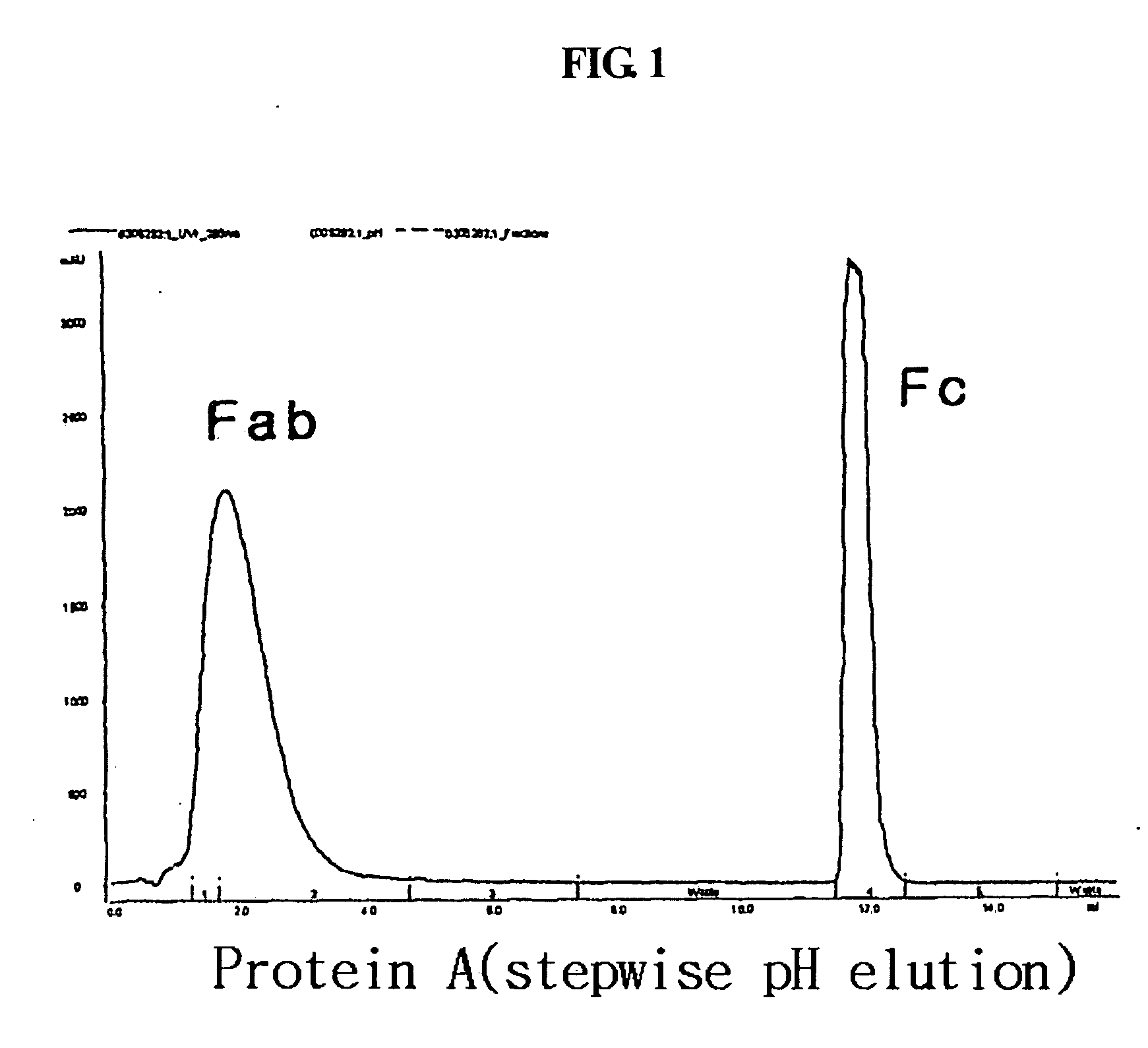
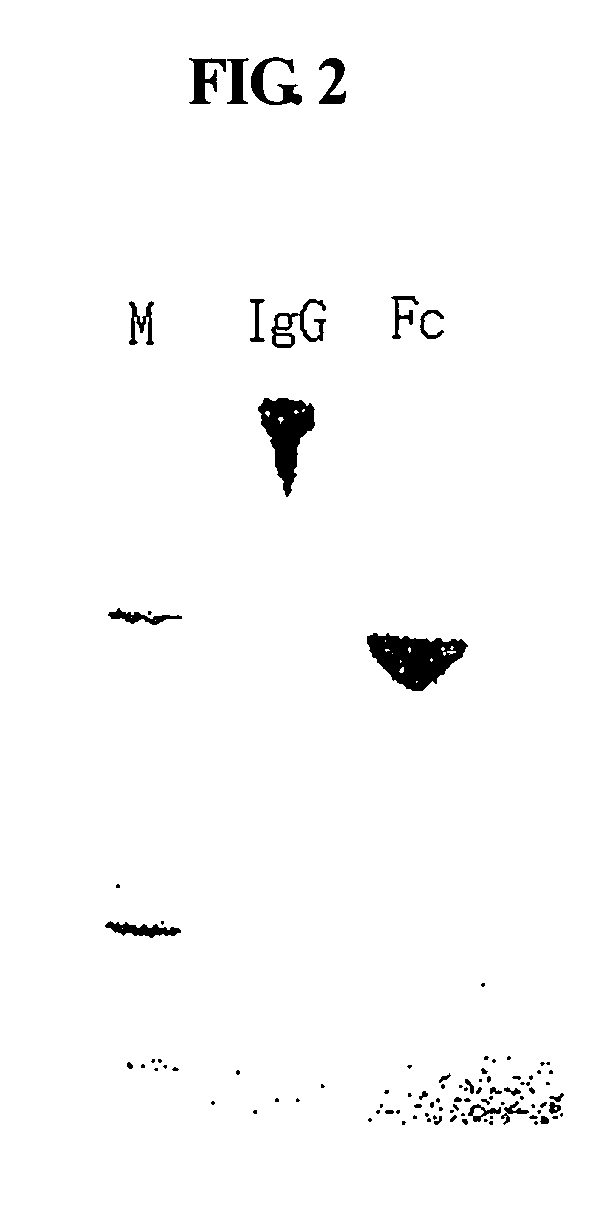
[0091] An immunoglobulin Fc fragment was prepared as follows. 200 mg of 150-kDa immunoglobulin G (IgG) (Green Cross, Korea) dissolved in 10 mM phosphate buffer was treated with 2 mg of a proteolytic enzyme, papain (Sigma) at 37° C. for 2 hrs with gentle agitation. After the enzyme reaction, the immunoglobulin Fc fragment regenerated thus was subjected to chromatography for purification using sequentially a Superdex column, a protein A column and a cation exchange column. In detail, the reaction solution was loaded onto a Superdex 200 column (Pharmacia) equilibrated with 10 mM sodium phosphate buffer (PBS, pH 7.3), and the column was eluted with the same buffer at a flow rate of 1 ml / min. Unreacted immunoglobulin molecules (IgG) and F(ab′)2, which had a relatively high molecular weight compared to the immunoglobulin Fc fragment, were removed using their prope...

example 2

Preparation II of IFNα-PEG-Fc Protein Conjugate

Preparation of Fc-PEG Complex

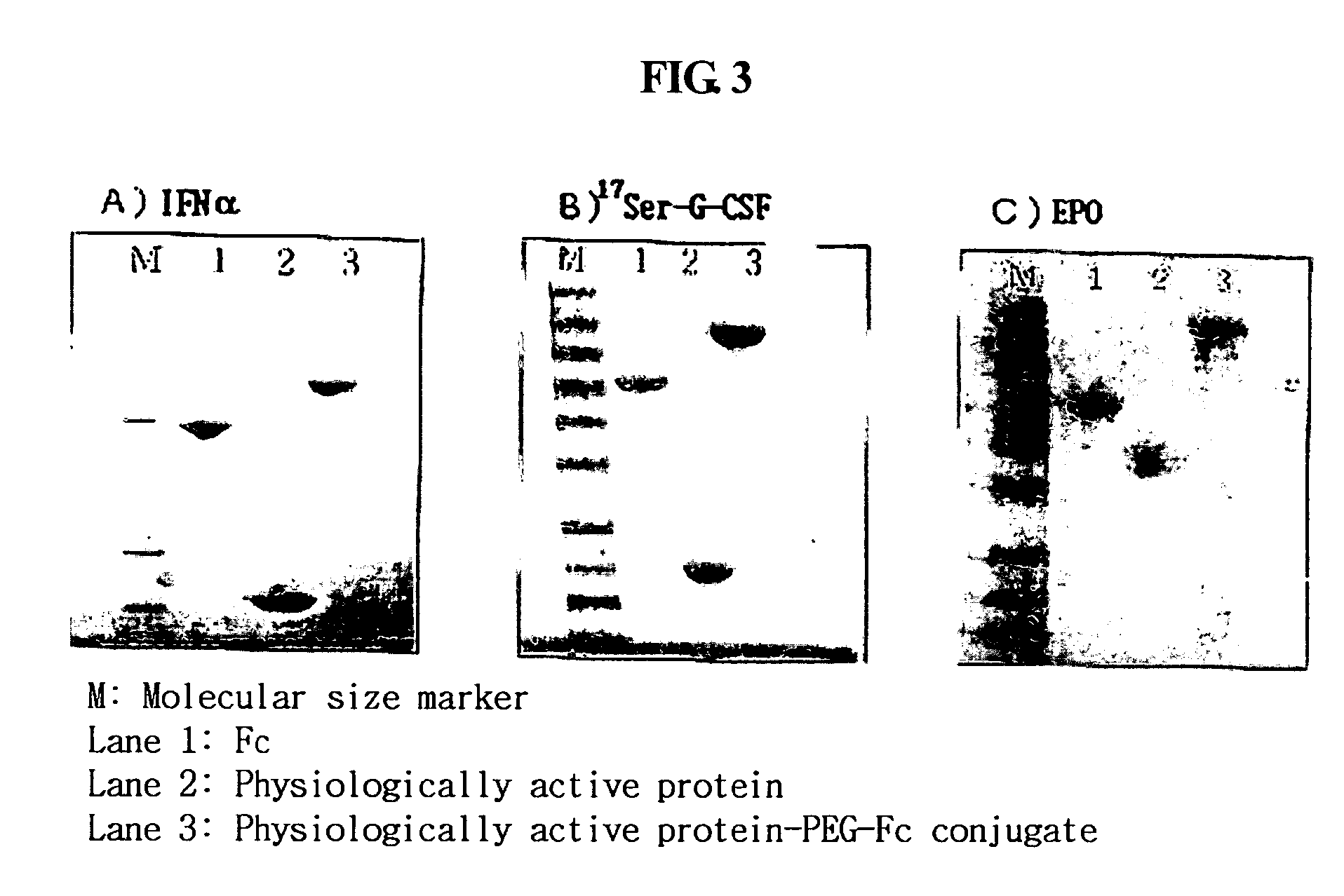
[0095] 3.4-kDa polyethylene glycol having an aldehyde reactive group at both ends, ALD-PEG-ALD (Shearwater), was mixed with the immunoglobulin Fc fragment prepared in the step 1 of Example 1 at Fc:PEG molar ratios of 1:1, 1:2.5, 1:5, 1:10 and 1:20, wherein the Ig Fc fragment had been dissolved in 100 mM phosphate buffer in an amount of 15 mg / ml. To this mixture, a reducing agent, NaCNBH3 (Sigma), was added at a final concentration of 20 mM and was allowed to react at 4° C. for 3 hrs with gentle agitation. To obtain a 1:1 complex of PEG and Fc, the reaction mixture was subjected to size exclusion chromatography using a SuperdexR column (Pharmacia). The Fc-PEG complex was eluted from the column using 10 mM potassium phosphate buffer (pH 6.0) as an elution buffer, and immunoglobulin Fc fragment not linked to PEG, unreacted PEG and dimer byproducts where PEG was linked to two immunoglobulin Fc fragment molecu...

example 3

Preparation of hGH-PEG-Fc Conjugate

[0097] An hGH-PEG-Fc conjugate was prepared and purified according to the same method as in Example 1, except that drug other than interferon alpha, human growth hormone (hGH, MW: 22 kDa) was used and a hGH:PEG molar ratio was 1:5.

the structure of the environmentally friendly knitted fabric provided by the present invention; figure 2 Flow chart of the yarn wrapping machine for environmentally friendly knitted fabrics and storage devices; image 3 Is the parameter map of the yarn covering machine
Login to View More

PUM

PropertyMeasurementUnit
Compositionaaaaaaaaaa
Molar ratioaaaaaaaaaa
Stabilityaaaaaaaaaa
Login to View More

Abstract

Disclosed are a protein conjugate with improved in vivo duration and stability and the use thereof. The protein conjugate includes a physiologically active polypeptide, a non-peptide polymer and an immunoglobulin Fc fragment. Since the three components are covalently linked, the protein conjugate has extended in vivo duration and enhanced stability for the physiologically active polypeptide. The protein conjugate maintains the in vivo activity at relatively high levels and remarkably increases the serum half-life for the physiologically active polypeptide, with less risk of inducing undesirable immune responses. Thus, the protein conjugate is useful for developing long-acting formulations of various polypeptide drugs.

Description

TECHNICAL FIELD [0001] The present invention relates to a protein conjugate comprising a physiologically active polypeptide, a non-peptide polymer and an immunoglobulin Fc fragment, which are covalently linked and have an extended duration of physiological action compared to the native form. BACKGROUND ART [0002] Since polypeptides tend to be easily denatured due to their low stability, degraded by proteolytic enzymes in the blood and easily passed through the kidney or liver, protein medicaments, including polypeptides as pharmaceutically effective components, need to be frequently administered to patients to maintain desired blood level concentrations and titers. However, this frequent administration of protein medicaments, especially through injection, causes pain for patients. To solve these problems, many efforts have been made to improve the serum stability of protein drugs and maintain the drugs in the blood at high levels for a prolonged period of time, and thus maximize the...

Claims

the structure of the environmentally friendly knitted fabric provided by the present invention; figure 2 Flow chart of the yarn wrapping machine for environmentally friendly knitted fabrics and storage devices; image 3 Is the parameter map of the yarn covering machine
Login to View More

Application Information

Patent Timeline
30 Nov 2006
Publication
US20060269553A1
IPC
A61K39/395; C07K16/46; C12N9/00; C07K16/00; C07K16/42; A61K47/42; C07K19/00; C12N15/70
CPC
A61K47/48415; A61K47/48423; A61K47/48507; C07K19/00; C07K2317/732; C07K2317/734; C07K2317/52; C07K14/505
Inventors
KIM; KIM, DAE JIN