However, regarding forming of a metal-made gear whose module is 0.2 or less, it is difficult to practically employ the electro-
discharge forming,
cutting, pressing, and forming by rolling, since there are problems in terms of accuracy of the gear, manufacturing cost and the like.
However, as compared to metal-made products, resin-molded integrated products are considerably inferior to the metal-made products in
mechanical strength and
hardness, tend to change in size and configuration thereof according to change in
environmental temperature, and have
creep properties.
Therefore, the resin-molding is completely unsatisfactory for forming an ultra-high-precision gear whose module is 0.2 or less and which is highly reliable.
In addition, as compared to the surface
hardness and tensile strength of metallic material, those of resinous material are considerably low.
Moreover, the resinous material is inferior to the metallic material in
heat resistance.
These properties of the resinous material have great adverse-effects on the durability and lifespan of the resin-molded product.
However, the present situation in the filed of the resinous materials does not yet reach the level of practical use of the
metallic materials including tool steels.
However, the tensile strength of the alloys is about 750 MPa and is low like that of the resin materials.
In addition, the
surface roughness of products made from the alloys is about 5 μm Ry and uneven shrinkage of the
alloy products occurs due to
crystal particles in the alloys and there are sharp convex regions on the surfaces of the alloy products.
Therefore, the alloys are unsuitable as materials for precision gears whose modules are 0.2 or less.
Incidentally, precision gears of tool steels are generally made by
machining, so that it is difficult to
mass-produce the precision gears at low cost.
In addition, it is considerably hard to get a
machining accuracy and, even if the hardness of the finished products is high, the
surface roughness of the products has a great effect on wear of the product materials which is brought about by sliding of the products in use, and consequently lifespan of the products is reduced.
However, a gear whose module is 0.2 or less and which has
surface smoothness of 2 μm Ry or less and is to be made by a manufacturing method in which
mass-production is taken into consideration, has not been proposed yet.
However, in this case, it is difficult to get a dimensional accuracy of the gear-shaped component, since the volume of metal powders used for
sintering is shrunk by a quantity equivalent to spaces between adjacent particles of the metal powders at the time of the
sintering.
In addition, there are vacancies in the component that has been made by the
sintering, and the vacancies are easy to produce cracks.
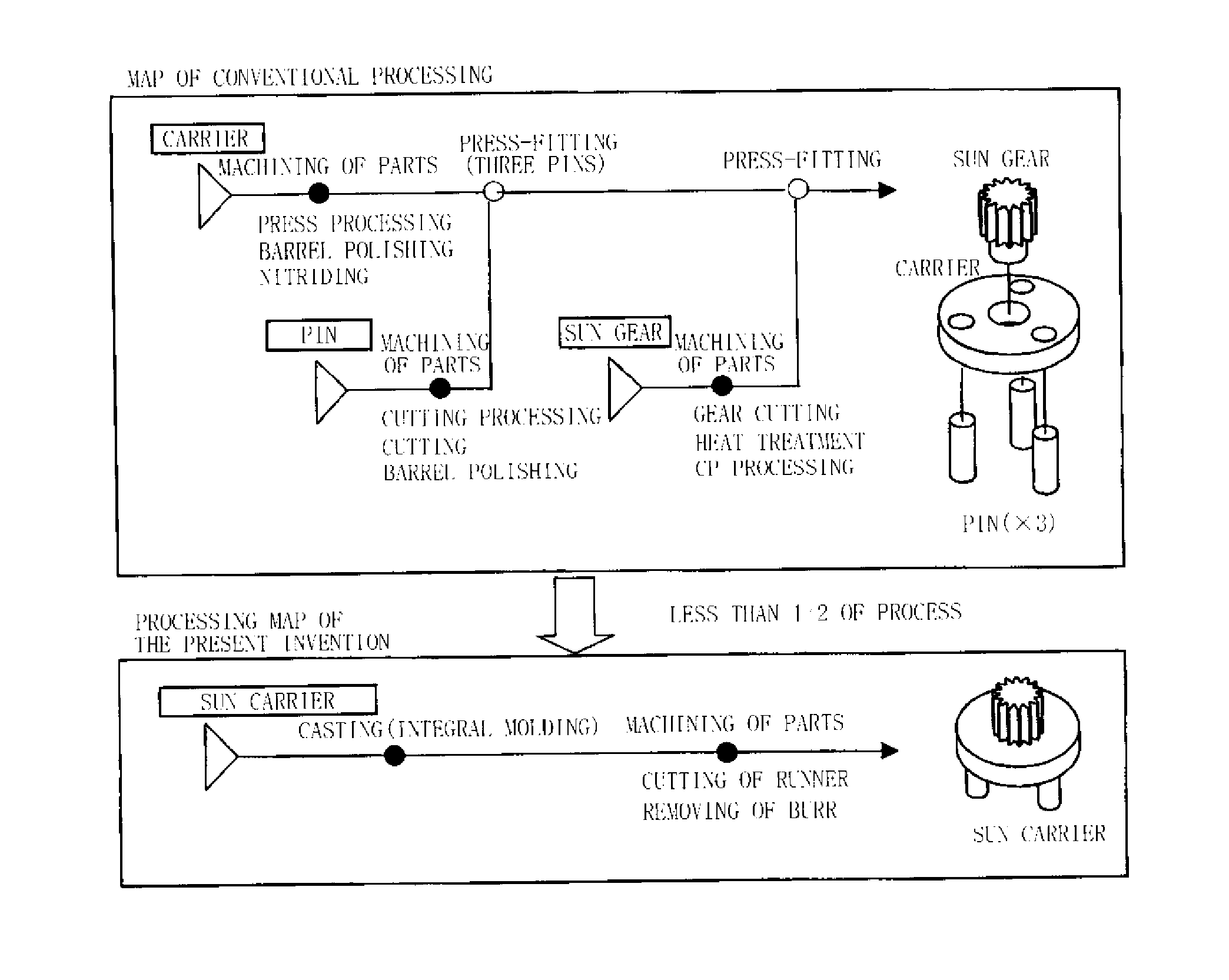
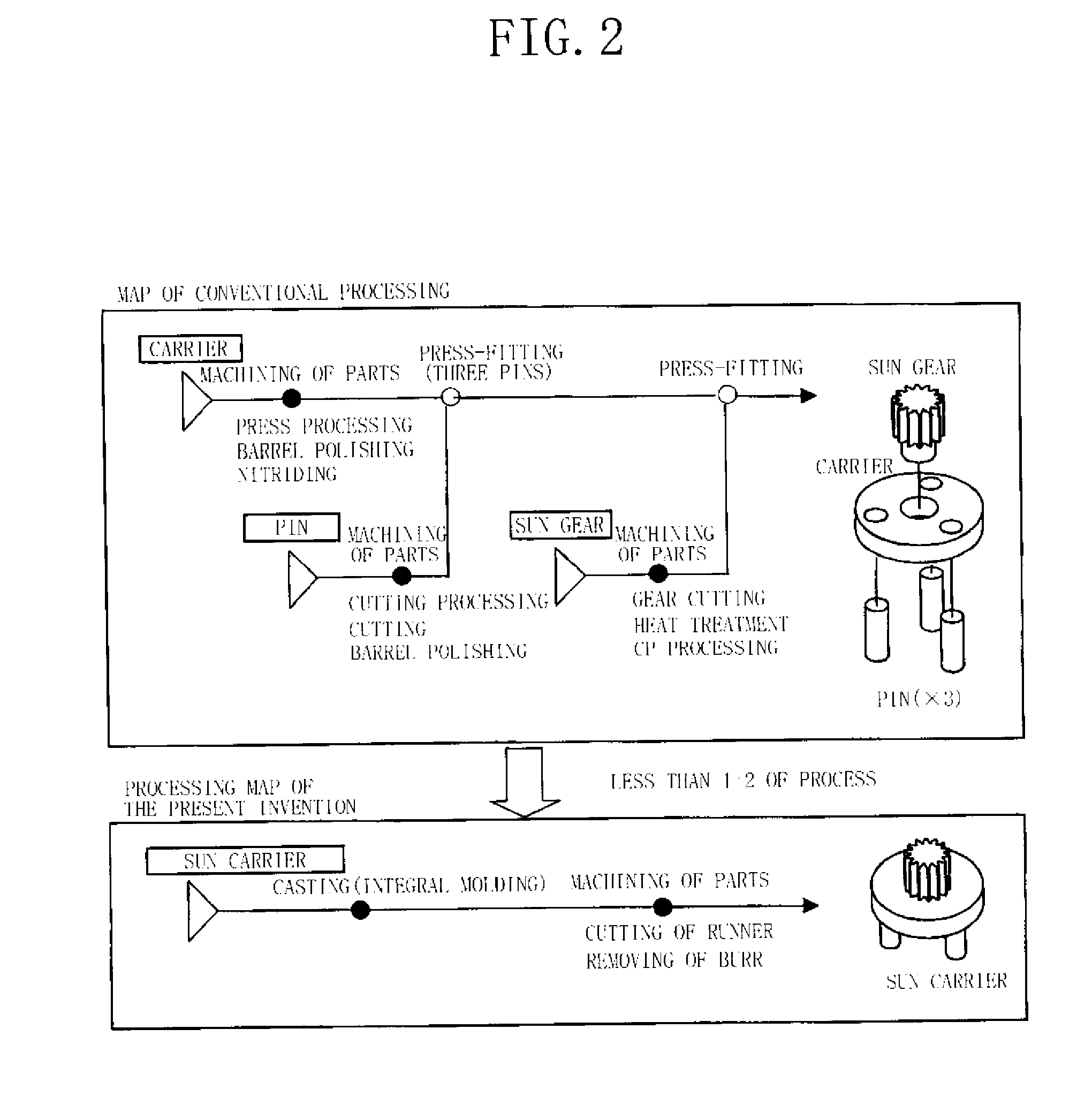
In addition, the pin itself is extremely small, so that it is hard to easily and efficiently carry out the press-fitting of the pin.
Therefore, this requires a great deal of skill.


 Login to View More