
Light Sensitive Compounds for Instant Determination of Organ Function
a technology of organ function and light-sensitive compounds, which is applied in the direction of group 3/13 element organic compounds, peptides, and group 5/15 element organic compounds, can solve the problems of inability to correlate single value returned several hours after sampling with other important physiologic events, inability to obtain new or repeat data, and inability to accurately predict the effect of organ function, etc., to achieve simple, efficient and effective monitoring of organ function.
- Summary
- Abstract
- Description
- Claims
- Application Information
AI Technical Summary
Benefits of technology
Problems solved by technology
Method used
Image

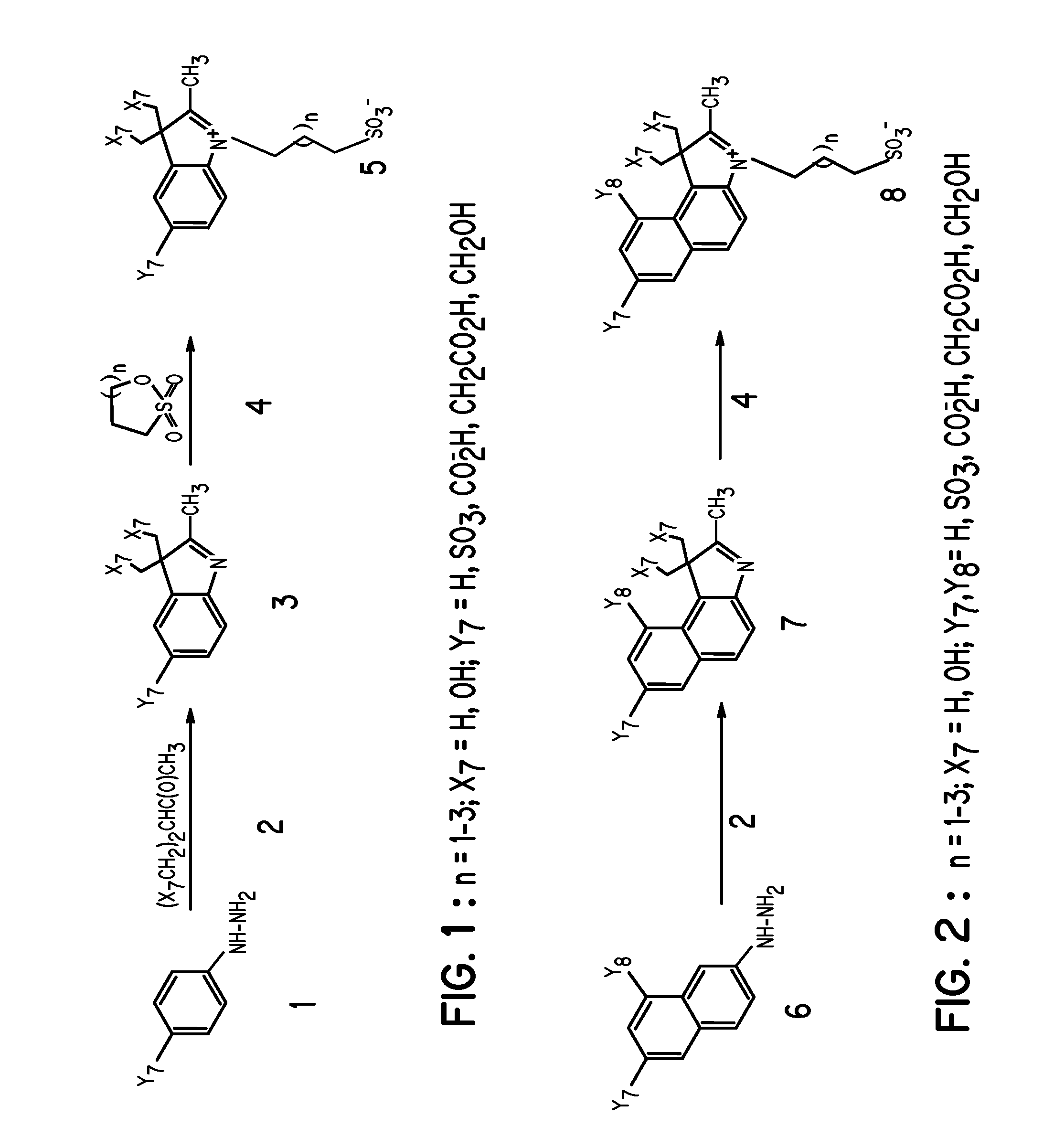
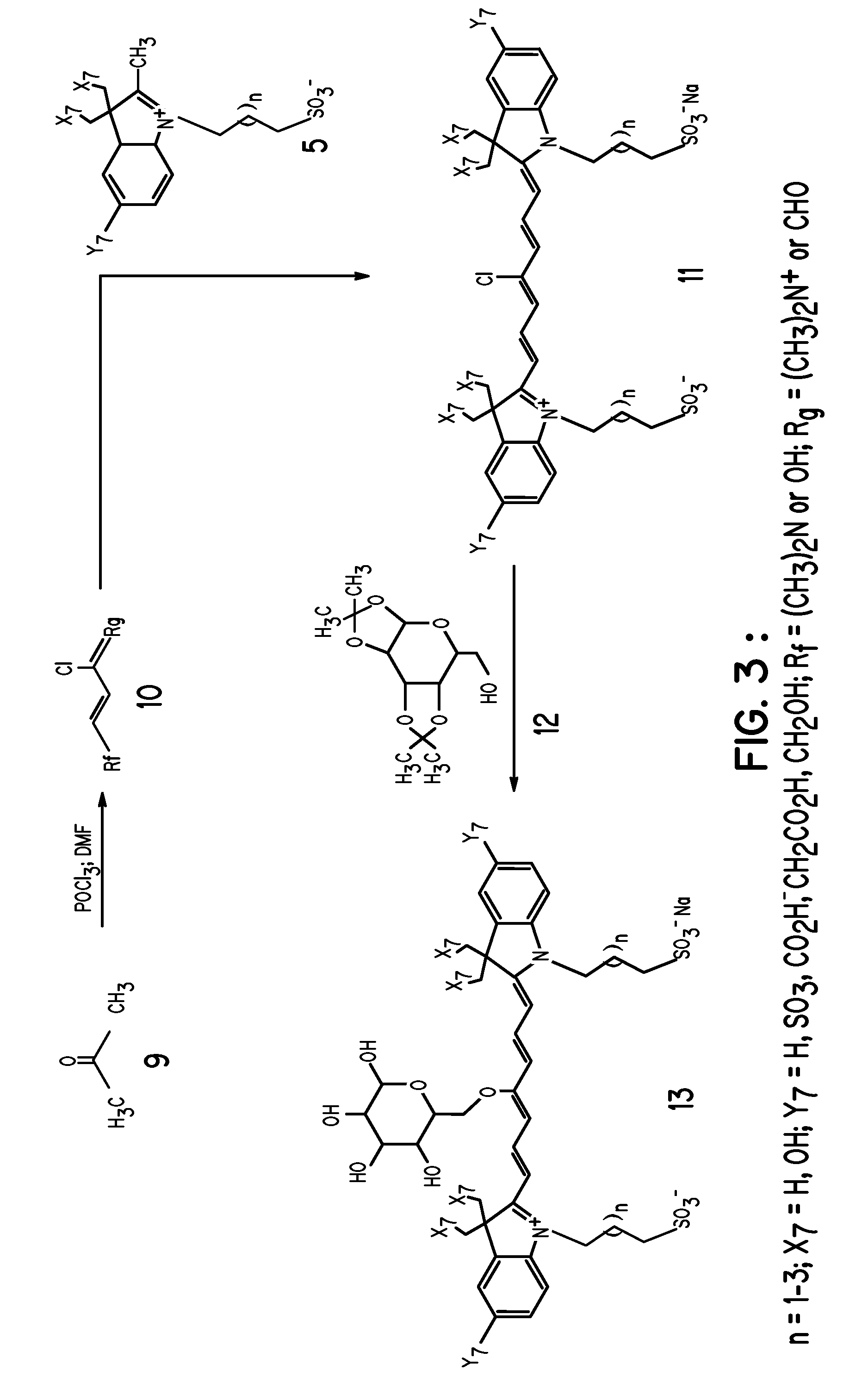
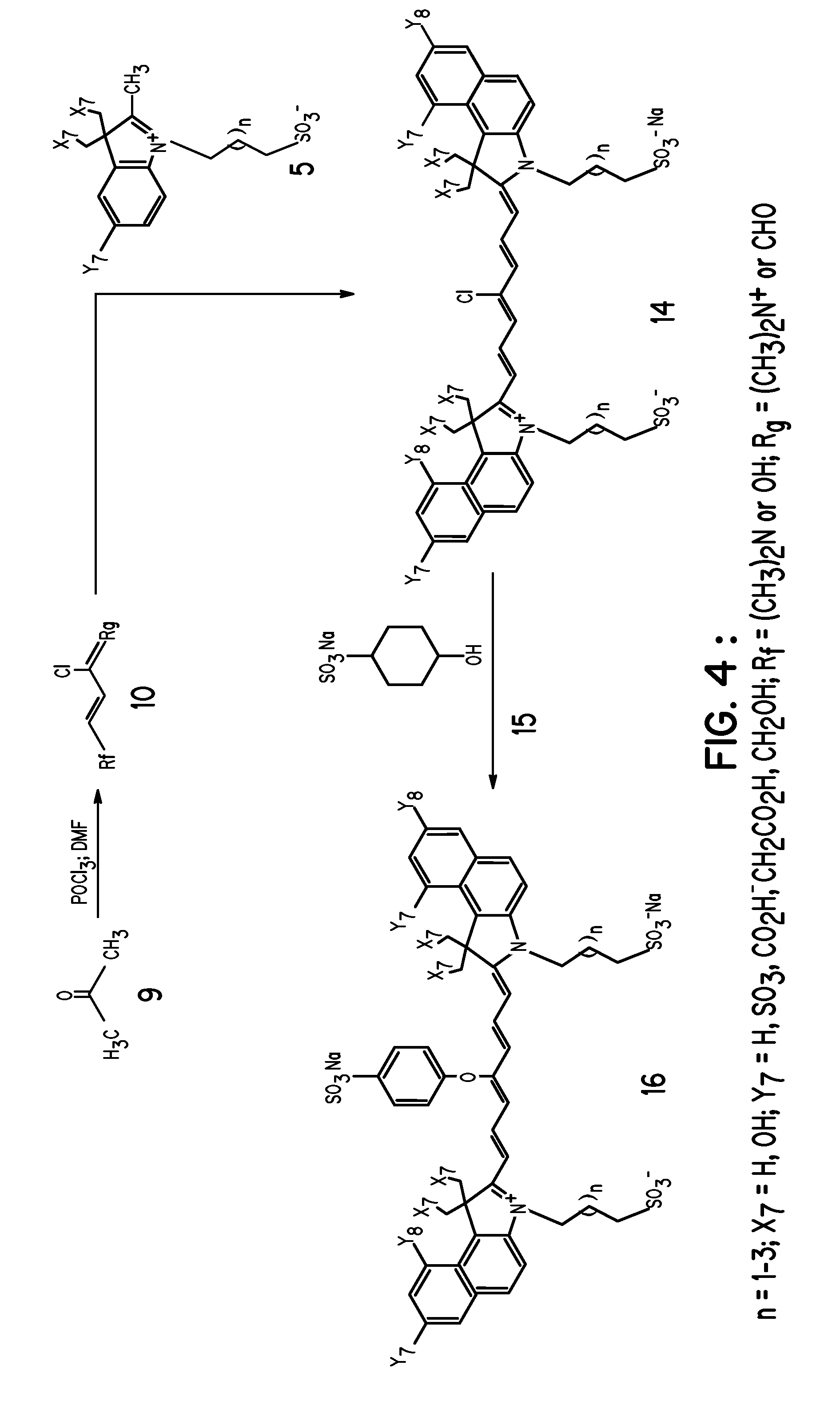
Examples
example 1
Synthesis of Indole Disulfonate (FIG. 1, Compound 5, Y7=SO3−: X7=H; n=1)
[0062] A mixture of 3-methyl-2-butanone (25.2 mL), and p-hydrazinobenzenesulfonic acid (15 g) in acetic acid (45 mL) was heated at 110° C. for 3 hours. After reaction, the mixture was allowed to cool to room temperature and ethyl acetate (100 mL) was added to precipitate the product, which was filtered and washed with ethyl acetate (100 mL). The intermediate compound, 2,3,3-trimethylindolenium-5-sulfonate (FIG. 1, compound 3) was obtained as a pink powder in 80% yield. A portion of compound 3 (9.2 g) in methanol (115 mL) was carefully added to a solution of KOH in isopropanol (100 mL). A yellow potassium salt of the sulfonate was obtained in 85% yield after vacuum-drying for 12 hours. A portion of the 2,3,3-trimethylindolenium-5-sulfonate potassium salt (4 g) and 1,3-propanesultone (2.1 g) was heated in dichlorobenzene (40 mL) at 110° C. for 12 hours. The mixture was allowed to cool to room temperature and the ...
example 2
Synthesis of Indole Disulfonate (FIG. 1, Compound 5 Y7=SO3−: X7=H; n=2)
[0064] This compound was prepared by the same procedure described in Example 1, except that 1,4-butanesultone was used in place of 1,3-propanesultone.
example 3
Synthesis of Benzoindole Disulfonate (FIG. 2, Compound 8, Y7, Y8=SO3−; X7=H: n=2)
[0065] This compound was prepared by the same procedure described in Example 1, except that hydrazinonaphthalenedisulfonic acid was used in place of hydrazinobenzenesulfonic acid.
[0066] Other compounds prepared by a similar method include polyhydroxyindoles such as:
PUM
| Property | Measurement | Unit |
|---|---|---|
| of wavelength | aaaaa | aaaaa |
| wavelength | aaaaa | aaaaa |
| wavelength | aaaaa | aaaaa |
Abstract
Description
Claims
Application Information
 Login to View More