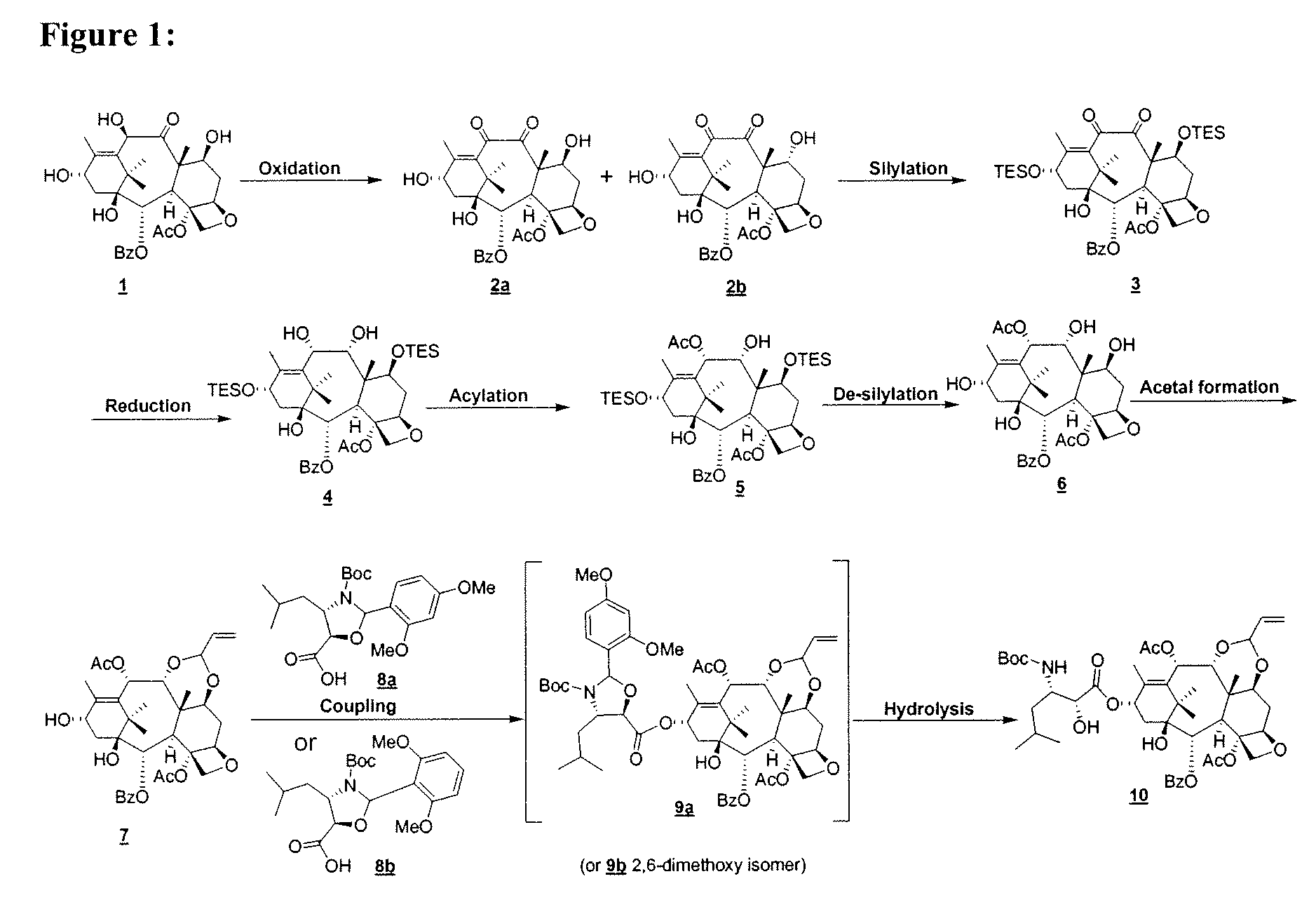
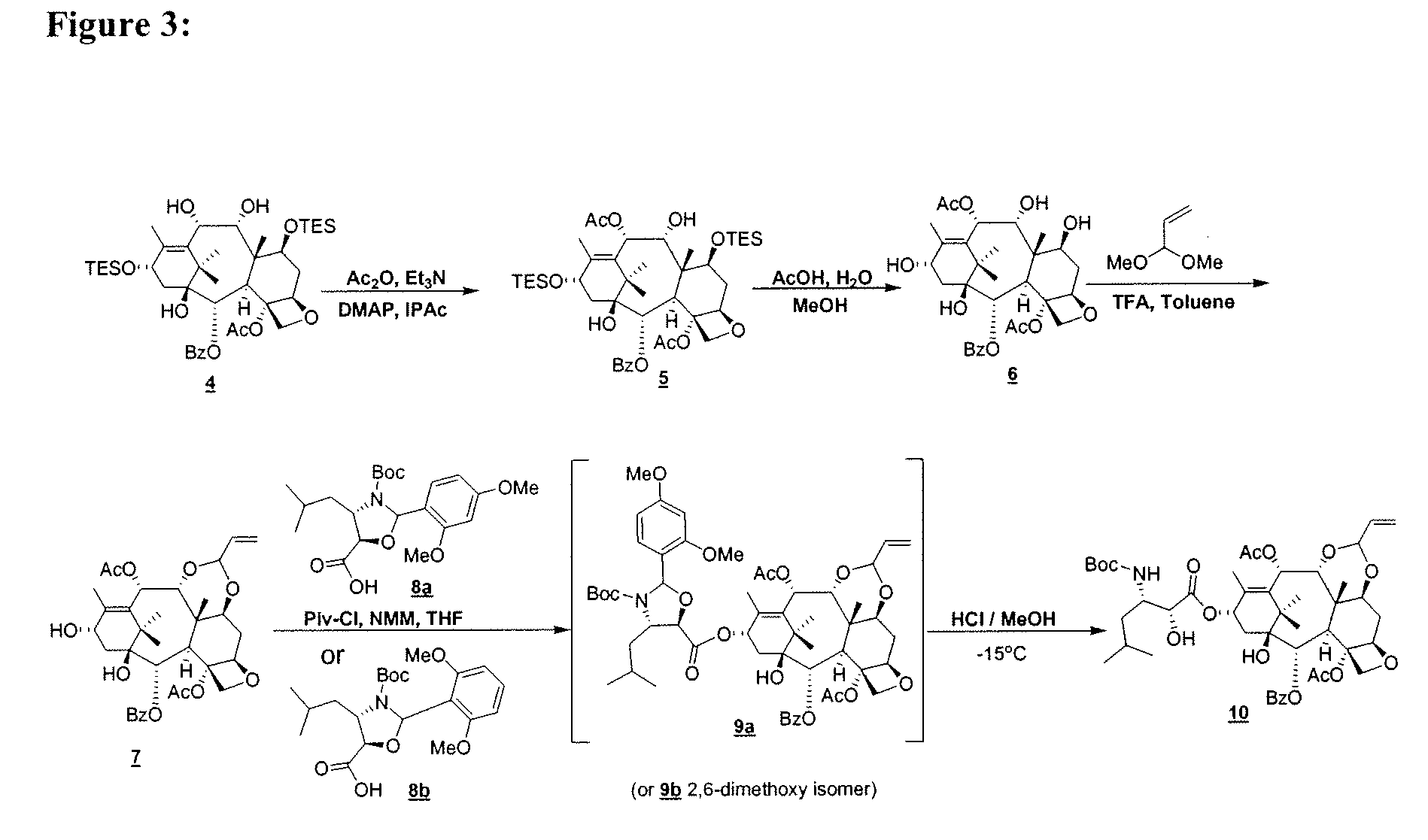
[0023]In FIG. 3, the di-ol 4 is converted to the corresponding 10-acylated
alcohol 5 using an
acylation agent such as
acetic anhydride, TEA, DMAP and IPAC. Selective
hydrolysis of the TES groups may be accomplished using, for example, AcOH in MeOH / H2O, or in IPAc / MeOH, to afford the
tetra-ol 6. Acetalization of the 7,9-di-ol of compound 6, preferably using
acrolein diethyl
acetal in an
organic solvent, such as
toluene, and TFA in an ice bath, provides the allylidene
acetal 7 in good yields. Similarly, the acetalizaton may also be performed using
acrolein dimethyl acetal in an
organic solvent. In one variation of the process, the allylidene
acetal 7 is prepared from the 10-acylated
alcohol 5 without isolation of the intermediate
tetra-ol 6.
[0025]In yet another embodiment, there is provided a process for the preparation of compound 10:the process comprising contacting an allylidene acetal 7 with a
side chain 8 under a
coupling reaction condition to form a coupled intermediate compound 9;wherein R8 and R9 together with the
nitrogen and
oxygen to which they are attached form a cyclic 2,4-dimethoxy benzylidene N,O-acetal or a cyclic 2,6-dimethoxy benzylidene N,O-acetal, and M is H or an
alkali metal selected from the group consisting of Li, Na and K;to form compound 9. Subsequent
hydrolysis of compound 9 forms compound 10. In one variation of the process, the
coupling reaction condition comprises contacting the allylidene acetal 7 with the
side chain 8 in Piv-Cl, TEA, DMAP and THF or Piv-Cl, NMM, DMAP and THF for a sufficient amount of time to form compound 9 which is hydrolyzed to form compound 10 in >90% yield. In addition to NMM and DMAP, other amine bases may be employed, including
DABCO,
pyridine, DBN, DBU, and the like. As illustrated in FIG. 3, coupling of the allylidene acetal 7 with the acid 8a affords the coupled product 9a. Deprotection affords compound 10 in good yields.
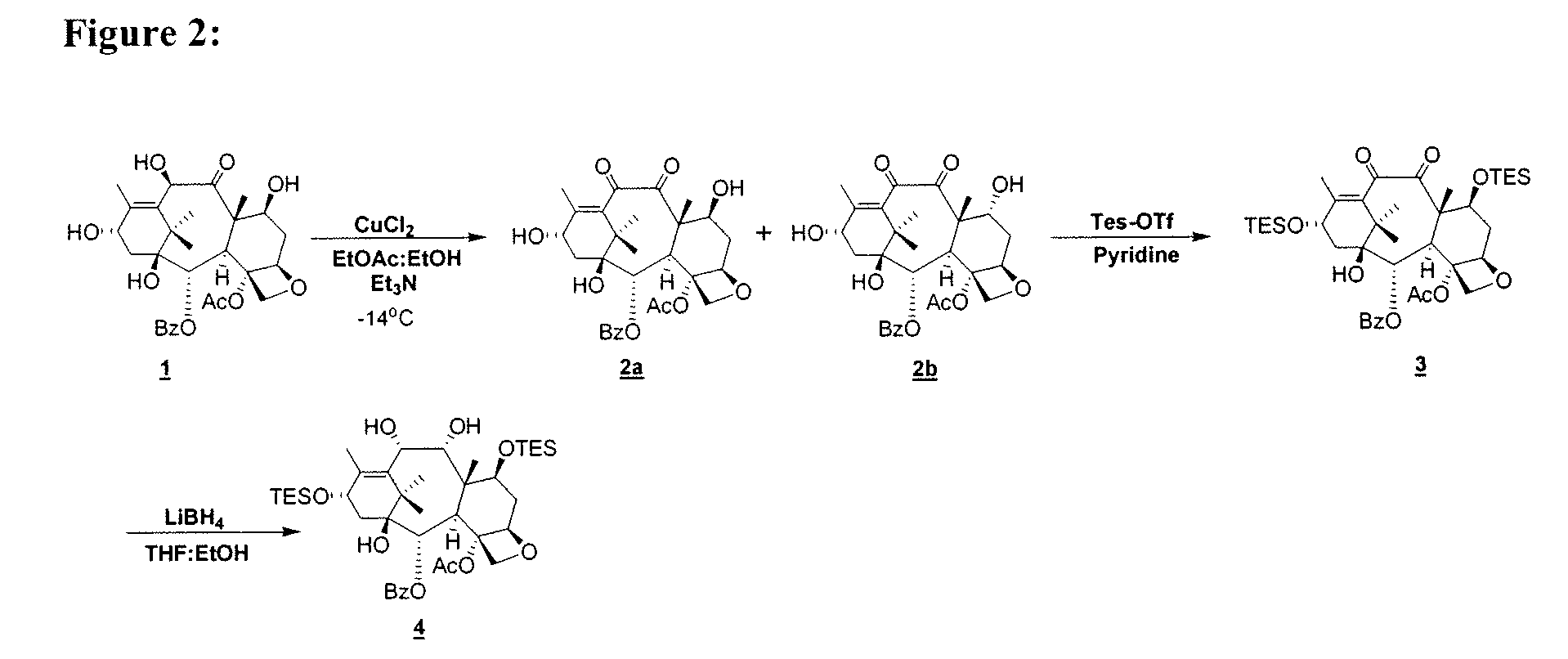
[0031]In another aspect of the above, there is provided a process for the preparation of compound 10, comprising: a) selective oxidation of keto-
alcohol 1 to afford compound 2; b) protection of the 1,7,13-tri-
hydroxy compound 2 to afford compound 3; c)
selective reduction to provide di-ol 4; d) derivatizing di-ol 4 to form ester 5; e) deprotection of the silyl ethers to form
tetra-ol 6; f) acetalization of tetra-ol 6 to form compound 7; g) coupling of compound 7 with compound 8a to afford compound 9a; and h) deprotection of compound 9a to form compound 10, as shown in FIGS. 2 and 3. In one variation of the process, the selective oxidation is performed with CuCl2, TEA, EtOAc and EtOH. In a particular variation, the protection of 1,7,13-tri-
hydroxy compound 2a is accomplished with TES-OTf,
pyridine and NMP at −10 to 50° C. In another variation, the
selective reduction of compound 3 is performed using LiBH4 in THF / EtOH to form di-ol 4. In yet another variation of the above process, derivatizing 9,10-di-ol 4 to form ester 5 is performed using
acetic anhydride, TEA, DMAP and IPAC. In yet another variation of the above process, deprotection of the silyl ethers to form tetra-ol 6 is performed using
acetic acid, IPAc / MeOH, or
acetic acid / MeOH / Water. In another variation, the acetalization of tetra-ol 6 to form compound 7 uses
acrolein dimethyl acetal or the acrolein diethyl acetal analog, in DCM or
toluene and TFA. In one aspect of the process, the coupling of compound 7 with compound 8a to afford compound 9a is performed with PIV-Cl, TEA, DMAP and THF. In another aspect of the process, the coupling of compound 7 with compound 8b to afford compound 9b is performed with PIV-Cl, TEA, DMAP and THF. In one variation of the process, deprotection of compound 9a to form compound 10 is performed using HCl in MeOH. In one variation, deprotection of compound 9b to form compound 10 is performed using HCl in MeOH. In certain variation of the above process, the process requires 2, 3, 4, 5 or 6 isolation steps. In one variation, the compound 2 is a mixture of compounds 2a and 2b. In another variation, the mixture of compounds 2a and 2b is used in subsequent step without isolation or purification. As used herein, the
elimination of an “isolation” step of the
intermediate product from a reaction mixture means that the
intermediate product that is obtained in its “crude” or non-purified form, with or without the
solvent in which the process was performed in, may be used in the subsequent step to provide the desired product in good yields without the need for the isolation and / or purification of the
intermediate product. Such a lack of an isolation and or purification step or procedure is of significant
advantage in
processing cycle time,
throughput and cost, especially when the reaction is performed in a production or manufacturing scale.


 Login to View More