Sub-lithographic faceting for mosfet performance enhancement

a technology of mosfet and performance enhancement, which is applied in the field of semiconductor semiconductor (cmos) transistors, can solve the problems of high defect density near the boundary, adversely affect the performance of mosfet, and complex process complexity, and achieve the effect of less stringent alignment requirements

a technology of mosfet and performance enhancement, which is applied in the field of semiconductor semiconductor (cmos) transistors, can solve the problems of high defect density near the boundary, adversely affect the performance of mosfet, and complex process complexity, and achieve the effect of less stringent alignment requirements

US20080169535A1Inactive Publication Date: 2008-07-17GLOBALFOUNDRIES INC

Image

Smart Image Click on the blue labels to locate them in the text.
Viewing Examples
Smart Image
  • Sub-lithographic faceting for mosfet performance enhancement
  • Sub-lithographic faceting for mosfet performance enhancement
  • Sub-lithographic faceting for mosfet performance enhancement

Examples

Experimental program
Comparison scheme
Effect test

first embodiment

[0059]According to the present invention, a first photoresist 135 is applied to the top surface of the silicon substrate patterned with STI 130. The first photoresist is patterned to create a space with parallel edges over the PFET area. The parallel edges of the first photoresist are preferably located outside the PFET area within the adjoining STI 130. Thereafter, a self-aligning self-assembling material is applied to the space over the PFET area and allowed to self-assemble and self-align to the surrounding pattern of the first resist 136. The self-aligned self-assembled resist 136 creates a pattern of multiple parallel lines as shown in FIG. 8A-8B within the space formed over the PFET area. Multiple parallel lines of the underlying pad nitride 120 are also exposed underneath the spaces between the pattern of multiple parallel lines formed by the self-aligned self-assembling material 136.

[0060]The exposed pattern, that is, the multiple parallel lines, over the pad nitride 120 is ...

second embodiment

[0069]According to the present invention, the multiple stacks of remaining pad oxide 110β€² and pad nitride 120β€² of sub-lithographic widths are then removed to expose a second portion 103 of the silicon surface preferably with a RIE process as shown in FIGS. 19A-19B. The second portion 103 is the flat portion of silicon surface between the edges of neighboring pairs of the multiple parallel non-adjoining V-shaped grooves 102.

[0070]Preferably, the second photoresist 155 and the third resist 165 are also removed leaving only sacrificial oxide 144 over the non-adjoining parallel V-shaped grooves 102. The resulting structure has the sacrificial oxide 144 over the multiple parallel non-adjoining V-shaped grooves 102 separated by a second portion103 between the edges of neighboring pairs of the multiple parallel non-adjoining V-shaped grooves 102 as shown in FIGS. 20A-20B.

[0071]A second anisotropic etch is then performed to form a second set of multiple parallel V-shaped grooves between the...

the structure of the environmentally friendly knitted fabric provided by the present invention; figure 2 Flow chart of the yarn wrapping machine for environmentally friendly knitted fabrics and storage devices; image 3 Is the parameter map of the yarn covering machine
Login to View More

PUM

No PUM Login to View More

Abstract

The present invention provides structures and methods for providing multiple parallel V-shaped faceted grooves with sub-lithographic widths on a semiconductor substrate for enhanced performance MOSFETs. A self-aligning self-assembling material is used to pattern multiple parallel sub-lithographic lines. By employing an anisotropic etch that produces crystallographic facets on a semiconductor surface, multiple adjoining parallel V-shaped grooves with sub-lithographic groove widths are formed. While providing enhanced mobility for the MOSFET, the width of the MOSFET is not limited by the depth of focus in subsequent lithographic steps or the thickness of semiconductor layer above a BOX layer due to the sub-lithographic widths of the V-shaped grooves and the consequent reduction in the variation of the vertical profile. Also, the MOSFET has a well defined threshold voltage due to the narrow widths of each facet.

Description

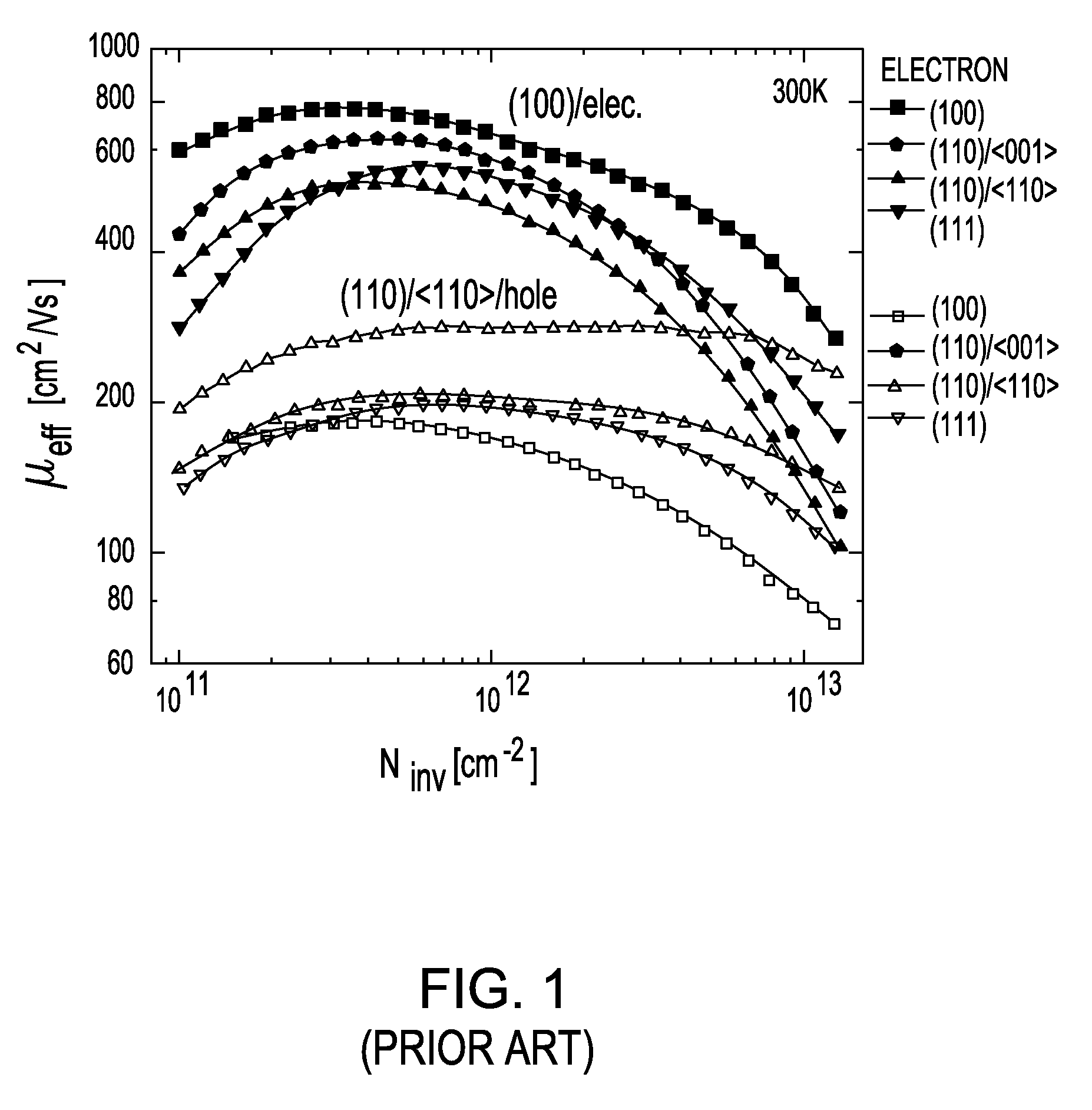
FIELD OF THE INVENTION[0001]The present invention relates to semiconductor devices, and particularly, to complementary metal oxide semiconductor (CMOS) transistors having facets with sub-lithographic widths.BACKGROUND OF THE INVENTION[0002]Performance of semiconductor field effect transistors depends on the crystallographic surface orientation on which the channel of the transistor is built through the mobility of minority channel carriers. For example, the electron mobility in silicon is the highest for the {100} surface orientations and the lowest for the {110} surface orientations, while the hole mobility is the highest for the {110} surface orientations and the lowest for the {100} surface orientations within silicon single crystal.[0003]Use of different crystallographic planes for PFET and NFET devices to enhance the performance of the overall circuit has been known in the prior art. This class of technology, called β€œhybrid orientation technology (HOT)” in the industry, provide...

Claims

the structure of the environmentally friendly knitted fabric provided by the present invention; figure 2 Flow chart of the yarn wrapping machine for environmentally friendly knitted fabrics and storage devices; image 3 Is the parameter map of the yarn covering machine
Login to View More

Application Information

Patent Timeline
17 Jul 2008
Publication
US20080169535A1
IPC
H01L29/06; H01L21/311
CPC
H01L21/28123; H01L21/3086; H01L21/3088; H01L29/78; H01L29/0673; H01L29/1037; H01L21/823807
Inventors
BUTT, SHAHID A.; DYER, THOMAS W.